Solomons Naval Campaign:
Publisher’s Preview
by Mike Bennighof, Ph.D.
September 2026
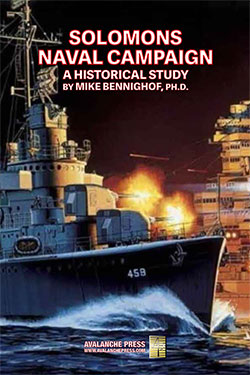 Solomons Naval Campaign is a book of history, intended as a companion to Ironbottom Sound, a scenario book that expands Second World War at Sea: South Pacific. Solomons Naval Campaign is a book of history, intended as a companion to Ironbottom Sound, a scenario book that expands Second World War at Sea: South Pacific.
Following their victory at the June 1942 Battle of Midway, the American high command sought to take the fight to the Japanese. In August they began a campaign to take the strategic island of Guadalcanal and its almost-complete airfield from the Japanese. That touched off the hardest-fought sustained naval campaign of World War II, as Allied and Japanese ships and planes battled to control the seas and skies of the Solomon Islands.
Solomons Naval Campaign is a Historical Study of these air and sea battles, from the preliminary planning of both side through the invasion of Guadalcanal, the attempts to reinforce the island by both sides, and finally the Japanese decision to evacuate. And then we take our story up the Solomons chain, as the Americans fight to take first the Russell Islands and then the New Georgia group, all in the face of fierce Japanese resistance.
There are plenty of books about this campaign; ours dives deeper into the sinews of war, to explain the events as a chain of decisions. We look at the resources of both sides, the ships and the planes and the men, and also just the resources, the oil and the food and the ammunition and how they shaped the campaign.
Solomons Naval Campaign is a companion volume to our Second World War at Sea: South Pacific game and Ironbottom Sound scenario book. It’s not a game book, but it does explain the events seen in those games from the player’s perspective: what elements, some obvious and others less so, shaped the decisions made by the participants on both sides. That’s the essence of all of our Historical Studies.
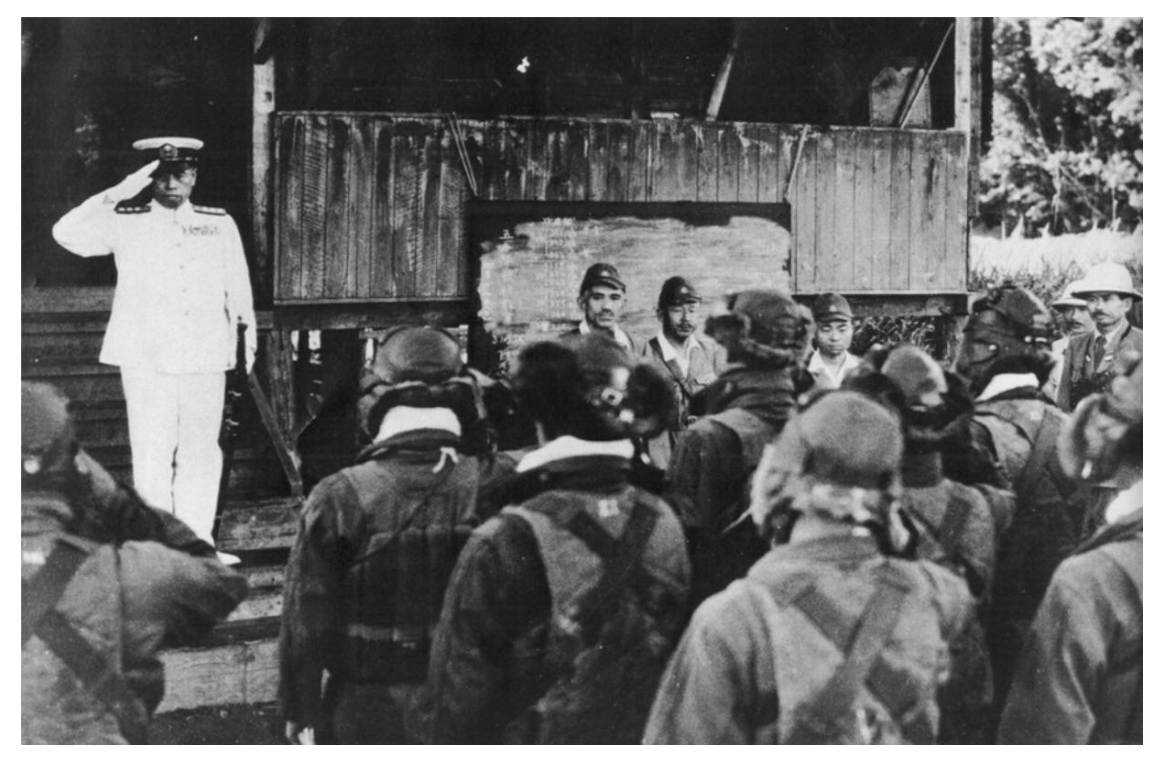
Admiral Isoroku Yamamoto salutes a group of Japanese naval pilots. April 1943.
We begin Solomons Naval Campaign before the Solomons naval campaign, with an overview of the Pacific naval situation in the summer of 1942 and both sides’ preparations for a campaign in and around the islands. Those grew out of the Japanese plans for Operation FS, a series of invasions aimed at New Caledonia, the New Hebrides, Samoa, and Fiji. That would cut communications between Australia and the United States. The Americans began building infrastructure to oppose such a move, and the Japanese to support it. Among the Japanese improvements, they began work on an airfield on Guadalcanal in the southern Solomons. When Chief of Naval Operations Ernest J. King sought to go on the offensive after the American victory at Midway, that airfield provided a suitable target, and the bases to support such a move had already been built or at least begun.
The Americans practiced their landings in Fiji, with fairly poor results, as we describe in detail. Then it was on to Guadalcanal immediately after, with many of the landing craft damaged during the exercise. The landings themselves went well, but the Japanese struck back quickly and decisively, with all of the forces available at Rabaul, their nearest major base.
That would be the pattern for the next four months. The Japanese often had material superiority in the theater, but no means to replace losses. And so they reacted with a piecemeal strategy, both in terms of forces deployed on operations (just enough to defeat the anticipated American response), and in building up the infrastructure to sustain a long campaign. The Americans, for their part, poured their abundant resources into rear-area logistics and support, and the airfield on Guadalcanal. Like the Japanese, they proved reluctant to commit their battleships to the waters of Ironbottom Sound until a moment of dire need.
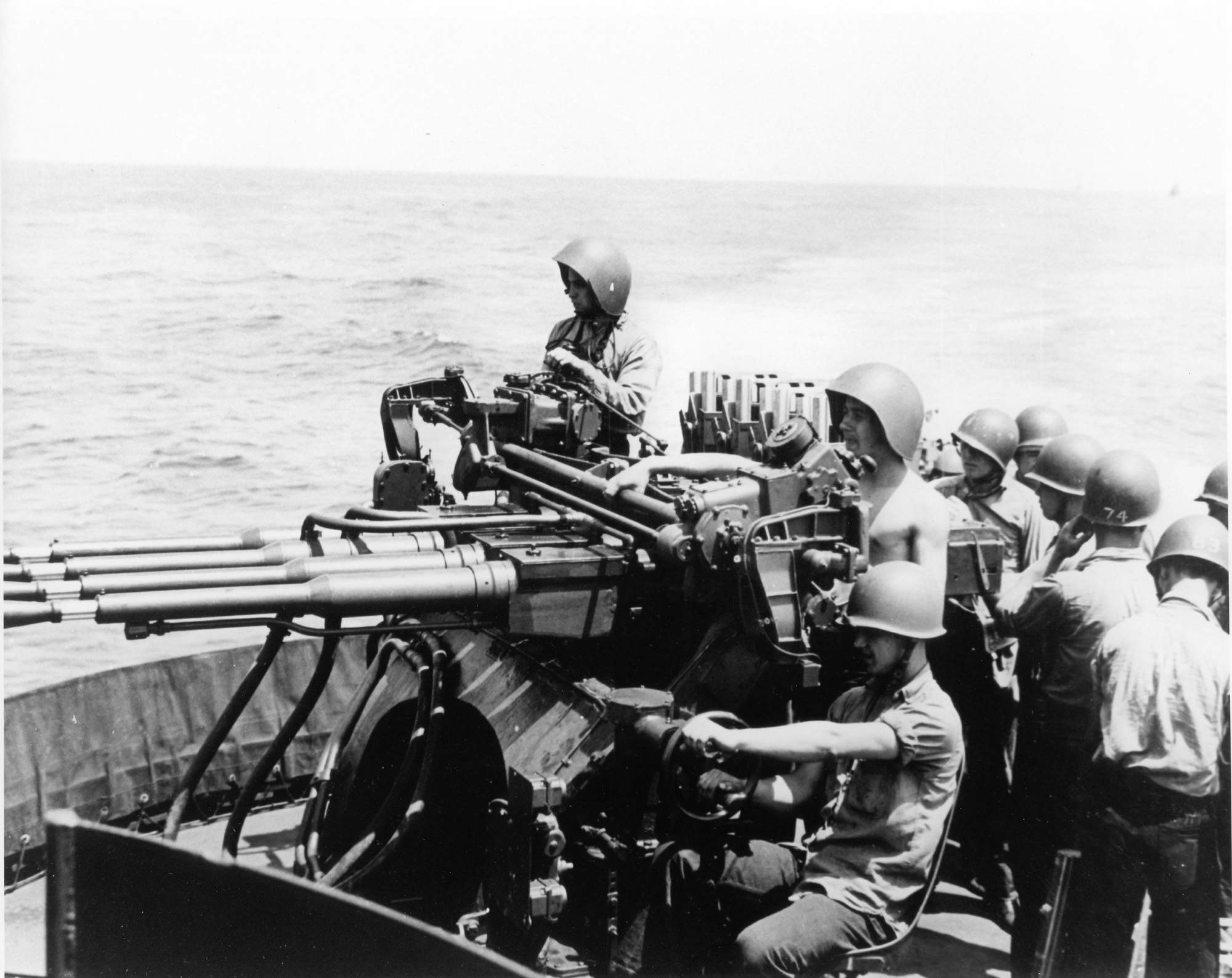
A 1.1-inch “Chicago Piano” quad mount aboard South Dakota. Solomons Naval Campaign also tells the Legend of Shitty Dick.
All of the battles (and there were plenty of battles) need to be seen in that context. The Japanese often planned their operations with minimal necessary force, and then frittered away that force on less-than-vital side missions. The Americans feared the loss of a carrier, and usually kept their flattops well to the south of Guadalcanal. Less often mentioned in popular histories of the campaign is the American concern over their relatively scant number of fleet oilers, which kept the carriers on a short leash and made the American command reluctant to allow their tanks to fall below half full. If they ventured too far and one of the few oilers met a Japanese torpedo, the carrier could be left in dire straits. Complicating the situation, the Navy had decided in February 1942 to convert four of its fleet oilers to escort carriers.
Thanks to their strategy of economy of force, the Japanese ended up making multiple efforts to bring fresh troops to Guadalcanal (or supply the ragged, starving men trying to fight there), resulting in both surface and carrier battles. Ironbottom Sound saw five major surface battles, all of them taking place at night. The Americans won two of these battles, the Japanese won two, and one was a draw. Two of the Pacific War’s four major carrier battles took place in the lower Solomons, with each side claiming one victory.
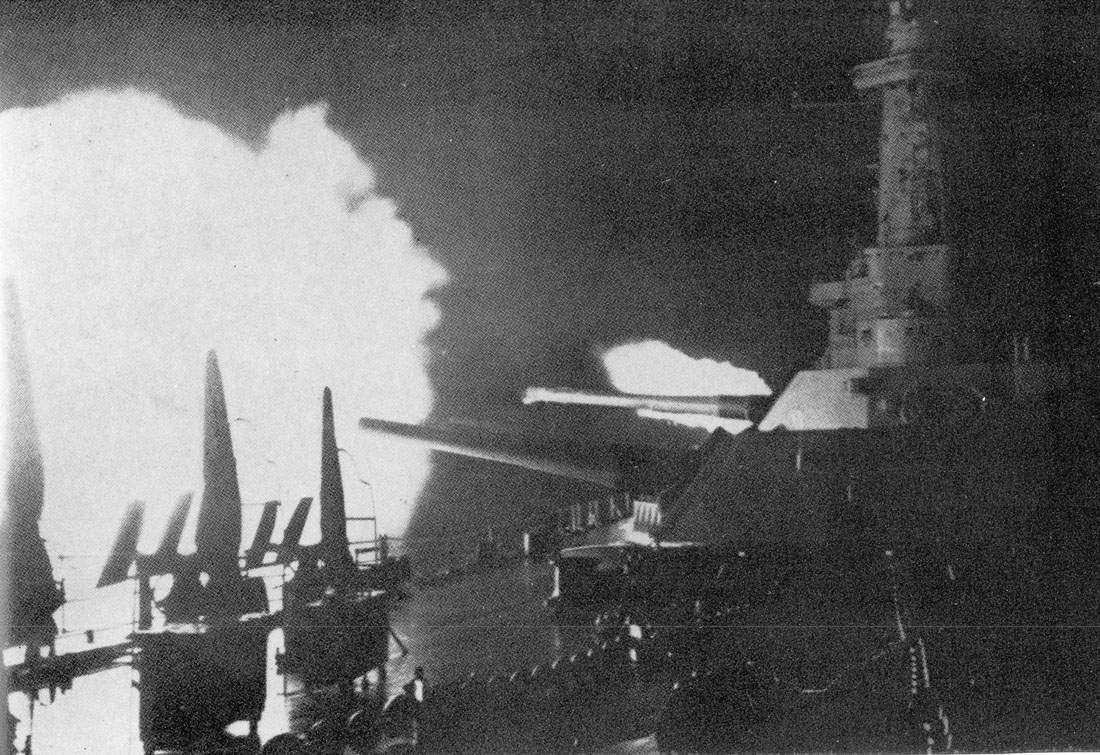
Washington fires her main battery, during the 15 November Battleship Action.
And that’s the story of the campaign: the Japanese and Americans fought to a draw in terms of individual battles. But the Japanese lost the campaign, and lost it decisively. After their victory at Savo Island in August, and the drawn battle off Guadalcanal in mid-November, the Japanese had the opportunity to close with and destroy the Americans remaining in the Sound. Instead, they turned back for home.
Sailors and aircrew of both sides showed extraordinary courage, professional skill, and dedication. The Japanese had their chances to win this campaign. They held back their full force to preserve it for the crucial battle of the war they’d started with the Americans, not realizing that the crucial battle was upon them. In the face of relentless American effort, that opportunity would not come again.
As I wrote up above, Solomons Naval Campaign is a companion book to our Second World War at Sea: South Pacific game and its scenario expansion, Ironbottom Sound. There are plenty of other books about the campaign; what makes Solomons Naval Campaign different is its thesis (right up there in the paragraph above this one) which is the same as that of the game, South Pacific. You can read right along as you play South Pacific and Ironbottom Sound, or just read it on its own and not bother with the games.
Order Solomons Naval Campaign Here.
Companion piece to Ironbottom Sound, or just read it separately.
Order South Pacific Here.
Order Ironbottom Sound Here.
Includes Solomons Naval Campaign book.
Tales of the South Pacific
The grandest naval game ever made, with more scenarios and history.
• South Pacific
• Ironbottom Sound
• Solomons Naval Campaign
Retail Price: $236.98
Package Price: $200
Gold Price: $160
Tell the Tales.
Sign up for our newsletter right here. Your info will never be sold or transferred; we'll just use it to update you on new games and new offers.
Mike Bennighof is president of Avalanche Press and holds a doctorate in history from Emory University. A Fulbright Scholar and NASA Journalist in Space finalist, he has published a great many books, games and articles on historical subjects; people are saying that some of them are actually good.
He lives in Birmingham, Alabama with his wife and three children. He misses his lizard-hunting Iron Dog, Leopold.
Daily Content includes no AI-generated content or third-party ads. We work hard to keep it that way, and that’s a lot of work. You can help us keep things that way with your gift through this link right here.
|