South Pacific:
Scenarios & History, Part One
by Mike Bennighof, Ph.D.
May 2026
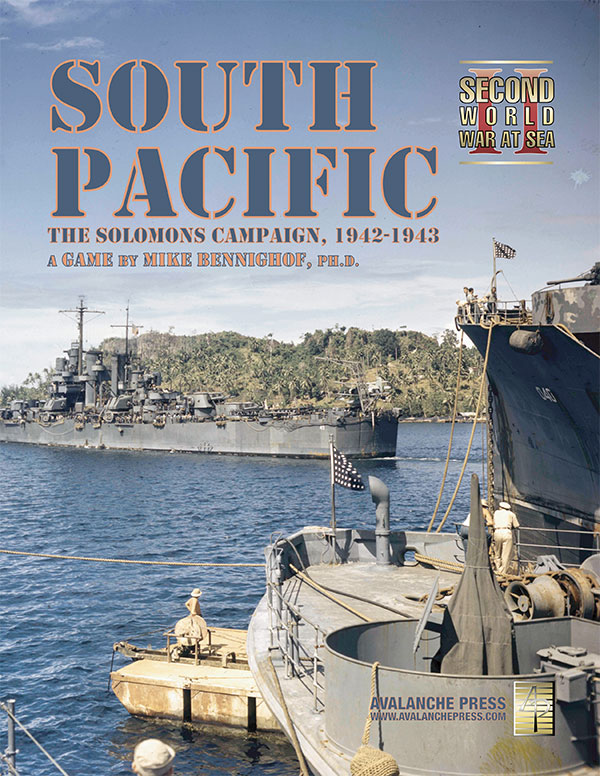 Ironbottom Sound is a scenario book that expands Second World War at Sea: South Pacific. It comes with 36 new scenarios for South Pacific, extending the story through August 1943 and the campaign for New Georgia. All of the maps and pieces needed are included in South Pacific; the companion history book, Solomons Naval Campaign, comes bundled with Ironbottom Sound. Ironbottom Sound is a scenario book that expands Second World War at Sea: South Pacific. It comes with 36 new scenarios for South Pacific, extending the story through August 1943 and the campaign for New Georgia. All of the maps and pieces needed are included in South Pacific; the companion history book, Solomons Naval Campaign, comes bundled with Ironbottom Sound.
After their decisive victory at the Battle of Midway, the Americans sought to follow up with an offensive of their own. With the strategic emphasis going to the war against Germany, the offensive had to be fairly modest in scope. Admiral Ernest J. King, the Chief of Naval Operations, settled on the lower Solomon Islands as a target in early July 1942, with the operation to take place a month later. Airbases here would help cover the lines of communication between the United States and Australia, and conversely make it more difficult for the Japanese to interdict them.
As finally conceived, the operation would seek to occupy both the Japanese seaplane base on Tulagi and the partially-completed airstrip on Guadalcanal. The ground force would come from the 1st Marine Division (at this point still armed with bolt-action Springfield rifles of Great War vintage), reinforced with assorted small Marine units. Air cover would be provided by all three of the U.S. Navy’s operational aircraft carriers in the Pacific, with screening provided by most of the Navy’s available cruisers and destroyers plus three Australian cruisers and an American fast battleship. The well-drilled but slow and oil-guzzling older battleships of Task Force One remained in Hawaii. King wished to deploy at least two of them, but Pacific theater commander Chester Nimitz adamantly opposed their appearance in the South Pacific.
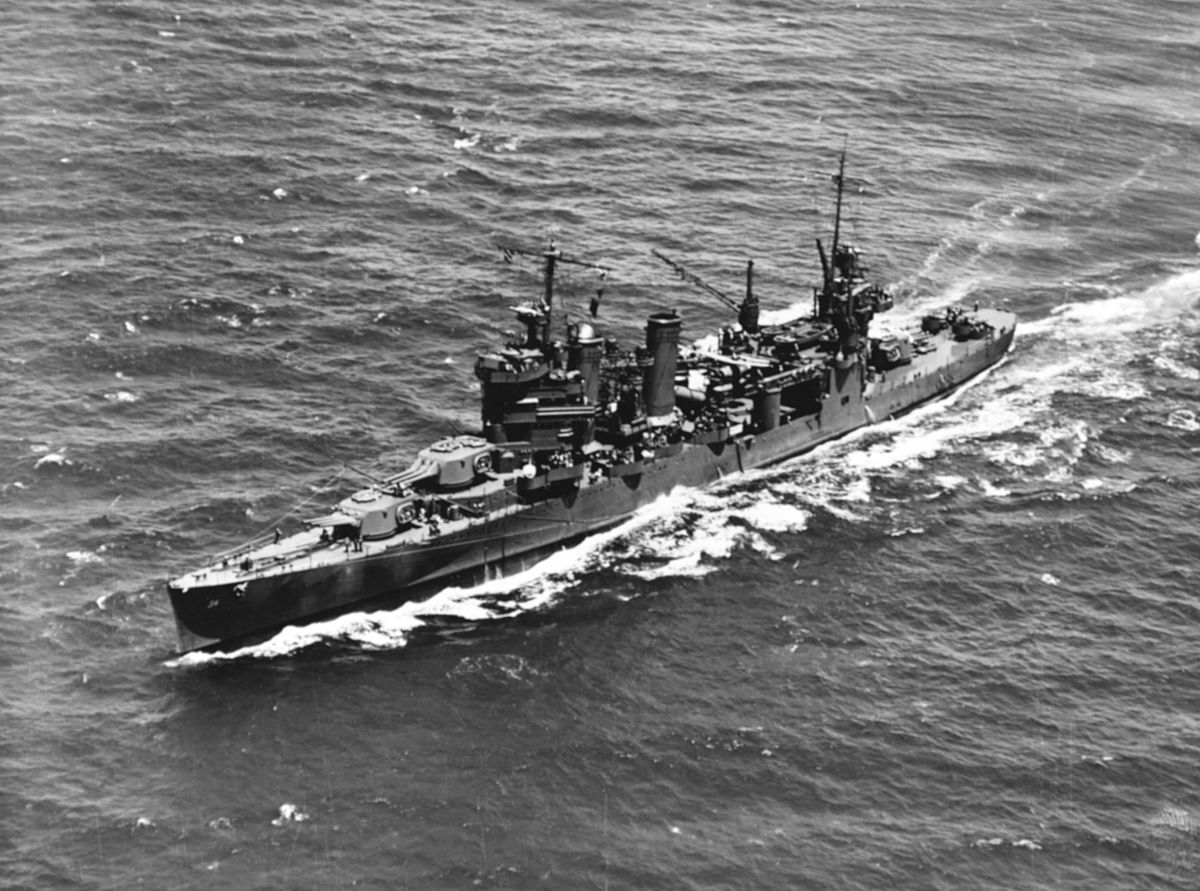
Heavy cruiser Astoria, in happier times.
Operation Watchtower’s forces gathered in Fiji by late July, and on 1 August they set out for the Solomons. Bad weather covered their approach, and not until 6 August did the Japanese detect the advancing armada. And that’s where the Operation Watchtower chapter of South Pacific, the game, begins.
Second World War at Sea: South Pacific is based on the crucial air and naval battles waged in the Solomons, and it’s the centerpiece of the game series. The game is organized in our story-arc format, where we use the scenarios to move the narrative forward, and tell the story of the campaign through play of the game.
 Second World War at Sea games are organized into chapters, that allow us to take a deeper look at a campaign or a segment of a campaign. The Watchtower chapter is focused on just the first two weeks of the Solomons campaign, but there’s a lot of action and plenty of variables to study. Second World War at Sea games are organized into chapters, that allow us to take a deeper look at a campaign or a segment of a campaign. The Watchtower chapter is focused on just the first two weeks of the Solomons campaign, but there’s a lot of action and plenty of variables to study.
Second World War at Sea games carry two types of scenarios. Operational scenarios take place on the operational map, where task forces of ships move across the waters and flights of aircraft move overhead. Battle scenarios take place on the Tactical Map; until now that’s exclusively been the generic blue map that we include in every Second World War at Sea game. South Pacific also includes that map, and a special Ironbottom Sound tactical map as well.
 Chapter One, titled The Invasion: August 1942, is a big chapter by any measure: ten scenarios (four operational and six battle scenarios), taking up 13 pages of a 64-page scenario book. Other publishers call that “a complete game.” For us, it’s the first of five chapters. Chapter One, titled The Invasion: August 1942, is a big chapter by any measure: ten scenarios (four operational and six battle scenarios), taking up 13 pages of a 64-page scenario book. Other publishers call that “a complete game.” For us, it’s the first of five chapters.
Even then, I could not stuff everything I wanted to say into the South Pacific scenario book. So we added the Ironbottom Sound book for more scenarios, and the Solomons Naval Campaign Historical Study for, well, the historical study.
 In Ironbottom Sound, I expanded on all of the chapters except the first. Probably because I designed it first, Chapter One includes all the scenarios that I wished for South Pacific on the topic. So, there are no additions to Chapter One in Ironbottom Sound, because I wrote plenty of them in South Pacific. In Ironbottom Sound, I expanded on all of the chapters except the first. Probably because I designed it first, Chapter One includes all the scenarios that I wished for South Pacific on the topic. So, there are no additions to Chapter One in Ironbottom Sound, because I wrote plenty of them in South Pacific.
When I first designed Second World War at Sea games, I probably would have included one operational scenario for Operation Watchtower stretching from the American arrival on the scene on 6 August through the arrival of the first Marine aircraft at Henderson Field (as the Americans dubbed the captured Japanese airstrip) on the 20th. I might have cut it off just after the withdrawal of the American fleet following the disastrous encounter with the Japanese in the Battle of Savo Island. But I’m pretty sure it would have been just one scenario.
 For South Pacific, I went with four separate operational scenarios. When you give players a long scenario, they’re going to make decisions that, with each passing turn and each subsequent decision, move the action on the game table further and further away from the historical events. That’s inevitable, but makes it difficult to re-create key moments in any battle or campaign, to put players in the place of the admirals making fateful decisions. For South Pacific, I went with four separate operational scenarios. When you give players a long scenario, they’re going to make decisions that, with each passing turn and each subsequent decision, move the action on the game table further and further away from the historical events. That’s inevitable, but makes it difficult to re-create key moments in any battle or campaign, to put players in the place of the admirals making fateful decisions.
Instead, Chapter One includes operational scenarios that pick up the action as the Americans begin their landings, as the Japanese start their reaction, and in the aftermath of the Battle of Savo Island as the Americans weight what to do next and the Japanese scramble to field an even more forceful response.
 Likewise, the Ironbottom Sound tactical map allows a similar approach with the battle scenarios, that wouldn’t have been possible with the generic Naval Tactical Map (well, we could have done it, but it wouldn’t have been very much fun to play). With the new map, we can start the action with the Japanese approach, just after the annihilation of the Allied northern patrol, and at the key moment, when Japanese commander Gunichi Mikawa chose to turn away rather than press on to wipe out the American transports (and expose his cruisers to punishing American air attacks once the sun rose). Likewise, the Ironbottom Sound tactical map allows a similar approach with the battle scenarios, that wouldn’t have been possible with the generic Naval Tactical Map (well, we could have done it, but it wouldn’t have been very much fun to play). With the new map, we can start the action with the Japanese approach, just after the annihilation of the Allied northern patrol, and at the key moment, when Japanese commander Gunichi Mikawa chose to turn away rather than press on to wipe out the American transports (and expose his cruisers to punishing American air attacks once the sun rose).
 We used to look at the operational and battle scenarios separately, but I like weaving them together. Every operational scenario has at least one corresponding battle scenario, based on actions that did or could have arisen from the operation. It’s a very good way to further the story, honing in on the consequences of the operational actions. We used to look at the operational and battle scenarios separately, but I like weaving them together. Every operational scenario has at least one corresponding battle scenario, based on actions that did or could have arisen from the operation. It’s a very good way to further the story, honing in on the consequences of the operational actions.
I wrapped the chapter with one more operational scenario, probably the most important though least-heralded move of the Watchtower operation. Nine days after the Savo disaster, the escort carrier Long Island set out into dangerous waters accompanied by the light cruiser Helena and destroyer Dale. She flew off 31 Marine aircraft that became the first air group stationed on Henderson Field.
 Unknown to the Americans, a Japanese H6K4 flying boat spotted the small task force and accurately reported “one aircraft carrier.” A Japanese surface action group sped south to intercept, but only arrived well after the baby flattop had launched her planes and waddled back to safety. Had they caught Long Island with her planes still aboard, the entire tenor of the campaign would have been changed: the Americans likely would have had to deploy squadrons off their real aircraft carriers to Henderson Field (as they did at times) on a more or less permanent basis, weakening their carrier air groups just before the Battle of the Eastern Solomons. Unknown to the Americans, a Japanese H6K4 flying boat spotted the small task force and accurately reported “one aircraft carrier.” A Japanese surface action group sped south to intercept, but only arrived well after the baby flattop had launched her planes and waddled back to safety. Had they caught Long Island with her planes still aboard, the entire tenor of the campaign would have been changed: the Americans likely would have had to deploy squadrons off their real aircraft carriers to Henderson Field (as they did at times) on a more or less permanent basis, weakening their carrier air groups just before the Battle of the Eastern Solomons.
That’s the sort of event I like exploring through game design. South Pacific and Ironbottom Sound are filled with moments like that.
Tales of the South Pacific
The grandest naval game ever made, with more scenarios and history.
• South Pacific
• Ironbottom Sound
• Solomons Naval Campaign
Retail Price: $236.98
Package Price: $200
Gold Price: $160
Tell the Tales.
Order Ironbottom Sound Here.
Includes Solomons Naval Campaign book.
Order Solomons Naval Campaign Here.
Companion piece to Ironbottom Sound, or just read it separately.
Order South Pacific Here.
Sign up for our newsletter right here. Your info will never be sold or transferred; we'll just use it to update you on new games and new offers.
Mike Bennighof is president of Avalanche Press and holds a doctorate in history from Emory University. A Fulbright Scholar and NASA Journalist in Space finalist, he has published a great many books, games and articles on historical subjects; people are saying that some of them are actually good.
He lives in Birmingham, Alabama with his wife and three children.
Daily Content includes no AI-generated content or third-party ads. We work hard to keep it that way, and that’s a lot of work. You can help us keep things that way with your gift through this link right here.
|