| Island
of Death:
Publisher’s Preview
By Mike Bennighof, Ph.D.
August 2016
Once upon a time, I decided we needed to publish a small, introductory game for what would become our Mechanized Battlefield series but at the time had no name (even though we'd published several games in it by then). The series designer, Brian Knipple, offered several suggestions, but made the fatal error of mentioning that he could design a game on the planned invasion of Malta that would not be very large.
 Warned that it would make a terrible introduction to the game system - with no tanks and a blizzard of special rules for airborne and amphibious landings - I wanted it anyway. One
of the very earliest wargames I ever played
covered the 1941 invasion of Crete and included
a "bonus game" about the planned
invasion of Malta. I played them, I didn't
like them, and somehow convinced my long-suffering
mother to return it to the toy store where
I'd laid down my $12.99 plus tax ($50.14
in 2007 dollars!). And I felt guilty about
that, for reasons I've never understood.
So to resolve a 30-year-old psychological
trauma, I asked Brian Knipple to design a
new game about Malta. Warned that it would make a terrible introduction to the game system - with no tanks and a blizzard of special rules for airborne and amphibious landings - I wanted it anyway. One
of the very earliest wargames I ever played
covered the 1941 invasion of Crete and included
a "bonus game" about the planned
invasion of Malta. I played them, I didn't
like them, and somehow convinced my long-suffering
mother to return it to the toy store where
I'd laid down my $12.99 plus tax ($50.14
in 2007 dollars!). And I felt guilty about
that, for reasons I've never understood.
So to resolve a 30-year-old psychological
trauma, I asked Brian Knipple to design a
new game about Malta.
He was right. Island
of Death is a terrible introduction to the series. But it's a great stand-alone game in its own right.
The Package
 Playing the game revealed that Malta
is very, very small. And so I decided to
double the size of the map, to 22x17 inches,
with much bigger hexes so two or three playing
pieces would fit (very tightly) in each.
Or fingers could easily reach in to pick
up a stack of them. That's the instruction
I gave the map artist; she was not impressed. Playing the game revealed that Malta
is very, very small. And so I decided to
double the size of the map, to 22x17 inches,
with much bigger hexes so two or three playing
pieces would fit (very tightly) in each.
Or fingers could easily reach in to pick
up a stack of them. That's the instruction
I gave the map artist; she was not impressed.
"That's not a map," she said. "That's
a flow chart."
And so it was. There are 22 beach hexes
on the map, divided into four zones. Each
beach hex had a thick black line connecting
it to a pair of boxes, labeled "First
Wave" and "Second Wave." Each
pair of boxes was in turn connected to a
large box labeled "Follow Up." The
boxes and lines took up just about as much
space as the island itself. In play they
were very useful, letting the Axis player
line up his or her invasion forces and showing
the Allied player what targets he could shoot
at with his coastal defense guns. But it
really did look like a flow chart.
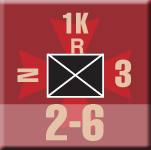 After the Italian landing forces either
got onto the island or got themselves annihilated
in the attempt, the flow chart became so
much wasted space. And so I moved it to its
own "planning map," a separate
card showing the flow of boxes and where
they connect on the island, complete with
a small version of the game map. That freed
the ocean hexes around the island, which
is important because Italian warships have
to sail there to bombard Allied positions. After the Italian landing forces either
got onto the island or got themselves annihilated
in the attempt, the flow chart became so
much wasted space. And so I moved it to its
own "planning map," a separate
card showing the flow of boxes and where
they connect on the island, complete with
a small version of the game map. That freed
the ocean hexes around the island, which
is important because Italian warships have
to sail there to bombard Allied positions.
The count of playing pieces went from 280
to 380, allowing all of the airborne company breakdown
counters (and there are a lot of them) to
be unique. In any game design, it's important
to keep to a single line of logic in each
function. For example, "high die rolls
good, low die rolls bad." In this case,
the back of a playing piece can show the
unit at reduced strength, or it can show
a different unit, but it should not show
a reduced version in some cases and a different
unit in others. The extra pieces also allowed
us to make sure the game had plenty of markers.
For some reason I put in 30 "Out of
Ammunition" markers when then game only
has 10 artillery units.
The System
The game engine is derived from that of Alamein,
but despite the best intentions it is
not exactly the same. The most obvious difference
is the lack of a detailed air game in Island
of Death. In Alamein,
air squadrons battle for superiority, support
their side's ground units and attack enemy
supply depots. Island
of Death makes the
very sound assumption that the Axis would
not have launched their invasion without
having first wiped out the Royal Air Force
presence on the island. Thus the Allied player
has no air units with which to oppose the
Axis. The Axis player doesn't really have
air units either, but instead has three air
support markers than can be used to support
ground units on the attack. The Axis player
can also undertake air strikes against Allied
defensive positions to "soften them
up" before the landings.
 Alamein is
a game with many tank units — I'm not even
sure how many, but the number of pieces with
tank pictures on them runs into the hundreds. Island
of Death has three: one German, one
Italian and one British. Only two units have
anti-tank values. The tank-vs.-tank and anti-tank
subsystems of the Alamein game engine are
fairly complex, but in the context of a large
sweeping clash of armored divisions it's
a very valid mechanic on historical grounds
and players like it. But the payoff for five
units which might meet in combat once per
game seemed very small for such an intense
process, so we replaced the Alamein procedure
with a grossly simplified version. Tanks
can increase the combat odds for the attacker,
or decrease them (to a lesser extent) for
the defender. Alamein is
a game with many tank units — I'm not even
sure how many, but the number of pieces with
tank pictures on them runs into the hundreds. Island
of Death has three: one German, one
Italian and one British. Only two units have
anti-tank values. The tank-vs.-tank and anti-tank
subsystems of the Alamein game engine are
fairly complex, but in the context of a large
sweeping clash of armored divisions it's
a very valid mechanic on historical grounds
and players like it. But the payoff for five
units which might meet in combat once per
game seemed very small for such an intense
process, so we replaced the Alamein procedure
with a grossly simplified version. Tanks
can increase the combat odds for the attacker,
or decrease them (to a lesser extent) for
the defender.
In North Africa, commanders had to constantly
worry about supplying their troops and the
Allied side usually had a definite advantage
thanks to their ability to ship materiel
to Egypt via the Indian Ocean. Units on Malta
still need their beans and bullets, but the
game system is not nearly as intricate in
this area as it is in Alamein. Headquarters
do not have to be prepared to function fully;
it's assumed that any formation tasked with
an airborne or amphibious landing would be
at an even greater state of readiness than
that of the "prepared" divisions
in the desert game while the garrison is
also ready for action. Units still have to
be supplied to fully function, but we removed
the "isolated" status since on
an island this small we found units rarely
qualifying for it.
The Game
So after all of those changes, how does
it play?
 Despite the low price and the small map, Island of
Death is not a simple game. The
Axis player has three types of landings to
execute. First, there are the airborne drops
of the German Ramcke parachute brigade and
the Italian Folgore Parachute Division. There
aren't enough airplanes to drop them all
at once, and there's always a chance that
their companies can be scattered across the
island and into the Mediterranean. But they
are both elite formations, and if they manage
to gather their strength they can grab and
hold ground. Their real task is to get hold
of at least one airfield so that that second
type of landing can occur: the arrival of
the Italian Spezia Air-Landing Division.
While not as good as the paratroopers, the
glider troops show up intact and are a welcome
addition of force. Despite the low price and the small map, Island of
Death is not a simple game. The
Axis player has three types of landings to
execute. First, there are the airborne drops
of the German Ramcke parachute brigade and
the Italian Folgore Parachute Division. There
aren't enough airplanes to drop them all
at once, and there's always a chance that
their companies can be scattered across the
island and into the Mediterranean. But they
are both elite formations, and if they manage
to gather their strength they can grab and
hold ground. Their real task is to get hold
of at least one airfield so that that second
type of landing can occur: the arrival of
the Italian Spezia Air-Landing Division.
While not as good as the paratroopers, the
glider troops show up intact and are a welcome
addition of force.
Meanwhile, the third type of landing is
taking place on the beaches, where two Italian
infantry divisions storm ashore assisted
by a handful of marine companies. The 4th "Livorno" Division's
battalions are as good as any in the Malta
garrison; the 20th "Friuli" Division
is not as capable. But they bring artillery
and engineers with them and a dozen battalions'
worth of infantry — IF they can get past
the Allied coastal guns and beach defenses.
This is where the game will probably be
decided. The Italian infantry, particularly
the well-led Livorno Division, will grind
up the garrison if it gets ashore intact.
The Allied player has to throw them back
into the sea when they're still weak and
separated. If the very capable Maj. Gen.
Domenico Chirieleison can get his division's
battalions formed up and on the attack, it
will be a very dark day for the British Empire.
It's possible for the Allied player to still
win the game if the parachute landings have
been destroyed or contained, but it's the
paratroopers who grab the glory while the
infantry do the fighting.
The Allied player's goal is to hold on as
long as possible, in the hopes that the Royal
Navy will intervene or the Italian high command
will cancel the operation. The Axis player
has to inflict casualties while limiting
his or her own, and capture objectives —
in particular, airfields and ports.
Fortress Malta
 Island
of Death covers a battle that never
actually occurred, and that allows us to
explore variations on the plans for Operation
Hercules/Operazione C.3. The book Fortress Malta adds 420 pieces, seven scenarios and a whole blizzard of variants, history and analysis. If you like Island of Death, you need Fortress Malta - it turns a fun game into a deep historical study (that's even more fun!). Island
of Death covers a battle that never
actually occurred, and that allows us to
explore variations on the plans for Operation
Hercules/Operazione C.3. The book Fortress Malta adds 420 pieces, seven scenarios and a whole blizzard of variants, history and analysis. If you like Island of Death, you need Fortress Malta - it turns a fun game into a deep historical study (that's even more fun!).
Order Island of Death now!
Order Fortress Malta now!
Mike Bennighof is president of Avalanche Press and holds a doctorate in history from Emory University. A Fulbright Scholar and award-winning journalist, he has published over 100 books, games and articles on historical subjects.
He lives in Birmingham, Alabama with his wife, three children and his dog, Leopold.
|