Elsenborn Ridge:
Scenario Preview, Chapter One
by Mike Bennighof, Ph.D.
September 2025
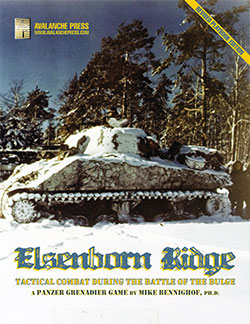 There are several games that I consider centerpieces of the Panzer Grenadier series. Elsenborn Ridge stands out, though, for its standing as an entry point to the series: it has Americn forces fighting Germans (both regular Army and SS militia), both sides get to attack and defend, it has a relatively small load of special rules and a very solid scenario set. There are several games that I consider centerpieces of the Panzer Grenadier series. Elsenborn Ridge stands out, though, for its standing as an entry point to the series: it has Americn forces fighting Germans (both regular Army and SS militia), both sides get to attack and defend, it has a relatively small load of special rules and a very solid scenario set.
Elsenborn Ridge has 35 scenarios, in eight chapters plus an introductory section. Let’s have a look at the first full chapter, taking place as the German offensive opens.
Chapter One
Through the Mist
Positioned directly on the German-Belgian border, the 99th Infantry Division held a twenty-mile front just behind the International Highway that ran along the frontier. The “Checkerboard Division,” eventually nicknamed the “Battle Babies” had been formed in 1942 and shipped to Europe in September 1944. The division repeatedly gave up cadres to help form new units, and had men stripped away as replacements for divisions already seeing heavy losses in comb at. To fill its ranks, the 99th Infantry Division received drafts of former anti-aircraft gunners, excess Army Air Force ground crews, and men from the Army Specialized Training Program, high-intelligence draftees at first sent to college but then pulled out and sent to Europe as hastily-trained infantry replacements.
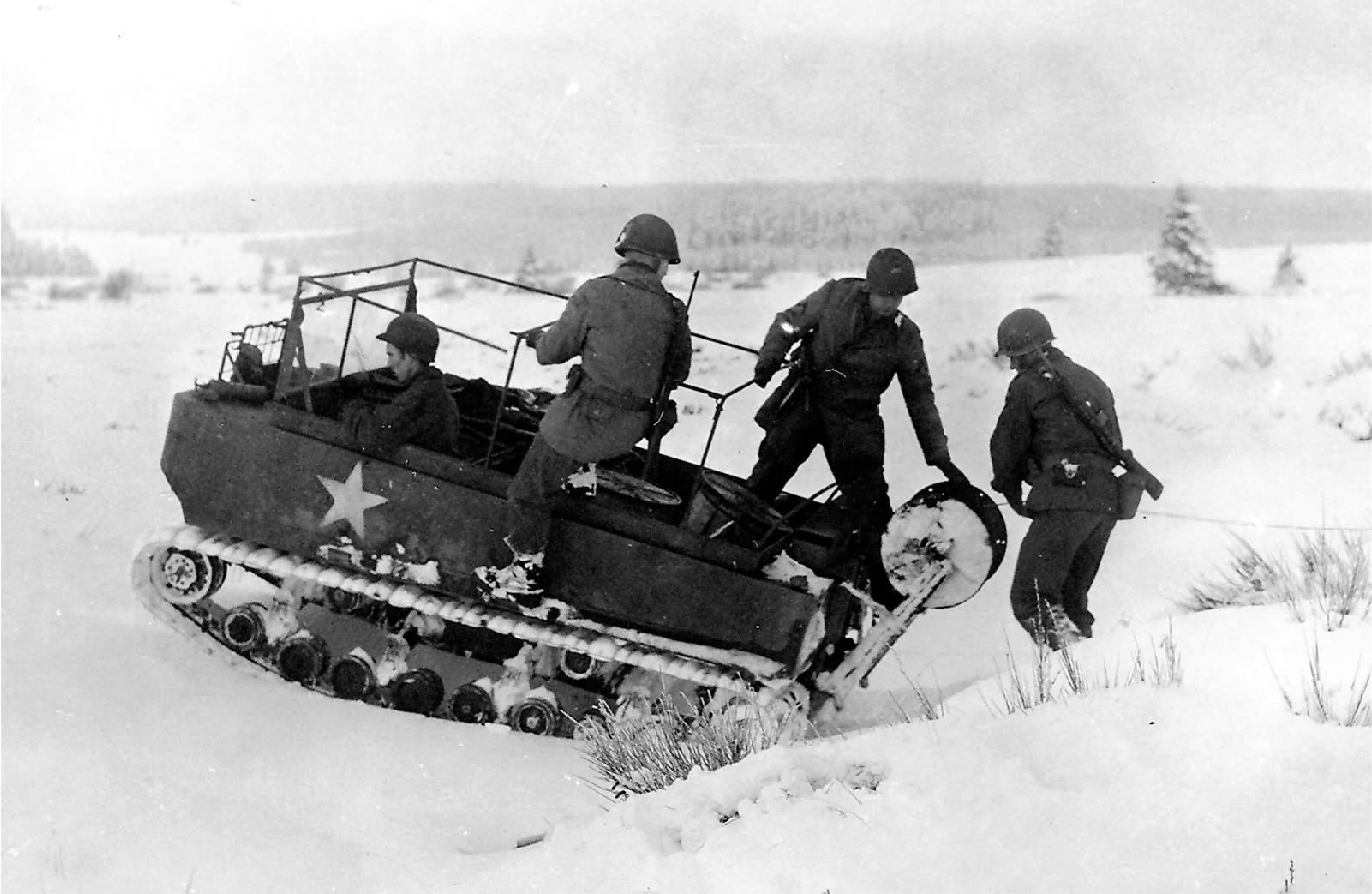
Soldiers from the 99th Infantry Division laying telephone wire.
The 99th Infantry Division entered the line on 9 November 1944, and on 13 December started limited offensive operations aimed at probing the Siegfried Line defenses on the German side of the border. Three days later, an artillery bombardment fell on the division’s positions, heralding the counter-attack that the American division and higher headquarters had expected. But this was far more than a limited move t recover lost ground.
Scenario One
Autumn Mist
16 December 1944
After a brief artillery bombardment, the Germans sent infantry divisions forward as the first wave of the attack known as Operation Herbstnebel, or Autumn Mist. These units would open the way through the American defenses for the panzer divisions to exploit deep into the Allied rear. At least that was the way it had been drawn up on Sixth SS Panzer Army's planning maps.
Conclusion
Using searchlights directed at the low-hanging cloud cover, the Germans created what they called “artificial moonlight” to enhance visibility. It could not, however, enhance the willingness of the raw People’s Grenadiers to stand up to American firepower. The advance made some initial headway, forcing the 393rd Infantry Regiment’s Company K to surrender and surrounding the rest of the regiment’s 3rd Battalion. But the American defense rallied and the German attack stalled.
Design Notes
This is just a small scenario to start things off; the stats at Panzer Grenadier HQ show that Scenario Number One is almost always the one played the most. It’s a solid intro to the game system, with a minimum of special rules though you do have to keep up with increasing visibility. The Germans are badly outgunned except for artillery support in the early turns about equivalent to the High Seas Fleet’s battle line.
 Scenario Two Scenario Two
An Operation Named Mist
16 December 1944
While part of the People’s Grenadier division struck down the Schwarzenbruch Trail toward the village of Krinkelt, another regiment attacked into the woods to the south in hopes of flanking the American defenders. The Germans had numbers on their side, but the Americans had not been surprised.
Conclusion
The initial German bombardment did little damage to American positions in this sector, and the advancing People’s Grenadiers walked into a torrent of rifle and machine-gun fire. A single barefoot BAR gunner killed over a dozen Germans. But German numbers told and the assault had begun to make headway by mid-morning, when the Americans threw in their last reserve, the regimental anti-tank minelaying platoon. Lt. Harry Parker led his men in a wild, screaming bayonet charge, and after he skewered one German, dozens of others threw down their weapons and fled.
Notes
This is a slightly larger scenario than the last, also featuring improving visibility and a Great War style opening artillery barrage. The Germans have numbers, too, but their troops would rather be elsewhere. The Americans are outnumbered but well-supported, so they can hold their ground if they play well.
Scenario Three
Dismal Failure
16 December 1944
The northernmost attack of the Ardennes offensive targeted the town of Höfen, which stood directly on the front lines. The rough terrain here would not support a panzer drive, but Sixth SS Panzer Army considered it important to secure the wooded hills here. The road leading northward from Elsenborn needed to be broken, to make it difficult for the powerful American divisions around Aachen to strike southward into the German flank.
Conclusion
The German assault met disaster, as the Americans had carefully prepared their artillery fire plan and called down devastating shellfire on top of the attackers. No American position fell, and the German division suffered massive casualties. It pulled back from the front and played no further role in the Battle of the Bulge, its combat effectiveness utterly destroyed in a few hours.
Notes
Thanks to that truly excremental 1960’s Battle of the Bulge movie, there’s this false notion floating around that panic-stricken American troops ran away at the battle’s start. That’s not true; the Americans here are well-prepared and despite the huge artillery barrage that starts the game the German player is going to have to play really well to make headway with these crapulent attackers.
Scenario Four
Second-Hand Lions
16 December 1944
The German battle plan had been formed based solely on situation maps, but when patrols discovered that a green American infantry division had been inserted into the line, Fifth Panzer Army command altered its approach. Like the 99th, the “Golden Lions” of the 106th Infantry Division had been raided to provide replacements for other divisions’ combat losses. Hastily re-trained anti-aircraft gunners, washed-out pilot trainees and men of the Army Specialized Training Program filled the ranks instead. On the German side, the assault would be undertaken by the “ethnic Germans” of the 62nd People’s Grenadier Division - Czech and Polish conscripts with little enthusiasm for their ancient enemy’s Fatherland.
Conclusion
Col. Friedrich Kittel had grand plans for his division: it would tear a gap in the American lines and his bicycle-mounted reserve battalion would dash through to capture St. Vith and the trains loaded with gasoline he imagined waiting there. Though the American defenders were inexperienced, Kittel's troops were even worse - to get them to attack his officers had had to ply them liberally with alcohol and then lead from the front. Officer casualties were massive and progress was made only through sheer weight of numbers.
Notes
The Americans aren’t very good, but the Germans are truly terrible and they don’t have the massive artillery advantage of the prior scenarios. They do have a great many unwilling conscripts to throw into the breach, so this one’s going to be tough on the Americans.
Scenario Five
Collision
17 December 1944
The initial failures in the northern sector did not bode well for the German offensive. The roads had to be opened for the panzer divisions to meet their very ambitious objectives. Knowing it would weaken his drive later, corps commander Hermann Preiss ordered some of his tanks forward to assist the People’s Grenadiers; if the American lines could not be breached, there would be no use for the panzer forces later. Meanwhile, the Americans had received tank and infantry reinforcements of their own and were determined to restore their lines.
Conclusion
The American and German attacks crashed into each other, generating surprise on both sides and saying little for either’s scouting and preparation. The German attack had greater numbers behind it, and once a battalion of Panther tanks joined the fight, they pushed the Americans back. But the Germans were still far behind schedule.
Notes
Finally, we get a tank battle! The Americans have plenty of strength to hold their line at first, but those Panthers are going to be hard to handle when they eventually reach the battlefield. Fortunately the planning for this battle was done by the SS, so the Americans will only have to fend off the heavy metal for about the last third of the game.
And that’s our introduction. Next time, we dig into Chapter Two.
Order Elsenborn Ridge Here.
Sign up for our newsletter right here. Your info will never be sold or transferred; we'll just use it to update you on new games and new offers.
Mike Bennighof is president of Avalanche Press and holds a doctorate in history from Emory University. A Fulbright Scholar and NASA Journalist in Space finalist, he has published a great many books, games and articles on historical subjects; people are saying that some of them are actually good.
He lives in Birmingham, Alabama with his wife and three children. He misses his lizard-hunting Iron Dog, Leopold.
Daily Content includes no AI-generated content or third-party ads. We work hard to keep it that way, and that’s a lot of work. You can help us keep things that way with your gift through this link right here.
|