Jutland: The Baltic Sea
Design Notes, Part One
by Mike Bennighof, Ph.D.
June 2025
 Russia’s devastating defeat in the 1904-05 war with Japan stripped the empire of most of its naval strength. Only the Black Sea Fleet, and a handful of ships still incomplete when the war ended, remained. But once the post-war political and economic upheavals settled somewhat, the Tsar’s admirals began planning for a fleet revival in the Baltic. Russia’s devastating defeat in the 1904-05 war with Japan stripped the empire of most of its naval strength. Only the Black Sea Fleet, and a handful of ships still incomplete when the war ended, remained. But once the post-war political and economic upheavals settled somewhat, the Tsar’s admirals began planning for a fleet revival in the Baltic.
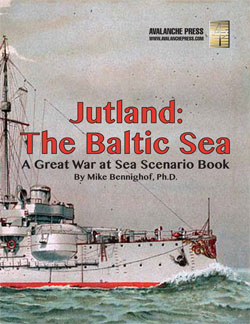
That’s the theme of Jutland: The Baltic Sea, an expansion book for Great War at Sea: Jutland’s Second Edition. It’s got 70 new pieces (50 of them double-sized ship pieces). Most of them (50 of the 70) are Russians; the Swedes get 14 and the Germans get six, though all of the latter two nationalities are double-sized. They’re all our standard silky-smooth pieces, die-cut with minimal pressure to spare them the damage of old-school die-cutting.
Of course, if we’re going to give you spiffy new ship pieces, of course we have to give you scenarios so you can play with them.
When I re-designed Great War at Sea: Jutland, I first did a simple revision of the original game, but soon grew dis-satisfied with that approach and scrapped it. I couldn’t make it into the game I wished it to be without a massive scenario book several inches thick, and I didn’t want to compromise, either. That’s both the strength and weakness of a creator-owned firm.
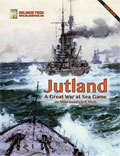
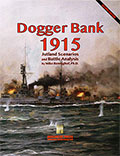
 So Jutland, the game, is now all about Jutland, the battle. It has 22 scenarios, and all of them are intensely focused on the great battle. We have two scenario/analysis books (North Sea 1914 and Dogger Bank 1915) with another 71 scenarios between them, and I fully intend to write one or two more to complete the coverage of the entire North Sea naval war. So Jutland, the game, is now all about Jutland, the battle. It has 22 scenarios, and all of them are intensely focused on the great battle. We have two scenario/analysis books (North Sea 1914 and Dogger Bank 1915) with another 71 scenarios between them, and I fully intend to write one or two more to complete the coverage of the entire North Sea naval war.
What we don’t have in any of those is the naval action on the Baltic Sea, between the Russians and Germans (the Swedes poked their head into the fray once, probably foolishly, and were lucky not to get themselves into the shooting war they’d so carefully avoided). I’ll write a scenario/analysis book about these battles as well, but Jutland: The Baltic Sea is not that book. It came about when I still planned to give Jutland, the game, the simple revision, so it has no historical scenarios. Instead, it’s all about the fleets that might have been.
 The Baltic Sea is quite small, as seas go, only slightly bigger than the land-locked Caspian Sea. But it’s a vital waterway, providing Russia with her “Window on the West” and Germany with access to Sweden’s iron mines (at least during the ice-free months). It’s also oddly shaped, with a small central basin, the Gulf of Bothnia directly to the north, separated from the main basin by an archipelago with tens of thousands of tiny islets, and the Gulf of Finland heading directly to the east, with the Russian capital and industrial center of St. Petersburg (plus the Kronstadt naval base) at its far end. The Baltic Sea is quite small, as seas go, only slightly bigger than the land-locked Caspian Sea. But it’s a vital waterway, providing Russia with her “Window on the West” and Germany with access to Sweden’s iron mines (at least during the ice-free months). It’s also oddly shaped, with a small central basin, the Gulf of Bothnia directly to the north, separated from the main basin by an archipelago with tens of thousands of tiny islets, and the Gulf of Finland heading directly to the east, with the Russian capital and industrial center of St. Petersburg (plus the Kronstadt naval base) at its far end.
The First World War saw Germany fight Russia in the Baltic Sea, and the bulk of our scenario set takes that as its starting point – except with much stronger fleets. The historical Russian Baltic Fleet eventually operated four dreadnoughts, which made exactly one sortie into the central Baltic. They were simply no match for the overwhelming force the Germans could bring to bear by shifting their High Seas Fleet from its bases on the North Sea coast through the Kiel Canal and into the Baltic.
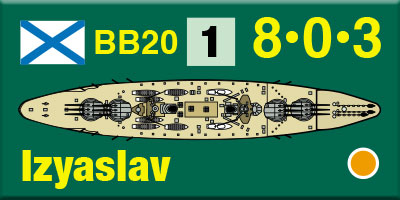
 The Russian admirals – chiefly Baltic Fleet commander Nikolai von Essen – wanted a fleet that could, if not defeat the Germans, at least contest their mastery of the Baltic. The Russians sought new designs for dreadnoughts, to be built in Russia or abroad, and those ships are the heart of The Baltic Sea. We gave the Russians 21 more dreadnought battleships and battle cruisers, all of them based on actual designs presented to the Russian Admiralty. The Russian admirals – chiefly Baltic Fleet commander Nikolai von Essen – wanted a fleet that could, if not defeat the Germans, at least contest their mastery of the Baltic. The Russians sought new designs for dreadnoughts, to be built in Russia or abroad, and those ships are the heart of The Baltic Sea. We gave the Russians 21 more dreadnought battleships and battle cruisers, all of them based on actual designs presented to the Russian Admiralty.
The Baltic Sea has six scenario chapters, each of them with a historical introduction describing some of the new ships. And then we get to play with them. The new Russian dreadnoughts take up three of the six chapters. In the first, we have the early proposals tied to the 1908 discussions that led to the construction of the four Gangut-class dreadnoughts. But the original program called for a dozen dreadnoughts, and The Baltic Sea includes those two extra classes: one a British design, the other an Italian proposal from Ansaldo.
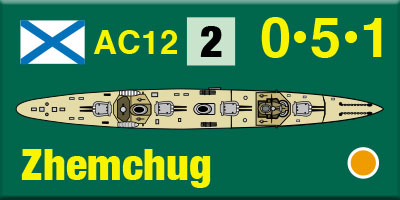 Each chapter is in our story-arc format, meaning that the scenarios tell a story of naval campaigns that never happened, with both operational scenarios (on the Jutland operational map, the right-hand half that never gets used in Jutland 2e) and battle scenarios (just on the tactical map, where the ships get to move and shoot at each other). Each chapter is in our story-arc format, meaning that the scenarios tell a story of naval campaigns that never happened, with both operational scenarios (on the Jutland operational map, the right-hand half that never gets used in Jutland 2e) and battle scenarios (just on the tactical map, where the ships get to move and shoot at each other).
With a dozen dreadnoughts, Essen has the fleet to match his aggressive nature. The Russians come deep into German waters to challenge their enemies, and they strike against the flow of iron ore down the Swedish coast. The Germans respond with their own show of force, hoping to bring the Russians to battle and end these displays.
 The next dreadnought chapter is all about Essen’s most practical proposal: to buy the five dreadnoughts under construction for South American navies (one for Brazil, two each for Argentina and Chile). The Russians had the financing in order, and their diplomats primed to make a deal “within three days” of a dreadnought coming onto the market. They ended up with none of the ships. The next dreadnought chapter is all about Essen’s most practical proposal: to buy the five dreadnoughts under construction for South American navies (one for Brazil, two each for Argentina and Chile). The Russians had the financing in order, and their diplomats primed to make a deal “within three days” of a dreadnought coming onto the market. They ended up with none of the ships.
We can overturn that dismal result, and give the Russians all five of them. Great War at Sea follows the old principle of a warship having “visible” and “invisible” qualities. The visible qualities are the ones you see when she’s tied up at dock or on trials: speed and armament.
 These are impressive ships, in their visible qualities. Their protection, not so much, at least for the three British-built ships (a constant feature of British export designs, which maximized the visible to awe the politicians who wrote the checks). With them, the Russians now have 17 dreadnoughts, and in the second chapter they face the Swedes and the Germans together, this increase in Russian power having moved Sweden from friendly toward the Central Powers to actively engaged. These are impressive ships, in their visible qualities. Their protection, not so much, at least for the three British-built ships (a constant feature of British export designs, which maximized the visible to awe the politicians who wrote the checks). With them, the Russians now have 17 dreadnoughts, and in the second chapter they face the Swedes and the Germans together, this increase in Russian power having moved Sweden from friendly toward the Central Powers to actively engaged.
That also brings into the game a new rule that we didn’t include in the long-ago first edition of Jutland, but should have: the Archipelago. Between Sweden and Finland lie tens of thousands of islands, some of them substantial enough to host small cities, but most of them just rocks sticking out of the water (or lying just below it). In an Archipelago Battle, the Tactical Map is dotted with islands and ships are constantly in danger of running aground. This is the battle for which the Swedes built their fleet of coast-defense ships and torpedo boats. Are they enough against dreadnoughts?
Those are just two of the six scenario chapters; we’ll dive into the remaining four in Part Two.
You can order The Baltic Sea right here.
The Epic of Jutland
The greatest naval game ever made, and four expansions that make it even greater.
• Jutland 2e.
• Jutland: North Sea 1914.
• Jutland: Dogger Bank 1915.
• Jutland: Risk Fleet.
• Jutland: Baltic Sea.
Retail Price: $278.95
Package Price: $225
Gold Club Price: $180
Sing of the Epic Here.
Sign up for our newsletter right here. Your info will never be sold or transferred; we'll just use it to update you on new games and new offers.
Mike Bennighof is president of Avalanche Press and holds a doctorate in history from Emory University. A Fulbright Scholar and NASA Journalist in Space finalist, he has published a great many books, games and articles on historical subjects; people are saying that some of them are actually good.
He lives in Birmingham, Alabama with his wife and three children. He misses his lizard-hunting Iron Dog, Leopold.
Daily Content includes no AI-generated content or third-party ads. We work hard to keep it that way, and that’s a lot of work. You can help us keep things that way with your gift through this link right here.
|