| Crimson Seas, Part 2
Evolution of the Inland/Lake Battleship Design
By Milan Becvar
June 2024
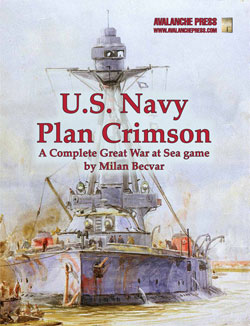 United States construction was from the onset designed with offensive action in mind. The role of the aggressor on the Great Lakes would be primarily to conduct bombardments and provide invasion transport escorts and this would be done in circumstances of superior numbers. The ships did not have to be very fast and a marginal speed advantage over the average transport would be sufficient to provide effective an escort or to intercept any enemy convoys. Excess speed would require more machinery driving up cost and size as well as reducing space available or protection or firepower. With U.S. ports well-fortified, if Canadian Lake Battleships were faster and chose to run so much the better, as they would eventually either have to fight or be sunk at their moorings. While correct for the most part the slow speed of the U.S. Inland Battleships would be a factor in being unable to force decisive engagements and perpetuate a Canadian Lake Fleet presence for a longer period. Beyond a negative impact on public opinion, this also eroded foreign confidence in a quick United States conquest. The Canadian Navy built the extremely fast, big-gunned but lightly armored Alberta Class Lake Battleships as a gamble to exploit this situation. United States construction was from the onset designed with offensive action in mind. The role of the aggressor on the Great Lakes would be primarily to conduct bombardments and provide invasion transport escorts and this would be done in circumstances of superior numbers. The ships did not have to be very fast and a marginal speed advantage over the average transport would be sufficient to provide effective an escort or to intercept any enemy convoys. Excess speed would require more machinery driving up cost and size as well as reducing space available or protection or firepower. With U.S. ports well-fortified, if Canadian Lake Battleships were faster and chose to run so much the better, as they would eventually either have to fight or be sunk at their moorings. While correct for the most part the slow speed of the U.S. Inland Battleships would be a factor in being unable to force decisive engagements and perpetuate a Canadian Lake Fleet presence for a longer period. Beyond a negative impact on public opinion, this also eroded foreign confidence in a quick United States conquest. The Canadian Navy built the extremely fast, big-gunned but lightly armored Alberta Class Lake Battleships as a gamble to exploit this situation.
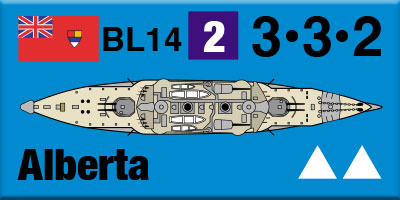
As previously mentioned, the need for economy in manpower and cost along with the necessity of a ship either being able to fight or run polarized Great Lakes naval fleets into two basic types: Inland/Lake Battleships and escorting destroyers/torpedo boats. There seemed to be no incentive to invest in large hulls of the cruiser type. A ship without adequate armament to harm a Lake Battleship and protection to stand up to one could not protect or attack transports escorted by Lake Battleships as speed would not be a factor. However the majority of the costs for the Lake Fleet were being made by a cost sharing arrangement with Great Britain and there was a significant influence by the Royal Navy on Canadian building programs. The same arguments made for the battle cruiser were applied to building fast, more lightly armored lake units that carried the same armament as their more heavily armored cousins. Such ships would always be a threat to unescorted shipping, able to perform morale-damaging hit and run raids or bombardments and not be caught by U.S. battle units. They could also serve as a hunter of U.S. destroyers or light cruisers and prevent raiding posses of U.S. destroyers roaming freely as they could be hunted down by fast Empire light units backed by the Albertas.
Big Guns
Lake Battleships carried a large primary armament to hit hard at long range in order to fight other Lake Battleships or bombard land targets. Primary guns also created a zone that light torpedo-carrying units had to pass through in order to launch their fish. Secondary guns could be mounted at available locations in the Lake Battleship hull without the significant increase of hull dimensions that additional primary mounts would have required. Earlier Inland Battleships featured large amounts of secondary guns as it allowed the hull to carry more guns with at least an intermediate range capability to counter the possibility of a large amount of small fast ships overwhelming a group of Battleships.
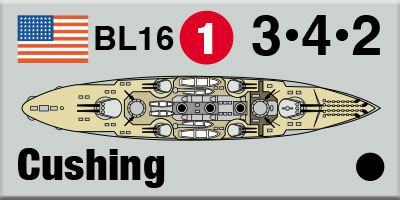
The Lake Battleship design equation of a mixed primary and secondary armament continued up to and slightly past the building of the revolutionary all-big-gun Dreadnought and the decline of the mixed-gun battleships. As the numbers of Lake Battle Units increased and the U.S. and Canadian fleets grew on each lake, the long range gun action of opposing Lake Battleships gradually became the more significant threat than fast light units or groups of armed freighters. Increasing the number of primary guns caused a rise in displacement as well as occupied valuable hull space. Inland Battleships did not have sufficient beam due to a need to fit into canal lock chambers to allow secondary turrets or hull gun mount positions in portions of the hull containing primary gun turrets or engine machinery. Adding more primary gun turrets required a reduction in the calibre of secondary guns as well as elimination of secondary turrets to allow hull mountings using the saved space. The retention of a relatively heavier secondary armament by later “dreadnought” type Canadian Lake Units was a reflection of the U.S. material superiority in light units. Canadian Lake Battleships could expect to face larger numbers of U.S. destroyers and light cruisers and kept the 6-inch gun to stay within the intermediate range envelope.
Size Matters
There are two points in the Great Lakes basin where canals are required to move between the three distinct lake bodies. The need for canals existed between the largest and most northern Lake Superior and the two large central lakes of Huron and Michigan that also connected into the lower Lake Erie by an open waterway. Lake Erie in turn was higher than Lake Ontario the last lake before the St. Lawrence River, which emptied into the Gulf of St. Lawrence. At the time of the conflict the both the Canadians and the United States had canals which allowed movement between all the lakes but no trust or co-operation existed to allow work on any ambitious plans for a connection to the sea.
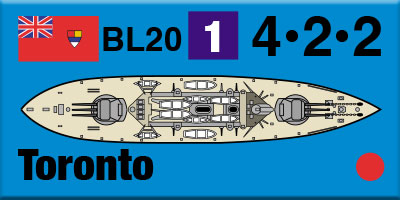
As a result of the canals the upper theoretical limits on Lake Battleship size was the maximum length and beam that was able to fit within the chambers of the canal locks allowing the ships to be raised or dropped to their different lake levels. Having ships able to move between all the lake bodies was essential to make maximum use of each unit of the lake fleet. Depending on the circumstances a ship would be able to re-deploy to another lake for various strategic purposes ranging from covering losses in one area to trying to gain numerical superiority in another. Both the United States and the Canadian Dominion began also began programs to enlarge canal locks allowing for an eventual increase in ship size but there was no surge in tonnage and battle units remained relatively small. Canal lock size and cost constraints resulted in design economies such as reduction in crew accommodations, avoiding superimposing turrets also reduced beam and Inland Battleships did not carry large superstructures to retain stability. Lake Battleships slowly grew from the modest 10,000 tons of the first examples and allowed ships to be planned in the 16,000-18,000 ton range (approximately the size of the British Lord Nelson/Dreadnought/Invincible) although actually no unit over 14,000 tons was completed by 1920.
Click here to join the Gold Club
See your Gold Club Insider newsletter for ordering information.
Sign up for our newsletter right here. Your info will never be sold or transferred; we'll just use it to update you on new games and new offers.
Want to keep Daily Content free of third-party ads? You can send us some love (and cash) through this link right here.
|