Indian Empires:
Publisher’s Preview
by Mike Bennighof, Ph.D.
January 2025
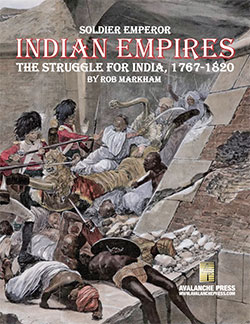 Before British colonialists unified India to more easily exploit and oppress the subcontinent, independent Indian kingdoms vied with one another and with outside powers for regional dominance. War raged across Europe in the last decades of the 18th Century and first years of the Nineteenth, and it also visited India. Before British colonialists unified India to more easily exploit and oppress the subcontinent, independent Indian kingdoms vied with one another and with outside powers for regional dominance. War raged across Europe in the last decades of the 18th Century and first years of the Nineteenth, and it also visited India.
India’s relative wealth in the pre-industrial era – 22.6 percent of worldwide income in 1700, compared to 23.3 percent for all of Europe combined – attracted waves of foreign invaders. Disaster struck in the 1760’s when two such waves crested at the same time: the fierce Afghans of the Durrani Empire coming overland and the acquisitive British and French who arrived by sea. Unable to unite against the invaders, India was subjected to a series of wars between the three largest indigenous kingdoms and the foreign interlopers. After decades of intrigue and spilled blood the British seized complete dominance of India. The Raj crushed local political and economic structures, draining India’s wealth to build a vibrant industrial base in Britain, and by 1952 India’s share of worldwide income had dropped to 3.8 percent.
Soldier Emperor: Indian Empires is our multi-player wargame based on the wars leading to this dismal outcome. There are eight scenarios, for two to five players depending on the scenario. In most of these the players take the role of Britain, France, Mysore, Hyderabad or the Maratha Confederacy. In the final scenario the two players represent Britain and the Sikh Empire. Each of the first seven scenarios can be played by fewer than five players, with some of the less potent Great Powers taking a minor role instead.
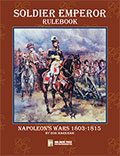
Indian Empires is a sister to our Soldier Emperor game and a revised edition of our old Soldier Raj game, with a new rulebook to bring it into line with the Second Edition (the current version) of Soldier Emperor’s rulebook. It’s a complete standalone game; Soldier Emperor is not required to play any of the scenarios. Our upcoming Sultan & Shah book includes rules, a map, pieces and some cards to link the two games together.
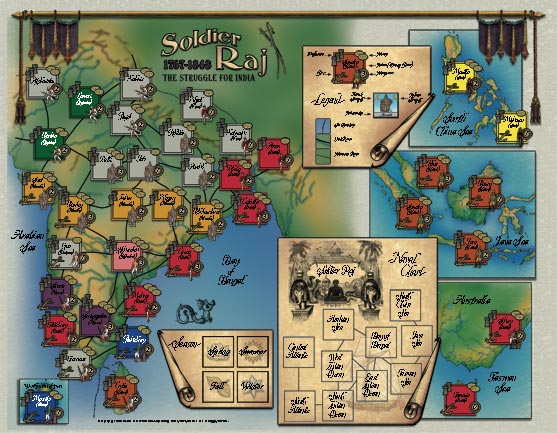
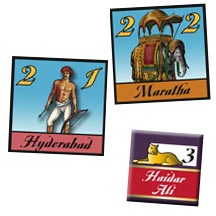
Indian Empires is a beautiful game: the fine map, playing cards and pieces. The game itself plays very well, with a lot of challenges in the relatively crowded terrain of India. Each player has his or her own full-color player aid card. There are 120 large (one-inch-square) tiles representing fleets and armies, and 88 slightly smaller ones for the leaders and markers. Each army or fleet piece has a painting by Terry Moore Strickland, specially commissioned for this game. And there are 64 very nice “real” playing cards.
As an Avalanche Press game, Indian Empires is of course loaded with the unique and fascinating history of the Indian subcontinent. This is a story seldom told in the West, much less played out in game form. The Indian kingdoms of this era had arisen following the collapse of the once-dominant Mughal Empire. The Mahratta Confederation in north-central India seemed the successor to Mughal power, but their crushing defeat at the hands of the Afghan Durrani Empire at Panipat in 1767 slowed their growth and instilled division among their factions.
That left three major and several minor kingdoms vying for power, at least in their own regions. The Mahrattas, the vigorous new kingdom of Mysore and the Nizam of Hyderabad alternatively fought the British interlopers and one another. What they could not manage was to unite to eject the Europeans from the subcontinent.
Indian Empires is very much focused on the Indian empires, and their struggles with one another and with the Europeans. It also folds in the broader conflict between the colonialists, in the East Indies, the Indian Ocean islands, the Philippines and Australia (this all ties into Soldier Emperor).
The basic game engine is pretty simple: the map is divided into areas, rated for their value in terms of money and manpower produced and fortification value (not necessarily representing actual fortresses, though it can include that, but their ability to resist an enemy on their own - these are big areas). The areas are connected to allow movement between them (and only along these connections).
Players move their armies between the areas; leaders help them move faster. Then they can fight field battles or sieges; again, leaders help them fight better. Fleets similarly move between sea areas, and can fight each other or assist armies in attacking coastal areas. Combat is pretty simple (roll a six!).
 The goal is to capture enemy-held territories to force your sovereign will upon them (measured in victory points). Doing so is not simply a matter of marching and fighting (but you’re going to have to march and fight). It’s the card play that sets this game (and its sisters) apart, and the diplomacy that interlocks with it. The goal is to capture enemy-held territories to force your sovereign will upon them (measured in victory points). Doing so is not simply a matter of marching and fighting (but you’re going to have to march and fight). It’s the card play that sets this game (and its sisters) apart, and the diplomacy that interlocks with it.
There are no neutrals in either Soldier Emperor or Indian Empires: there are only enemies you have not yet attacked. With so many potential enemies, your friends become even more important. Yet they will turn on you should it benefit their cause. After all, nations do not have friends, they have interests.
Cards help you in diplomacy, to gain minor allies (including mercenaries) or new leaders, inflict your enemies with disease or stupidity, affect the weather in your favor, and so on. You can play cards at any time, including right after you draw one. You can trade them. Or you can bluff with them. Indian Empires (like Soldier Emperor) is not what some call a “card-driven game,” but it is most definitely driven by card play.
The game plays relatively quickly (it sort of has to, so it can be played alongside Soldier Emperor), yet the interaction of card play, diplomacy and on-board military strategy make it pretty intense. Game play is built around the intrigue that prevented the Marathas from uniting India despite fielding hundreds of thousands of troops (many of them armed and trained along European lines) yet allowing the British to seize the subcontinent with a fraction of that many men.
It’s an unusual game topic, but looks good and plays well.
Order Indian Empires Here.
Sign up for our newsletter right here. Your info will never be sold or transferred; we'll just use it to update you on new games and new offers.
Mike Bennighof is president of Avalanche Press and holds a doctorate in history from Emory University. A Fulbright Scholar and NASA Journalist in Space finalist, he has published a great many books, games and articles on historical subjects; people are saying that some of them are actually good.
He lives in Birmingham, Alabama with his wife and three children.
Want to keep Daily Content free of third-party ads? You can send us some love (and cash) through this link right here.
|