| Snowstorm of Steel:
Scenario Preview, Part Five
By Mike Bennighof, Ph.D.
December 2025
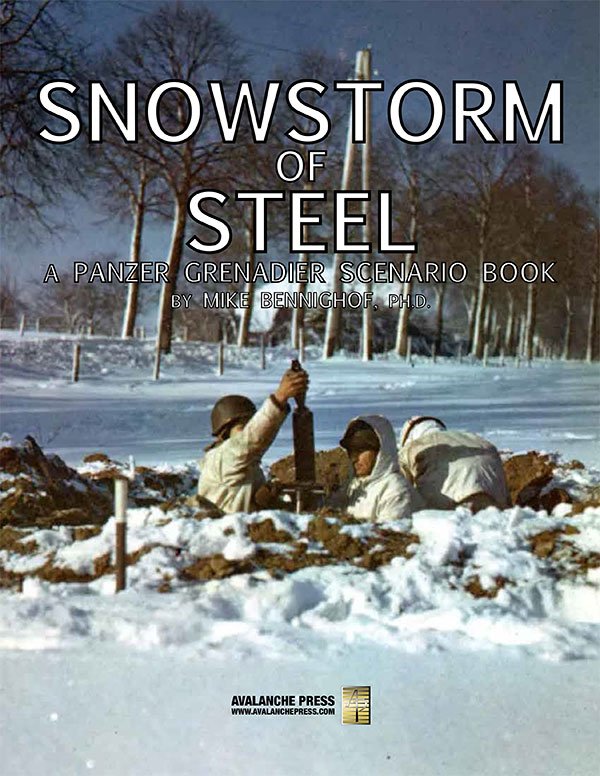 The Campaign Study, like Panzer Grenadier: Snowstorm of Steel, is something we do to add still more fun to our games. Extra scenarios, sometimes pulling in parts from another game, sometimes not. They’re small and not very expensive, but they make your old game, the one right thereon the shelf, new again. The Campaign Study, like Panzer Grenadier: Snowstorm of Steel, is something we do to add still more fun to our games. Extra scenarios, sometimes pulling in parts from another game, sometimes not. They’re small and not very expensive, but they make your old game, the one right thereon the shelf, new again.
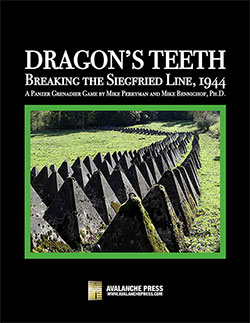
Snowstorm of Steel is double the usual size of our Campaign Studies (32 rather than 16 pages, 23 scenarios rather than 10 to 12). It’s primarily for Elsenborn Ridge; a few of those scenarios call for some extra pieces from Dragon’s Teeth. This is a model for what we’re trying to do (though usually not quite this large): all 23 of those scenarios are based on historical actions that really took place during the Battle of the Bulge. That’s more scenarios than other publishers put in what they call a “complete game.” Snowstorm of Steel makes Elsenborn Ridge new again.
Let’s have a look at the fifth and final chapter, as the American 6th Armored Division grinds up the Armed SS and spits them out:
Chapter Five
Super Sixth
The U.S. 6th Armored Division had a lame nickname, but had been raised in February 1942 from regiments of the 1st and 2nd Armored Divisions and thus had a well-trained cadre from the start. The division moved to England in February 1944, and landed in Normandy in July.
And then the Super Sixth appears to have been considered less than super. Its combat commands saw combat in the Cotentin Peninsula in an infantry-support role, and then the entire division helped besiege the German-held port of Brest. Only in November did the division reach the front, engaging in several days of intense combat along the Nied River before going over to the defensive. And from there the division would be sent to help relieve Bastogne a month later.
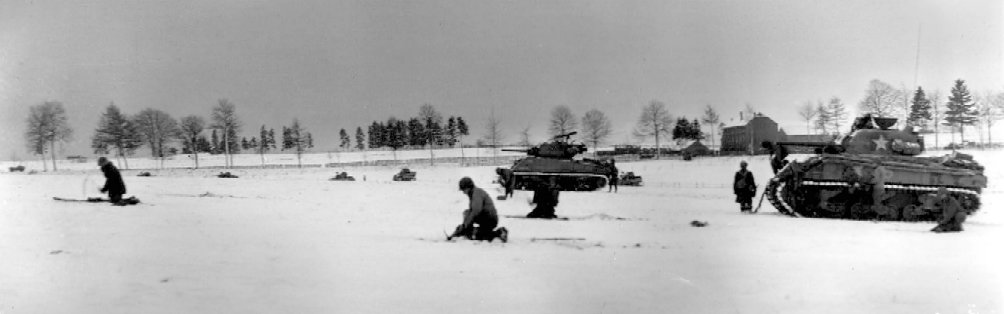
Sixth Armored Division armored infantry and tanks preparing to attack. South of Bastogne, 31 December 1944.
That lack of experience showed in the division’s combat deployment; its march columns would become tangled more than once in the narrow, icy roads of the Ardennes. But a full-strength, fully trained armored division was a rare thing in December 1944, and the Super Sixth would be tasked with driving the Germans back from the Bastogne perimeter.
Scenario Twenty
All The Fine Young Criminals
1 January 1945
The Super Sixth rolled into its assembly points a day late, charged with driving back the Germans from their advanced positions south and south-east of Bastogne. Narrow, icy roads and inexperienced traffic control slowed the American deployment, the same as it did for a newly-committed German formation, the Armed SS militia’s Hitler Youth Division. The fanatic teens of the SS division would strike first.
Conclusion
Maj. Gen. Robert Grow of 6th Armored Division had hoped to add infantry from the Santa Fé Division to his assault, but his division ended up going it alone. His armored infantry dismounted and fought the fascist children at close quarters in the heavy forest, taking the objective of Arloncourt, but the SS took it back and would not give it up despite heavy losses.
Notes
It’s not a very large scenario, with the high school boys of the Hitler Youth on the attack against a smaller American force supported by tanks, some of those armed halftracks, and artillery. And all of the foot soldiers have halftracks to ride in, with their own firepower. This won’t be so easy for the fascist youth.
Scenario Twenty-One
High School Dropouts
2 January 1945
In its second day on the front south of Bastogne, 6th Armored Division made good progress despite heavy losses of its own, pushing around not only the high schoolers of the Hitler Youth but the over- and under-aged People’s Grenadiers on either flank of the militia. But the young militiamen not only hung on in Arloncourt, they launched an attack from there in the afternoon, seeking to eject the Americans from Michamps and Oubourcy.
Conclusion
Lacking enough infantry to hold their ground, the Super Sixth gave up all but one of the villages. They inflicted massive losses on the militia, with the heavy .50-caliber machine guns mounted on the armored infantry’s halftracks wreaking a great slaughter among the Nazis. Grow’s division had given ground, but the formations opposing it could not maintain this exchange of blood for soil.
Notes
Night falls, and the ground is covered in snow and ice, and hordes of fanatic Nazis are charging through the mist to assault the American positions. The Germans have numbers on their side; the Americans have an edge in support weapons but are going to have a hard time standing their ground.
Scenario Twenty-Two
Royal Tigers
3 January 1945
Through the early morning of 3 January, the 6th Armored Division steadily pushed the Hitler Youth backwards. But the Germans had brought in reinforcements, seeking to launch an attack of their own, and with the aid of huge Royal Tiger tanks they struck back at their tormentors. With Bastogne now firmly in American hands and well-connected to the American lines, the offensive could only serve to disrupt the next American moves.
Conclusion
The all-conquering Tiger tanks failed to make much of an impression on the American defenses, aided by poor tank-infantry coordination between the Army tanks and Armed SS infantry. American artillery once again rained down on the attackers, even after they tried to pull back to their starting line.
Notes
There’s just one map board in play, and the Armed SS are bringing a lot of militia to the party. The sheer number of Germans is going to make it hard for the Americans to use those tank destroyers in their intended ambush role, but otherwise this is a perfect situation for them to show their worth.
Scenario Twenty-Three
Spoiled Attack
4 January 1945
With the fight for Bastogne already lost, the Germans continued a series of spoiling attacks aimed at disrupting the Americans and allowing the Germans to withdraw from the contested ground. The Hitler Youth retained their fanatic aggression, and attacked as though they still had a chance to surround Bastogne and defeat the Americans. Their recent attacks had brought their ranks to less than 40 percent of authorized strength, while 6th Armored Division remained combat-ready.
Conclusion
To an extent, the Hitler Youth succeeded: they disrupted the American positions and delayed their advance for hours. They penetrated one objective, the village of Mageret, but could not break into the other, the village of Wardin. In so doing they suffered substantial losses once again and exhausted the division’s offensive capability. The Americans would resume their advance the following morning, and this time the Hitler Youth could not stop them.
Notes
The SS come with a lot of guys and some armor to back them up; the Americans are hurting for numbers but their job is to shoot up the young true believers, and they’ve got the weaponry to do that. Plus, they have the awesome VT fuse that’s guaranteed to make Nazis cry.
And that’s all for Snowstorm of Steel.
Order Snowstorm of Steel Here.
Snowstorm of Steel is also available as a digital download. This is not a physical product (you’ll get a .pdf microseconds after completing your order):
Download Snowstorm of Steel Here.
It’s $16.99, but if you’re a Gold Club member, you can download for $11.89 using your private Gold Club link (That’s the only way to claim your Gold Club discount).
Sign up for our newsletter right here. Your info will never be sold or transferred; we'll just use it to update you on new games and new offers.
Mike Bennighof is president of Avalanche Press and holds a doctorate in history from Emory University. A Fulbright Scholar and NASA Journalist in Space finalist, he has published a great many books, games and articles on historical subjects; people are saying that some of them are actually good.
He lives in Birmingham, Alabama with his wife and three children.
Daily Content includes no AI-generated slop or third-party ads. We work hard to keep it that way, and that’s a lot of work. You can help us keep things that way with your gift through this link right here.
|