South Seas Mandate
The Americans
by Mike Bennighof, Ph.D.
June 2025
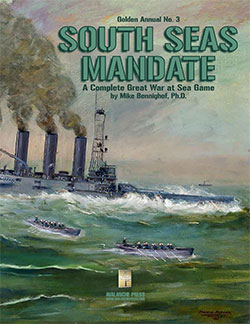 Note: Great War at Sea: South Seas Mandate is part of our Red-Orange Naval War alternative history story arc, positing a world-wide naval war in the early 1920’s between the United States on one side, and Britain and Japan on the other. Note: Great War at Sea: South Seas Mandate is part of our Red-Orange Naval War alternative history story arc, positing a world-wide naval war in the early 1920’s between the United States on one side, and Britain and Japan on the other.
It’s an alternate version of our Second Great War alternative history. In that story arc, the United States and Britain come close to an open naval war, but both sides back away (after committing to large-scale naval building programs). South Seas Mandate is the story of the opening moves of that war that never happened; the story continues in our much larger Great War at Sea: War Plan Orange game.
None of the American ships in South Seas Mandate actually existed, but all of them are based on actual plans – some of which came close to existing.
The 1916 Battle Cruiser
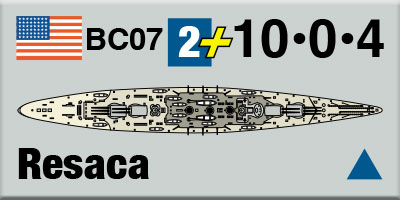
The core of the American vanguard is the Resaca-class battle cruiser, drawn up by the Navy’s Bureau of Construction and Repair in April 1916 as the latest in a long series of “battle scout” proposals. Design 169, her formal name, would have been a very big ship at 33,500 tons and 850 feet long (the Iowa-class battleships of a generation later came in at 860 feet, those these latter ships would be broader, much deeper and very much heavier than Design 169).
The slender shape helped her reach a design speed of 35 knots, to match the new light cruisers and destroyers of the 1916 program. That would require 180,000 horsepower, an enormous output that would take 18 oil-fired boilers with half of them placed above the machinery spaces. She would also have turbo-electric drive: her turbines would drive electric generators, which in turn would power electric motors that turned her drive shafts. This would allow even greater internal compartmentalization, as the shafts and turbines had no direct connection. Design 169 had the same multiple-bulkhead internal protection as contemporary battleships.
She would carry a main armament of ten 14-inch/50 Mark 7 rifles, the gun that equipped the New Mexico and Tennessee class battleships, in two twin and two triple turrets. She would also carry eighteen five-inch/51 guns, the standard secondary armament of American battleships and cruisers in this period. Four of them would be in shielded deck mounts and fourteen in casemates, including a pair of double-decker casemates forward like those of the contemporary Omaha-class cruisers.
All of those demands, for speed, firepower, and turbo-electric drive, blew the design well past her displacement limit and she was projected to come in at 37,000 tons. Work on cruiser designs kept the Bureau from addressing these at first, and when they finally did so the work came under enormous deadline pressure. The ship had to shed weight, and the architects did so by shaving down her armor, removing most of the scantlings that gave internal strength, removing the torpedo bulkheads and using the armored deck as a strength deck as well. They also swapped the positions of the main armament turrets, placing the triple turrets to fire over the twins, due to the narrow hull. The result would have been a very long, very lightly-built, and very vulnerable ship. She would be armored only against six-inch enemy fire, with weak internal protection thanks to the missing torpedo bulkhead.
The General Board approved the ship on 30 June 1916, to be laid down the f0ollowing year at a cost of $16 million per ship (the contemporary Tennessee-class battleships ran $10 million apiece). American entry into the First World War paused the project, which also gave the General Board a chance to reconsider the ship. They now demanded a switch to eight 16-inch guns, on the theory that such enormous weapons could knock out the enemy ships that would shred their lightweight armor before they could come into range. That would lead to the Lexington-class design, and that’s another story.
The 1910 Battle Cruiser

In November 1909, at Secretary of the Navy George Meyer’s request, the Bureau of Construction and Repair presented a set of six battle cruiser sketches. Most of them attempted to produce high speed while retaining both the firepower and armor protection of a true battleship, which resulted in gigantic ships that were unlikely to be funded by Congress.
But one design, based on the then-new battleship Wyoming, came in smaller than the battleship, thanks in large part to carrying only half of the firepower (six 12-inch/50 rifles in three twin turrets, all on the main deck and on the centerline, as opposed to a dozen big guns in six twin turrets, in three pairs). The battle cruiser version removed the super-firing turret of each pair and gave the ship a slimmer hull, but retained her 11-inch armored belt and raised her speed to 26 knots.
The 12-inch gun fell out of favor even before Wyoming had been commissioned, giving way to the 14-inch/45 Mark I for the succeeding New York class. The Navy appears to have had significant buyer’s remorse over Wyoming and her sister Arkansas, having pressed forward with the 12-inch gun because the 14-inch weapon had not completed testing.
With six 14-inch guns, the proposed battle cruiser would have equivalent firepower to larger proposals bearing eight 12-inch guns. The appearance of the Japanese battle cruiser Kongo, laid down in January 1911 and carrying eight 14-inch guns, ended discussion of the six-gun battle cruiser and designs with 12-inch guns.
We’ve included two examples of the six-gun ship. Antietam displaces 24,000 tons, with battleship-scale armor and a speed of 26 knots. She’s closer to German than British design philosophy, sacrificing firepower and extreme speed for protection.
The 1904 Armored Cruiser
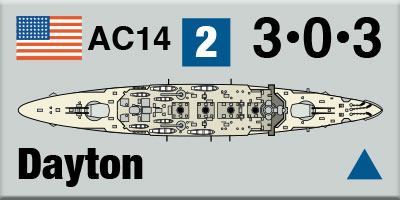
The Tennessee-class armored cruisers, authorized in two pairs in 1902 and 1904, carried heavier guns than the preceding class (10-inch, compared to 8-inch), but the Naval War College called for an improved version that did away with the heavy secondary battery in exchange for bigger main guns.
This next-generation armored cruiser would carry four 12-inch guns in twin turrets fore and aft, and a secondary armament of twenty-two 3-inch guns with no intermediate battery. She would have improved protection compared to Tennessee, though this still would not equal the armor of a true battleship.
The first proposal for such an armored cruiser came in 1904, but it re-surfaced in 1906 when the Americans learned the details of the new and very similar Japanese Tsukuba-class armored cruisers (later re-classed as battle cruisers). Disputes over propulsion stalled the proposal, which would never be formally endorsed. To make a useful cruiser speed, significantly better than the 21 knots clocked by new battleships, the ship would need turbines. But the U.S. Navy considered turbines less reliable than the conventional triple-expansion engine, and feared that a turbine-powered ship could not cross the broad Pacific without breaking down.
As turbines improved over the next few years, that became less of a concern, but it was enough to scuttle the 1904 armored cruiser. Soon afterwards, the advent of the true battle cruiser would have doomed the project in any event. But we’re not constrained by that reality, and have three of them in South Seas Mandate.
The Scout Cruisers

As American naval thought turned away from the big, expensive fast ships, a series of studies looked at new scout cruisers. The U.S. Navy had just three of them, under-sized and terribly under-armed for their projected task.
In February 1919, design work began on a new cruiser to succeed the Omaha class of the 1916 program. The General Board looked at an array of proposals, ranging from 5,000 to 10,000 tons’ displacement. Debate turned on the question of a large or small cruiser to fill the fleet’s needs. The bigger ship would carry bigger guns (8-inch weapons), while the smaller ship would have 6-inch guns. The Royal Navy had built a cruiser with 7.5-inch guns, the Hawkins class, and the big ship would be the American answer.
Formally known as Scout C, the 10,000-ton ship would carry seven 8-inch guns in three unarmored gunhouses: a triple mount forward, and a super-firing pair of twin mounts aft. The United States did not have a modern 8-inch gun at this time; the 8-inch/45 Mark 6 had been designed in 1900 and deployed on pre-dreadnought battleships and armored cruisers while the 8-inch/55 Mark 9 would not begin design work until 1922. Curiously, she included torpedoes (two triple deck mounts), something that the heavy cruisers that descended from her design would not carry.
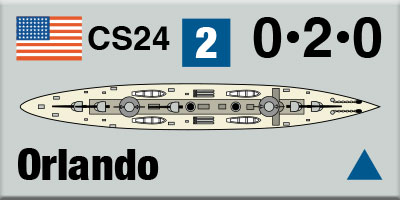
American naval thought had turned against the 8-inch gun. Its shells could not be manhandled by an individual sailor, greatly reducing its rate of fire. The shells could be loaded no faster than the big guns of a battleship, but could not penetrate battleship armor.
Commander William “Spike” Pye, later to command the battleship force after Pearl Harbor, was the first planner to review the proposals and recommended against Scout C. He felt the very high speed (36 knots) unnecessary, and preferred the smaller Scout D, a 5,000-ton ship armed with five 6-inch guns and a speed of 33.5 knots. The Navy could, Pye estimated, build half again as many of this ship on the same budget. Putting more hulls in the water would do more to fulfill the Navy’s needs.
Neither design included armor; both were oil-fired and had turbine propulsion (necessary to meet the speed requirements). Pye lamented their relatively short range, a detriment in the expected Pacific war, but greater range meant greater size and therefore greater cost.
The 1922 Washington accord laid down new standards for cruisers, which ended all of these proposals. Scout C would be the one to live on, as its specifications became the basis for the American position on what would be called heavy cruisers.
South Seas Mandate includes four examples each of Scout C and Scout D. We’ve addressed some of Pye’s arguments, giving them more range and giving the bigger ship some protection, at the price of their extreme speed.
Order South Seas Mandate Here.
Gold Club members can use their max discount.
Sign up for our newsletter right here. Your info will never be sold or transferred; we'll just use it to update you on new games and new offers.
Mike Bennighof is president of Avalanche Press and holds a doctorate in history from Emory University. A Fulbright Scholar and NASA Journalist in Space finalist, he has published a great many books, games and articles on historical subjects; people are saying that some of them are actually good.
He lives in Birmingham, Alabama with his wife and three children. He misses his lizard-hunting Iron Dog, Leopold.
Daily Content includes no AI-generated content or third-party ads. We work hard to keep it that way, and that’s a lot of work. You can help us keep things that way with your gift through this link right here.
|