South Seas Mandate
The Japanese, Part One
by Mike Bennighof, Ph.D.
July 2025
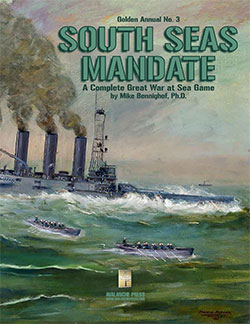 Note: Great War at Sea: South Seas Mandate is part of our Red-Orange Naval War alternative history story arc, positing a world-wide naval war in the early 1920’s between the United States on one side, and Britain and Japan on the other. Note: Great War at Sea: South Seas Mandate is part of our Red-Orange Naval War alternative history story arc, positing a world-wide naval war in the early 1920’s between the United States on one side, and Britain and Japan on the other.
It’s an alternate version of our Second Great War alternative history. In that story arc, the United States and Britain come close to an open naval war, but both sides back away (after committing to large-scale naval building programs). South Seas Mandate is the story of the opening moves of that war that never happened; the story continues in our much larger Great War at Sea: War Plan Orange game.
The fleets of South Seas Mandate are exactly the same size (this is what happens when you get to make up the story to suit the game). Of the 15 large warships, four of them did actually exist, though in a different form by the time World War II came around.
The fleets are not mirrors of one another: the Japanese have a handful of ships that are more powerful ships than anything fielded by the Americans, but most of their ships are not as studly. Let’s have a look at them
A New Light Cruiser

Most naval construction plans in the early decades of the 20th Century only considered battleships and battle cruisers. The Japanese Taisho 8-4 and 8-8 fleet plans even took their names from the number of battleships and battle cruisers included, but they also stretched on down the list to include the necessary cruisers, destroyers, and auxiliaries to create a balanced and powerful fleet.
A pair of light cruisers, the Tenryu class, began construction in 1917, joining the fleet in 1919. The initial order called for eight units, but the remaining six ships were cancelled before they had been laid down. Tenryu’s designers based her on the British Arethusa class: small, 3,200-ton cruisers intended to lead destroyer flotillas. She had a thin armored belt, a main armament of four 140mm (5.5-inch) guns plus six torpedo tubes, and turbines to drive her at 33 knots.
Dissatisfaction set in even before the ships had been completed; the cruisers would be expected to lead flotillas of much faster new destroyers. The Taisho 6 (1917) Plan would have included an improved version of Tenryu, designed by Teiji Kawase. The four main guns went from single mounts to a pair of twin gunhouses mounted fore and aft, to provide a wider field of fire. She would likewise have six torpedo tubes, but would carry the new 610mm Type 8 torpedo rather than the older 530mm Type 6 of Tenryu.
The Improved Tenryu, or Tenryu-kai, would still be smaller, slower, and more lightly-armed than the American Omaha-class light cruisers then in the design stage. Japan’s British allies had passed along the rough details, and these would be enough to doom the Tenryu-kai project.
We included four of them in South Seas Mandate. The Great War at Sea game system isn’t granular enough to make the difference between 33 and 36 knots show up in game terms, so they aren’t hampered by their speed. The light armament and small size, though, definitely limit their utility.
The Intermediate Cruiser
Along with six improved Tenryu-class light cruisers, the Taisho 6 Plan also included three 7,200-ton ships inspired by the British Hawkins-class cruisers. The latter, known as “Atlantic cruisers,” were big ships with long range and a main armament of 7.5-inch guns rather than the 6-inch guns that had become standard for light cruisers (as the largest shell that could be hefted by a single sailor).
The original design, submitted in September 1916, carried ten 140mm guns, in four twin gunhouses mounted fore and aft in super-firing pairs, and four single mounts, two along either side amidships. She would have four twin mounts for the new 610mm torpedo, also two of them on either side of the ship. Top speed would be 36 knots, with a hefty range and an armored belt 76mm thick.
This order would be cancelled along with the six Tenryu-kai, in favor of a new 5,500-tons light cruiser design that became the Kuma class. Design work continued under the direction of Yuzuru Hiraga, with the ship enlarged to 8,000 tons and all of the 140mm guns moved to twin gunhouses, six such mounts in “pyramid” arrangements fore and aft (with the super-firing mount on a pedestal between two others at main deck level). A variant on the design deleted the aft turret closest to amidships. Another variation replaced the twin 140mm gunhouses with single mounts for the new 200mm (7.9-inch) Model 3 gun that began development in 1916. Both versions had a very strong torpedo armament, between eight and twelve tubes for the new, powerful 610mm torpedo.
The version with a dozen 140mm guns remained the favored design, and the 1919 8-8 Fleet Plan included three of them. The Taisho 9 appropriations, approved in August 1920, raised the number of ships to four. That naval law remained in effect only until the signing of the Washington Naval Agreement in 1922, when it would be replaced by the Taisho 11 program conforming to the new ship standards.
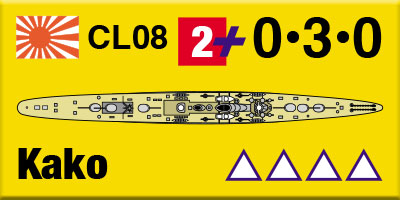
Contracts for the four cruisers quickly went to Mitsubishi and Kawasaki, two each to replace the battle cruisers Takao and Atago cancelled under the naval accord. The first pair, named Furutaka and Kako, were laid down in November and December, 1922 They would follow the variant design with six 200mm guns, each in single mounts. They would be the first heavy cruisers built to the treaty restrictions, but as an older design they were much smaller than later heavy cruisers (“Treaty Cruisers” could displace up to 10,000 tons; later Japanese heavy cruiser designs routinely went well over this limit).
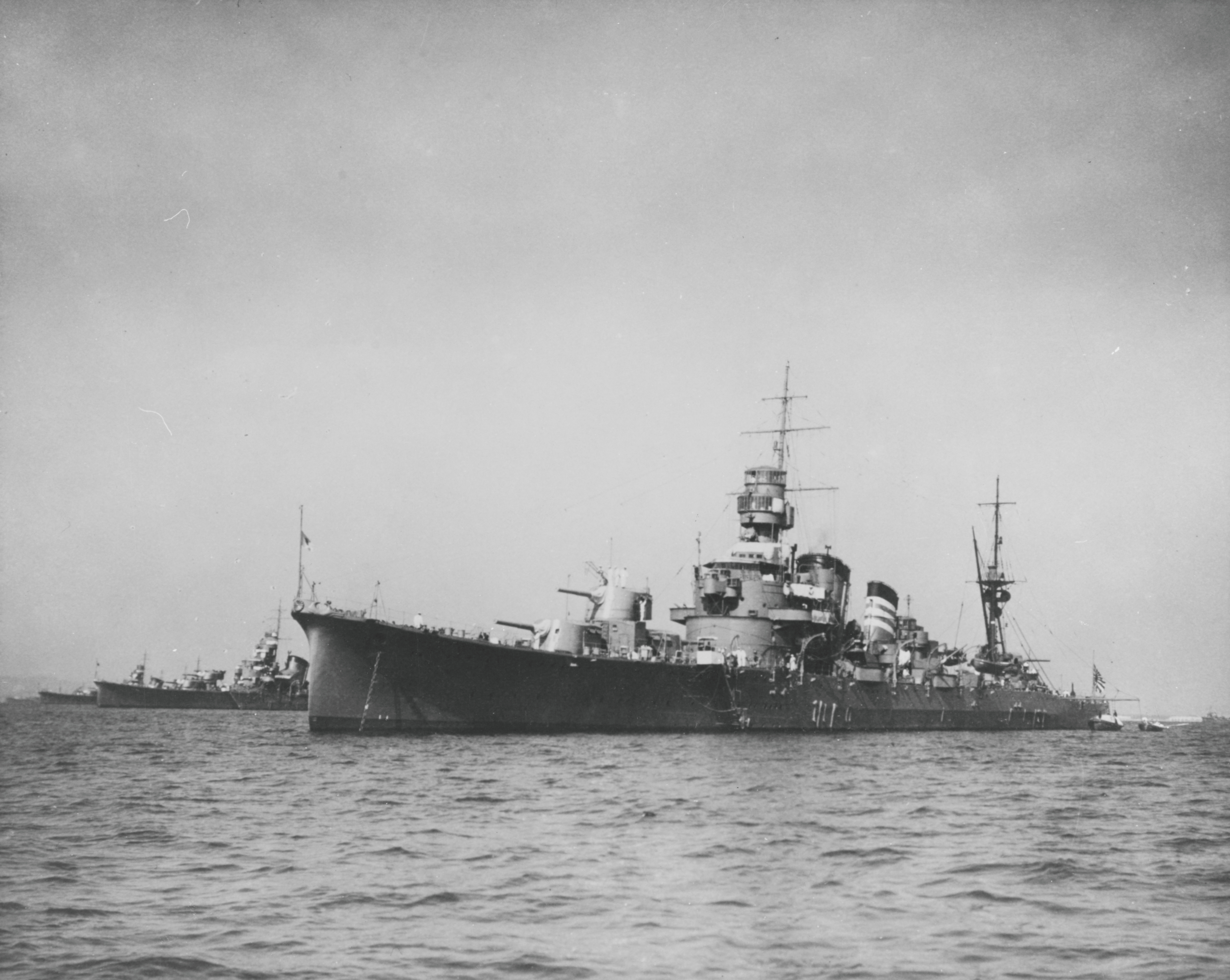
Furutaka seen in 1935, just before her reconstruction.
After the ships had been laid down, the Naval General Staff pressed to alter the main armament arrangement to three twin gunhouses; Kikuo Fujimoto, the acting head of the Design Section, believed the ships’ construction to be too far advanced for such a change. Furutaka and Kako would be completed with six single mounts but the second pair, Aoba and Kinugasa, carried their main armament in three twin gunhouses.
The single mounts proved troublesome in service, and while a rate of fire of three to five shots per minute had been expected, the two cruisers completed with them managed only two rounds per minute. Furutaka and Kako would be re-constructed between 1936 and 1939 to the same standard, with new-model 203mm guns in place of the older weapons.
All four ships appear in South Seas Mandate, in the 1919 Taisho 8 guise with six single-mount 200mm guns. For the period they are capable ships, with better size and armament than contemporary light cruisers. The coming of the heavy cruiser left them inadequate as compared to the new ships, but the Imperial Navy never seems to have considered pausing construction to re-design them as 10,000-ton ships. The funding existed, and in the bureaucratic dance known around the world, it had to be spent in its fiscal year lest it be lost.
Given their small size and relatively light armament, all four cruisers saw hard service and gave good results in the 1942 battles around Guadalcanal, where three would be lost and the fourth suffer irreparable damage that limited her to second-line duties for the rest of the war. But that’s another story.
Order South Seas Mandate Here.
Gold Club members can use their max discount.
Sign up for our newsletter right here. Your info will never be sold or transferred; we'll just use it to update you on new games and new offers.
Mike Bennighof is president of Avalanche Press and holds a doctorate in history from Emory University. A Fulbright Scholar and NASA Journalist in Space finalist, he has published a great many books, games and articles on historical subjects; people are saying that some of them are actually good.
He lives in Birmingham, Alabama with his wife and three children. He misses his lizard-hunting Iron Dog, Leopold.
Daily Content includes no AI-generated content or third-party ads. We work hard to keep it that way, and that’s a lot of work. You can help us keep things that way with your gift through this link right here.
|