South Seas Mandate
The Japanese, Part Two
by Mike Bennighof, Ph.D.
July 2025
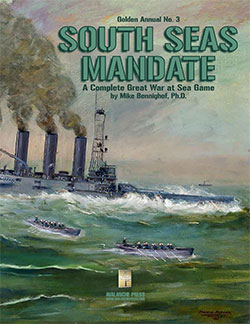 Note: Great War at Sea: South Seas Mandate is part of our Red-Orange Naval War alternative history story arc, positing a world-wide naval war in the early 1920’s between the United States on one side, and Britain and Japan on the other. Note: Great War at Sea: South Seas Mandate is part of our Red-Orange Naval War alternative history story arc, positing a world-wide naval war in the early 1920’s between the United States on one side, and Britain and Japan on the other.
It’s an alternate version of our Second Great War alternative history. In that story arc, the United States and Britain come close to an open naval war, but both sides back away (after committing to large-scale naval building programs). South Seas Mandate is the story of the opening moves of that war that never happened; the story continues in our much larger Great War at Sea: War Plan Orange game.
In the era before aircraft became a meaningful reconnaissance platform, fleets expected their scouting forces to find their enemies and shield their own location from enemy scouts. The light cruisers and destroyers would need support from ships armed with heavy guns. Two alternatives seemed likely: cruisers armed with heavy guns, or capital ships with the speed to keep up with the cruisers. The Imperial Japanese Navy studied both of these options.
Heavily-Armed Light Cruisers
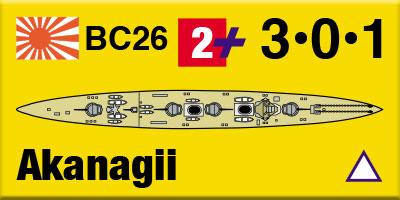
Both American and Japanese naval architects drafted designs that mated cruiser hulls with heavy-caliber guns. This notion harkened back to the original battle cruiser concept, to give heavy firepower support to the scouting forces. But the ships armed with heavy guns quickly grew to the size of battleships, making them capital ships themselves.
The American sketches put heavy guns on the Omaha-class light cruiser hull, and in the 1930’s designers looked at doing so with the Brooklyn-class light cruiser. Cdr. Yuzuru Hiraga, overseeing the Furutaka-class cruiser program (begun as a light cruiser, later classed as a heavy cruiser due to her armament), based his version of a heavily-armed light cruiser on an enlarged version of the 7,200-ton proto-Furutaka designed in 1917. She would be slightly longer and beamier than Furutaka, keeping the smaller cruiser’s fine lines to allow a top speed of 36 knots.
Hiraga sketched two versions of his heavily-armed light cruiser, one with three 12-inch guns and one with four such weapons, each of them in single mounts. The specification of 12-inch rather than 305mm guns (and 3-inch belt armor, rather than 76mm) places the designs before 1917, when Japan transitioned to the metric system. All of the heavy guns would be sited on the main deck.
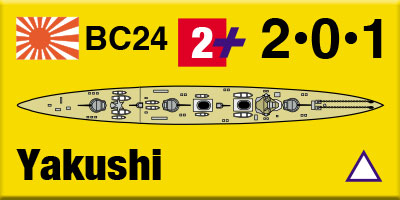
While sometimes compared to the British “light battle cruisers,” Hiraga’s design clearly shares the same family tree as Furutaka, down to her bridge structure. Hiraga, who learned his trade at the Royal Naval College in Greenwich, made his notes in English and called this ship a “Light Cruiser With 12-Inch Guns.” She would bring a small number of heavy guns to the scouting forces; the alternatives would be similar ships with a dozen 140mm (5.5-inch) or six 200mm (7.9-inch) guns.
The move from six 200mm guns to four 12-inch guns added about 400 tons to her displacement. The bulk of her displacement (2,200 tons) went to a massive power plant expected to make 127,000 horsepower, good for 37 knots. Hiraga made allowances for the stronger frames and hull needed to withstand the recoil of the much bigger main guns, also helping to increase her displacement to its final figure of 11,000 tons.
South Seas Mandate includes four of the heavily-armed light cruisers: two with four guns each, and two of the three-gun version. In game terms they’re classed as battle cruisers. They are very fast, lightly protected, and need to stay away from enemy ships with heavy guns. Had they been built, they probably would have ended up as light aircraft carriers or perhaps as anti-aircraft cruisers.
The Japanese Lexington
By the summer of 1916, Japanese naval intelligence had learned (probably from the British) that the U.S. Navy had been studying a very large battle cruiser with the shocking top speed of 35 knots. Hiraga, newly-named as chief naval architect of the new fleet building program, sketched out a possible Japanese response.
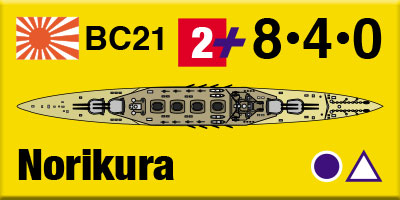
Hiraga drew the task of revising the design of the new Nagato-class battleships, originally drafted by Kaizo Yamamoto, to reflect the lessons of the Battle of Jutland imparted by Japan’s British allies. His design for the Type I battle cruiser drew heavily from the revised Nagato. She never received a name, as the Japanese (probably wisely) instead chose more balanced ships for their 8-8 program. We’ve called her Norikura, after Mount Norikura, the third-tallest volcano in Japan.
Norikura would have been a gigantic ship, coming in at 933 feet long with a displacement of 40,850 tons. By comparison, Nagato came in at 708 feet and 38,500 tons; the follow-on Kaga class weighed in at 44,200 tons and 768 feet long.
Hiraga used that great length to give her the fine lines needed to make 35 knots (Kaga only made 26 knots, and the Amagi-class battle cruisers 30 knots). To build a battle cruiser capable of catching Lexington, the ship needed both those lines and the space for a power plant generating 215,000 horsepower (Amagi would require 131,000; Nagato, the last heavy ship actually completed during this period, ”only” made 80,000 horsepower).

A 16-inch turret from the wreck of the battleship Mutsu. Norikura’s turrets would have been the same model.
Norikura would burn oil, like the other post-Nagato designs; coal-fired boilers could not provide anything like the required power. That long stretch between the turret groupings, and the four huge funnels, speak to the five boiler rooms taking up all of the space in the lower decks; two turbine rooms sat abaft of the boilers.
Hiraga’s sketchbook lists a main armament of eight 14-inch Year 3 guns. But the 14-inch guns used in the Kongo, Fuso and Ise classes were either Year 41 or Year 43 models (depending on whether they were manufactured in Britain or Japan). Japan went metric in 1917, and Nagato’s 16-inch guns were properly named 410mm Year 3 rifles. Given that Japanese practice gave battleships and their battle cruiser equivalents the same main armament, in South Seas Mandate we went with the bigger guns. That was likely Hiraga’s intent as well and the 14-inch listing a deliberate deception (the 14-inch main guns of Kongo were likewise described as 12-inch weapons at this stage).
The main guns would be in pairs of super-firing twin turrets, located well forward and aft. Secondary armament would consist of twenty 140mm (5.5-inch) guns in an armored casemate located at the forward end of the amidships structure. She would have eight torpedo tubes, in the unusual arrangement of four submerged tubes and four more above water. Four 76mm anti-aircraft guns completed the weaponry.
Japanese battle cruisers in general had fairly thin armor, and Norikura would have been no exception. She would have an armored belt of 229mm (nine inches), less than Amagi but better than Kongo. She would not be proof against her own armament, and likely not against the 12-inch guns of the early American battle cruiser proposals.
But she would be very fast.
Order South Seas Mandate Here.
Gold Club members can use their max discount.
Sign up for our newsletter right here. Your info will never be sold or transferred; we'll just use it to update you on new games and new offers.
Mike Bennighof is president of Avalanche Press and holds a doctorate in history from Emory University. A Fulbright Scholar and NASA Journalist in Space finalist, he has published a great many books, games and articles on historical subjects; people are saying that some of them are actually good.
He lives in Birmingham, Alabama with his wife and three children. He misses his lizard-hunting Iron Dog, Leopold.
Daily Content includes no AI-generated content or third-party ads. We work hard to keep it that way, and that’s a lot of work. You can help us keep things that way with your gift through this link right here.
|