| Snowstorm of Steel:
Scenario Preview, Part Two
By Mike Bennighof, Ph.D.
June 2025
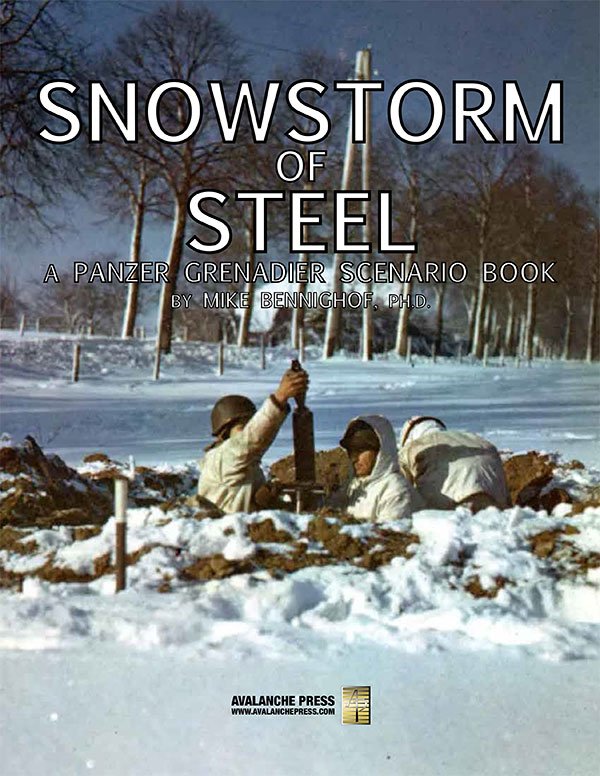 Joachim Peiper was a war criminal, a mass murderer, a fanatic follower of Nazi ideology and a failure as a battlefield commander. Joachim Peiper was a war criminal, a mass murderer, a fanatic follower of Nazi ideology and a failure as a battlefield commander.
That’s all abundantly clear in the historiography of World War II in general, and the Armed SS criminal organization in particular. It’s also something you won’t see from many wargame publishers, even at this late date (2025 as of this writing).
For decades, Peiper served as an avatar of supposed Nazi skill at arms; actor Robert Shaw’s firm jawline probably had a lot to do with that. In more recent years the glorification’s less common, even if there’s still a wargame designer proudly showing off his Peiper doll (excuse me, action figure). Instead, now we just pretend we’re interested in the tactical nuances of it all, and we leave the politics to others.
That’s not how we do things at Avalanche Press. The Armed SS was named a criminal organization in the Nürnberg Trials. Peiper had command responsibility for the murders of close to 500 people, prisoners of war and civilians, in just under one week of combat before his buffoonish command decisions destroyed his own unit.
The U.S. Army had something to do with the latter. American soldiers fought against, and defeated, the fascists in 1944. And that’s the part that’s worth remembering. Let’s resume our look at how that necessary victory is portrayed in Panzer Grenadier: Snowstorm of Steel.
Chapter Two
Old Hickory
While Joachim Peiper and his battle group bumbled their way to infamy, the rest of the 1st SS Panzer Division soon found itself with a new task: rescuing Peiper. Peiper had caught the Americans by surprise, yet still managed to stick his head into a noose.
Those efforts quickly ran into an old foe: the U.S. Army National Guard’s 30th “Old Hickory” Infantry Division, from North Carolina, Tennessee, and South Carolina. German propaganda would label the division “Roosevelt’s SS,” but these were veteran combat soldiers by this point in the war even though many of the original Guardsmen had been drawn off from the division as cadre for new units.
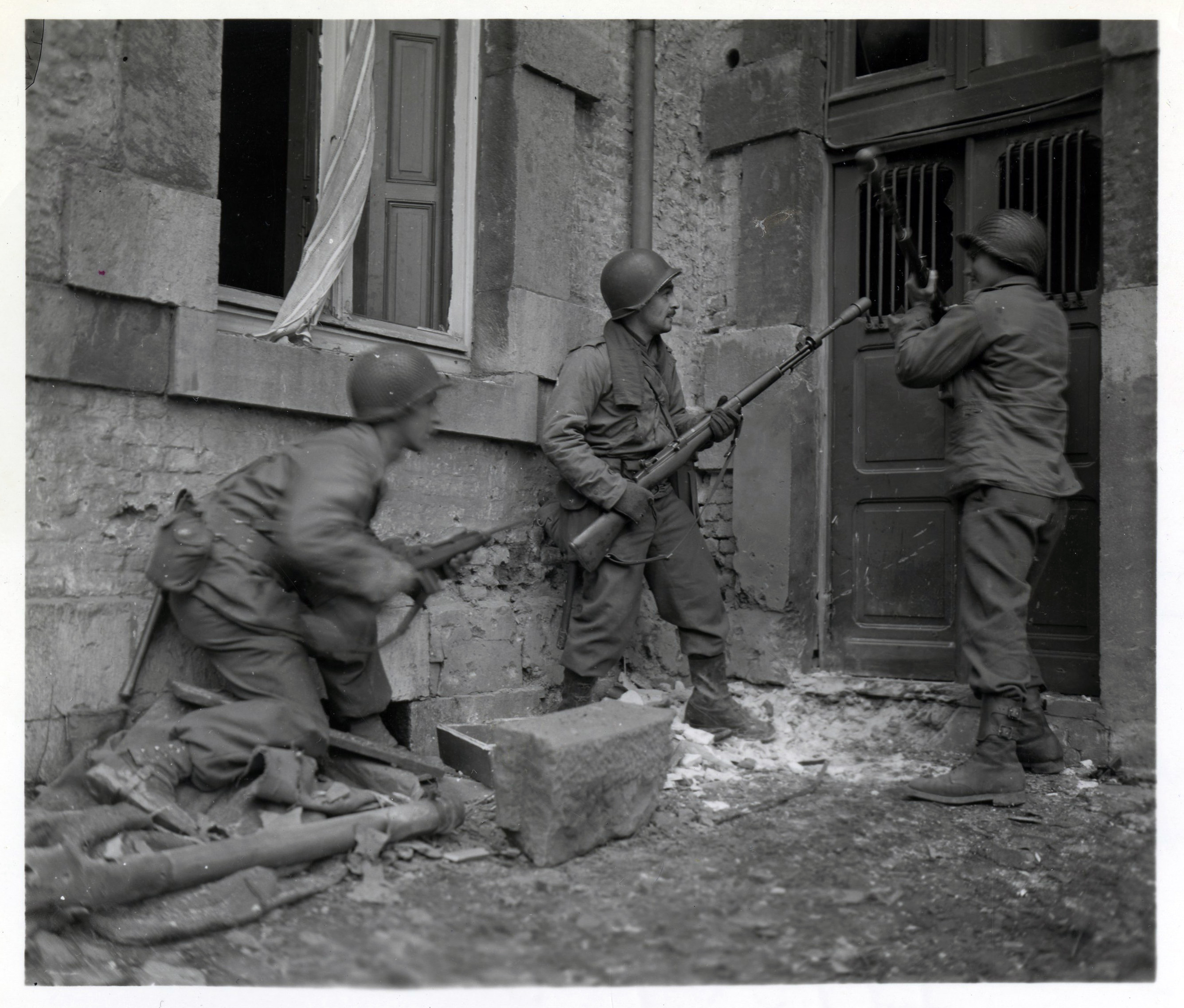
Soldiers of the 30th Infantry Division hunt an SS sniper in Stavelot, Belgium. 24 December 1944.
The Old Hickory Division had been fighting near Aachen when the German Ardennes offensive began. Rushed to the Ardennes, they once again engaged the 1st SS Panzer Division, who they’d defeated in August in Normandy. They now proceeded to do it again.
Scenario Eight
Tough as Hickory
21 December 1944
With Peiper trapped on the west bank of the Amblève River, the rest of the 1st SS Panzer Division tried to rescue their wayward battle group. This would be a tough assignment, given that Peiper had taken most of the division’s armor with him. When an infantry battalion of Battle Group Hansen probed northward toward Peiper’s last known positions, having lost their assault guns when a bridge collapsed, they found elements of two veteran American divisions bearing down on them.
Conclusion
The SS militiamen did not come close to breaking through to Peiper, but neither did the Americans reach Stavelot to tighten the noose around the trapped German battle group. The SS attacked with fanatical determination, but the Americans held their ground and deployed their massive edge in artillery firepower to ravage their enemies.
Notes
It’s an unusual scenario; the Germans have just one small SS group on the board to start, while the Americans press in from three sides with equally small groups. The Germans await strong reinforcements: should the Americans deploy to counter these, or try to crush the enemies already in play before help arrives?
Scenario Nine
Solstice Sacrifice
22 December 1944
American pressure on the isolated Battle Group Peiper compressed the SS perimeter to the area around La Gleize, increasing the distance the relief forces had to cover to reach them. SS Lt. Col. Werner Hansen sent two more infantry companies to reinforce the breakthrough attempt, but could not get any of his tanks across the Amblève River. The attempt to save Peiper would continue on foot.
Conclusion
The party fanatics had considerable combat experience on the Eastern Front, but they could not shift the American 117th Infantry Regiment, the former 3rd Tennessee. Two SS battalion commanders died trying to move their men forward, as the attack bogged down in the face of fierce resistance and relentless artillery fire. The small task force from the 3rd Armored Division did give ground, but it was not enough to save Peiper’s trapped men.
Notes
This one is a big scenario, with six boards in play. There aren’t a huge number of units to spread over them; the Americans have tanks and that artillery again, while the Germans will depend a lot on that one company of mechanized infantry. The SS is on the attack, with the left end of that huge board the focus of the action.
Scenario Ten
Crushing Relief
23 December 1944
It only took two days of fighting for the supposedly battle-hardened SS men of Battle Group Hansen to melt away. The struggle to reach Peiper’s isolated men now gave way to a desperate defense of their own positions, as the Americans went over to the attack. With their tanks still on the wrong side of the river, and few anti-tank guns, the SS infantry would have little support against the Shermans of 3rd Armored Division and the 30th Infantry Division’s attached 743rd Tank Battalion.
Conclusion
The well-planned American attack hit the SS from two different directions just as the militiamen had left their positions in a final attempt to advance. Spearhead’s tankers ground the German 12th Company under their treads at Petit Coo, and then gave the same treatment to the 11th Company at Biester. At that point the militia broke and ran, falling back for six miles before recovering in front of the Castle of Petit Spai, then in use as a home for the children of Belgian prisoners of war.
Notes
The Americans have six tank platoons, and even though half of them are light tanks, the Germans have but one anti-tank battery. The Americans must accomplish a great deal in order to win, but this is one scenario that will make Nazis cry.
Scenario Eleven
Antoine’s Farm
24 December 1944
In the pre-dawn hours, Peiper and his surviving men destroyed their remaining vehicles and heavy weapons in and around La Gleize and began to flee eastwards toward German lines. Major Gustav Knittel, who had shortly before ordered the massacre of eight American prisoners of war (a bazooka team from the 82nd Airborne Division) at his headquarters, now ordered his men to stand on the west bank of the Amblève River to allow Peiper’s men to escape. Near the Antoine Farm, the Old Hickory Division caught up with Knittel.
Conclusion
Despite horrendous casualties (Knittel had lost over half of his men and most of his vehicles since the opening of the offensive), the recon battalion held on long enough to allow Peiper’s men to reach them and escape American wrath. Knittem would serve just seven years imprisonment for his crimes before his release during a general amnesty, and like Peiper he became a used-car salesman.
Notes
The Americans have a battalion-sized tank-infantry team; they have good numbers, they have tanks, and they have that awesome American artillery (not quite as awesome as in other scenarios, but then the SS don’t have any). There aren’t many Germans, but the Americans will have to pretty much exterminate them to meet their objectives.
And that’s all for Chapter Two. Next time: Chapter Three.
Order Snowstorm of Steel Here.
Snowstorm of Steel is also available as a digital download. This is not a physical product (you’ll get a .pdf microseconds after completing your order):
Download Snowstorm of Steel Here.
It’s $16.99, but if you’re a Gold Club member, you can download for $11.89 using your private Gold Club link (That’s the only way to claim your Gold Club discount).
Sign up for our newsletter right here. Your info will never be sold or transferred; we'll just use it to update you on new games and new offers.
Mike Bennighof is president of Avalanche Press and holds a doctorate in history from Emory University. A Fulbright Scholar and NASA Journalist in Space finalist, he has published a great many books, games and articles on historical subjects; people are saying that some of them are actually good.
He lives in Birmingham, Alabama with his wife and three children.
Daily Content includes no AI-generated slop or third-party ads. We work hard to keep it that way, and that’s a lot of work. You can help us keep things that way with your gift through this link right here.
|