| Snowstorm of Steel:
Publisher’s Preview
By Mike Bennighof, Ph.D.
August 2026
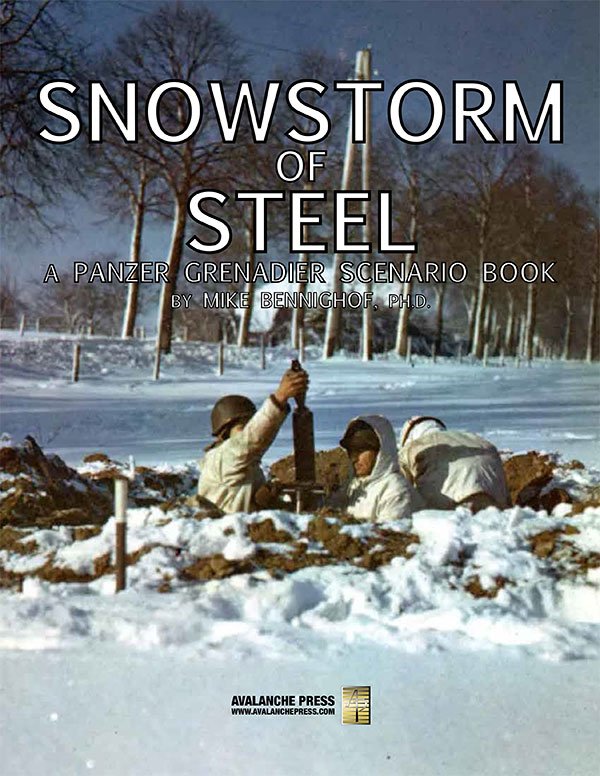 Panzer Grenadier: Elsenborn Ridge is the most popular title in the Panzer Grenadier series, but unlike the other top sellers at Avalanche Press, it hasn’t gotten there on a wave of expansions. Golden Journal No. 27: Sherman Tanks gave a boost, and is still in stock. Black Panthers is undergoing substantial enlargement and revision, while we’ve run out of pieces for the surprisingly successful Spearhead Division. Yet despite the scenario-rich environment, we’ve never issued a Campaign Study solely focused on Elsenborn Ridge. Panzer Grenadier: Elsenborn Ridge is the most popular title in the Panzer Grenadier series, but unlike the other top sellers at Avalanche Press, it hasn’t gotten there on a wave of expansions. Golden Journal No. 27: Sherman Tanks gave a boost, and is still in stock. Black Panthers is undergoing substantial enlargement and revision, while we’ve run out of pieces for the surprisingly successful Spearhead Division. Yet despite the scenario-rich environment, we’ve never issued a Campaign Study solely focused on Elsenborn Ridge.
Panzer Grenadier: Snowstorm of Steelcorrects that long-standing oversight. It’s a double-sized Campaign Study, built around completely re-designed versions of 23 scenarios that first appeared in 2011 in a book called Winter Soldiers. That book’s been out of print for a decade and was never upgraded to Fourth Edition standards. Its scenarios drew maps and pieces from the old Battle of the Bulge game, now long out of print. Much of the book was given over to a rather convoluted campaign game that I sincerely doubt anyone ever played; we’ve since switched to the much more straightforward “battle game” structure which are very easily playable (all they require is playing the existing scenarios, and using the battle game instructions to score how you did).
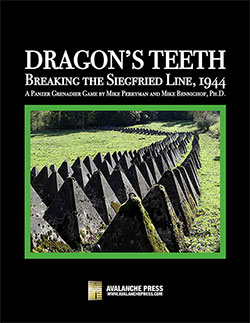
Snowstorm of Steel takes those scenarios, and gives them all a new round of development. They would have needed that to bring them in line with the current rulebook, but they also needed to be re-made to only use pieces and maps from games currently in print (in this case, Elsenborn Ridge for all of them, with a map from 1940: The Fall of France in a couple of scenarios and one from Dragon’s Teeth in another).
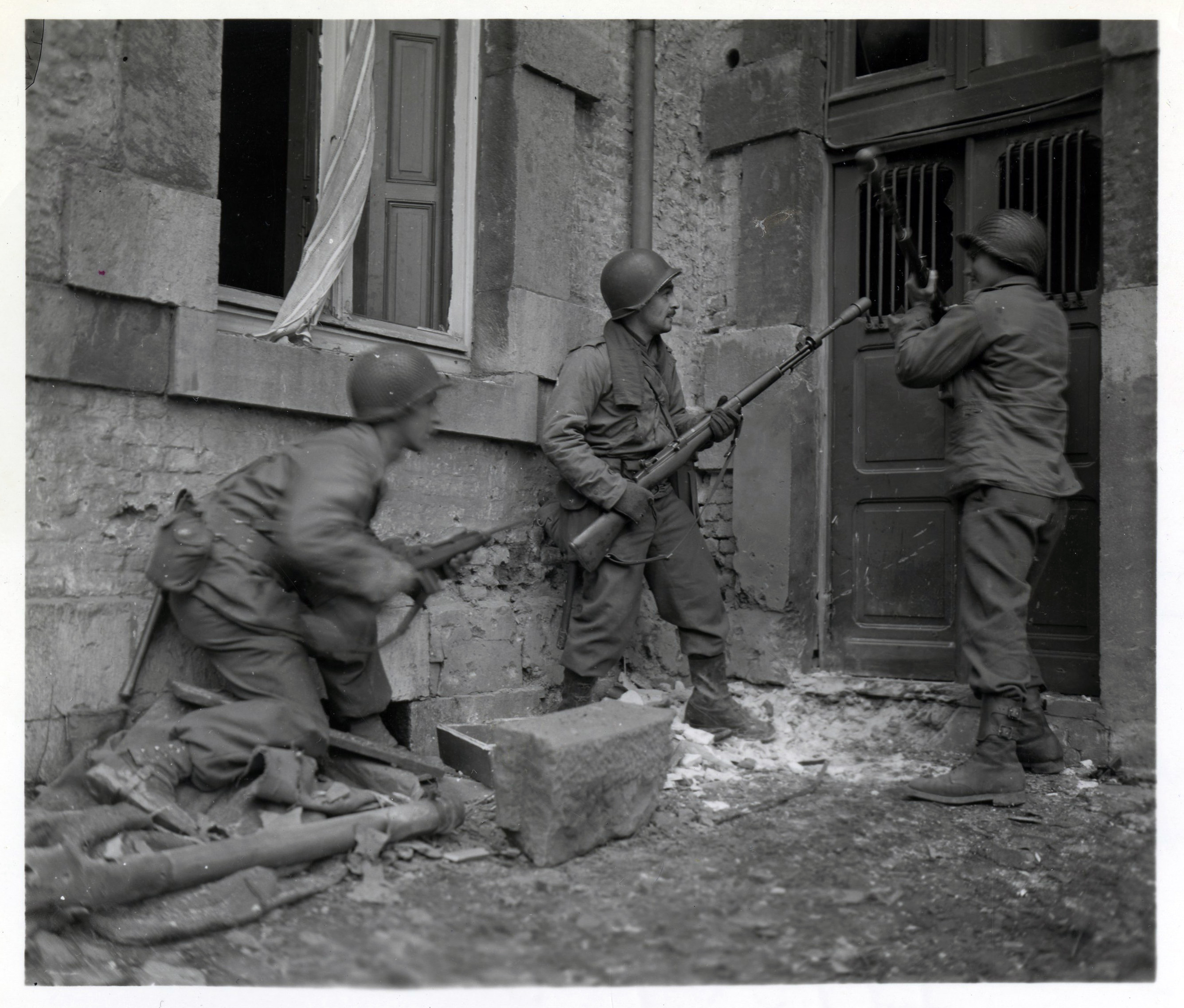
Soldiers of the 30th Infantry Division hunt an SS sniper in Stavelot, Belgium. 24 December 1944.
Changing the maps makes these different scenarios than the originals, even more so than the rules updates (as the latter still fall within the logic of Panzer Grenadier). That meant developing them all over again, which is never a simple task, but at least in this case I had a framework from which to work. They’re all designed by Mike Perryman, which made the task considerably easier; his work is always fundamentally solid. I did my reading, and re-wrote all of the scenario text (introductions and conclusions), too.
All of the scenarios take place, like the core Elsenborn Ridge game, during the Battle of the Bulge. I went with five chapters for the 23 scenarios; the slices of the campaign fell into five segments pretty logically. The battle game (or chapter) structure also makes the individual scenarios much easier to design, at least by my way of thinking. As designer or developer, you have to conceive of the individual action as part of a larger, continuing story. And once you have the concept of the broader story in mind, then the individual scenario becomes an exercise in fitting the action where it belongs. The state of the units involved (morale, prior losses, etc.), their objectives, their previous encounters with the enemy, and where they will go next: all of that should come together when you build the bigger picture. I have a drive to know that bigger picture, so even though the story-arc format demands a lot of research, it’s the sort of knowledge that I would find just as necessary to design a single scenario. And to me, the broader canvas, the ability to tell a story over multiple scenarios instead of just one, is quite liberating.
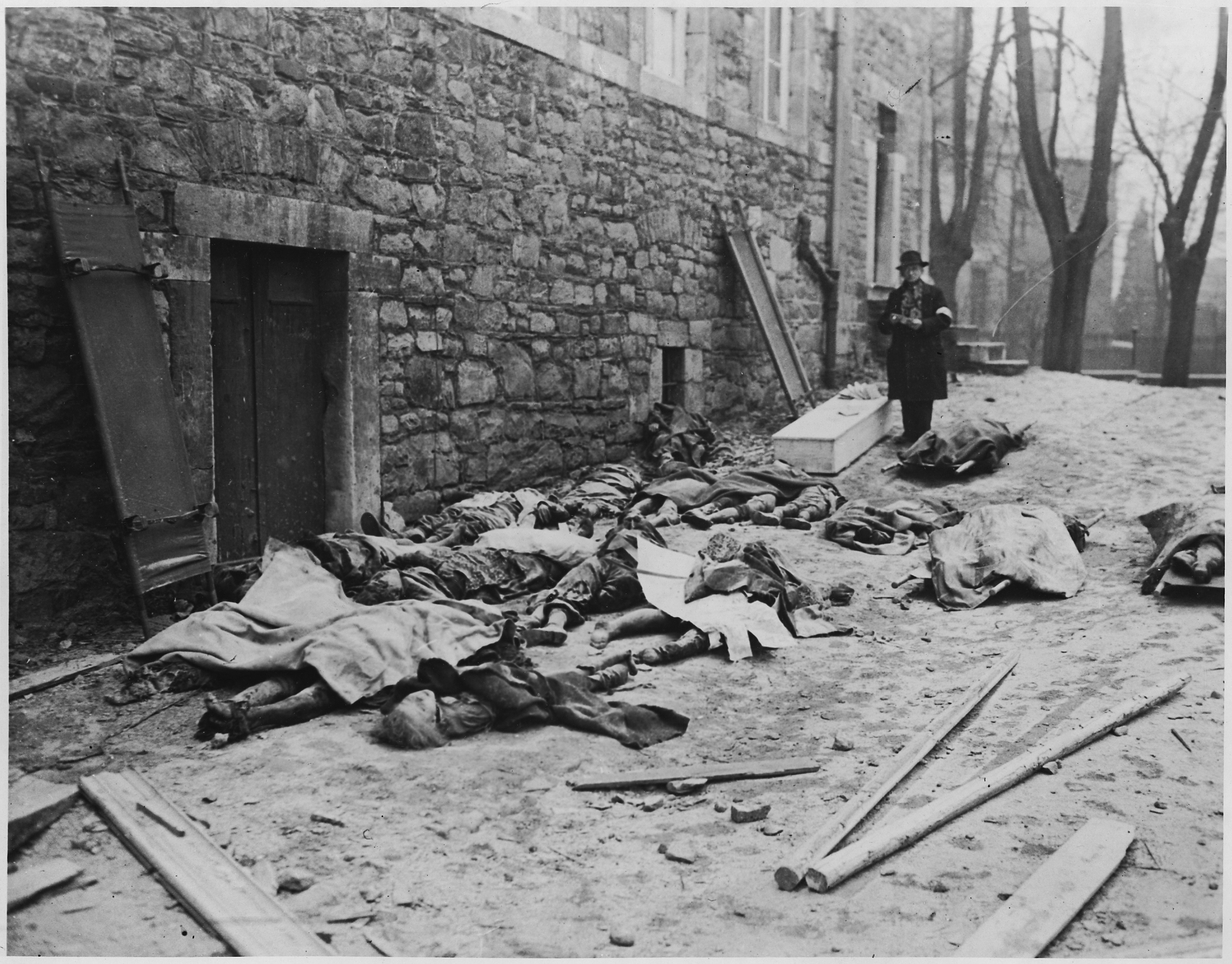
Nineteen Belgian civilians, mostly women and children, murdered by the Aryan heroes of Battle Group Peiper.
So anyway, Snowstorm of Steel. The first chapter is also the largest, seven scenarios drawn from the doomed rampage of the SS party militia’s Battle Group Peiper. It turns out that when you base your battle plans around not having much of a plan beyond gathering lots of high-testosterone Frontkämpfer (warfighters) and leaving out those sissy logistics and map-reading and engineering types, wars don’t tend to end well. In short, Joachim Peiper was a bumbling fool. But he bumbled along with lots of firepower and with fanatic militia who possessed a great deal of tactical combat experience. And that made them, despite the buffoonery at the top, an extremely dangerous opponent. We have a new game that also looks at these events, Ardennes 1944. Ardennes 1944 examines the story much more closely than in Snowstorm of Steel.
The second chapter shifts the point of view to the U.S. Army’s 30th “Old Hickory” Infantry Division. A National Guard outfit from Tennessee and North Carolina, they had fought and defeated the SS 1st Panzer Division in Normandy four months earlier, and now they proceeded to do it all over again. Peiper had taken all of the division’s tanks with him, and all of its armored personnel carriers, which left the Life Guard Division short of combat power, but with plenty of support units (since Peiper had left those guys behind). So now we get four more scenarios of SS-stomping. It’s a beautiful thing.
Next, Chapter Three shifts to the Lucky Seventh, the U.S. 7th Armored Division. In these five scenarios, they’re matched up with the 2nd SS “Empire” Panzer Division. These militiamen still have their tanks, and don’t have Peiper, which makes them a potent adversary. They still share the weak planning and organization of SS outfits: traffic jams, needed units in the wrong place, shortages of fuel and ammunition and so on. The Lucky Seventh is a good but not great formation; in the Ardennes, they did their job.
Chapter Four beings us to the 35th “Santa Fé” Infantry Division (if all those other books and games give SS divisions their precious nicknames, then we’re going to use them for American divisions). There are just three scenarios this time, all from the last two days of December, as the Guardsmen from Kansas, Nebraska, and Missouri kick around a variety of German units. The Germans have lost their ill-omened gamble, and the Americans are now making them pay for it.
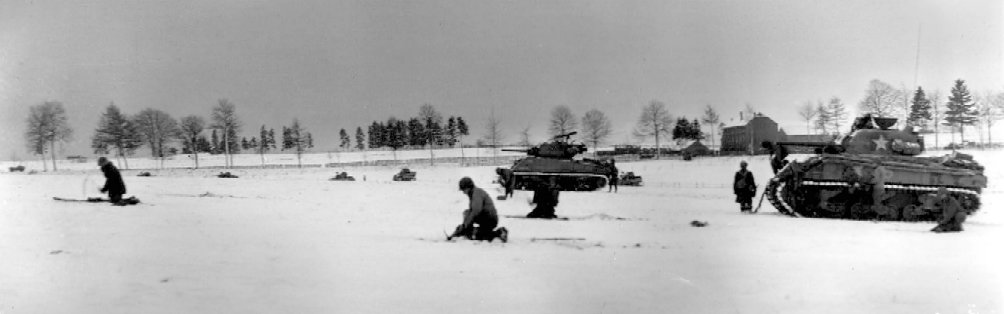
Sixth Armored Division armored infantry and tanks preparing to attack. South of Bastogne, 31 December 1944.
And we conclude with a chapter devoted to a supposedly sad sack American outfit, the 6th “Super Sixth” Armored Division. The Super Sixth might not have been very super, but they were better than their reputation, and in the early days of January they get four scenarios to prove it against the juvenile war criminals of the Hitler Youth.
And that’s what you get in Snowstorm of Steel. It’s a scenario-heavy book, as compared to our usual Campaign Study pattern. For a sweet low price, you can extend your Elsenborn Ridge fun by more than half as much as the original. Not a bad deal.
Order Snowstorm of Steel Here.
Snowstorm of Steel is also available as a digital download. This is not a physical product (you’ll get a .pdf microseconds after completing your order):
Download Snowstorm of Steel Here.
It’s $16.99, but if you’re a Gold Club member, you can download for $11.89 using your private Gold Club link (That’s the only way to claim your Gold Club discount).
Sign up for our newsletter right here. Your info will never be sold or transferred; we'll just use it to update you on new games and new offers.
Mike Bennighof is president of Avalanche Press and holds a doctorate in history from Emory University. A Fulbright Scholar and NASA Journalist in Space finalist, he has published a great many books, games and articles on historical subjects; people are saying that some of them are actually good.
He lives in Birmingham, Alabama with his wife and three children.
Daily Content includes no AI-generated slop or third-party ads. We work hard to keep it that way, and that’s a lot of work. You can help us keep things that way with your gift through this link right here.
|