| Snowstorm of Steel:
Scenario Preview, Part One
By Mike Bennighof, Ph.D.
June 2025
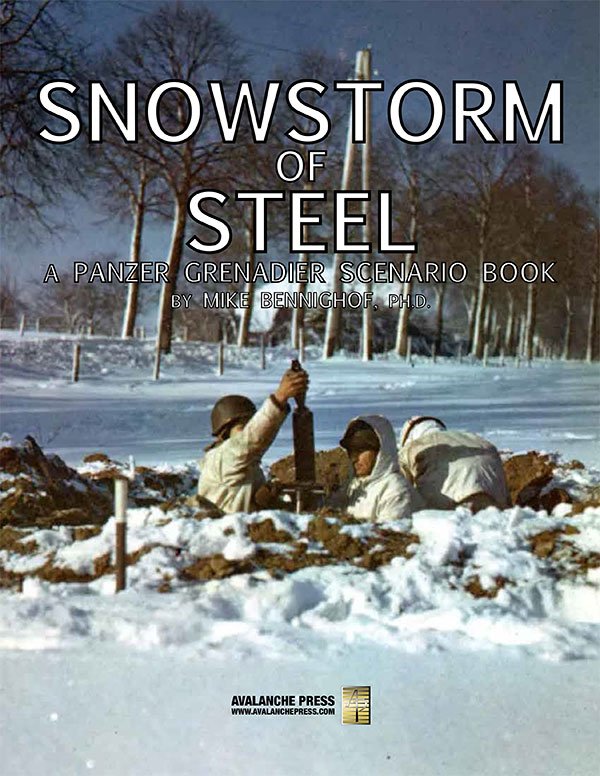 A long time ago, we released a Panzer Grenadier scenario book called Winter Soldiers. It had scenarios for Elsenborn Ridge and the long out-of-print Battle of the Bulge game, and a lengthy, convoluted campaign game that I greatly doubt was ever played. A long time ago, we released a Panzer Grenadier scenario book called Winter Soldiers. It had scenarios for Elsenborn Ridge and the long out-of-print Battle of the Bulge game, and a lengthy, convoluted campaign game that I greatly doubt was ever played.
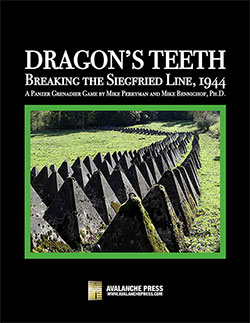
Snowstorm of Steel takes those scenarios, re-works them to use only games that are currently in print (Elsenborn Ridge, Dragon’s Teeth and 1940: The Fall of France) and to conform to the 4th edition series rules. Since that means changing the maps and pieces for many of them, they’re pretty much new scenarios. I did not develop them the first time around, so I did my reading and re-wrote the intros and conclusions, too.
This first chapter is all about the SS Battle Group Pieper. They’ve gotten a lot of ink over the years, and a great many portrayals in wargames. But they lasted in combat for less than a week, and were wiped out except for a few hundred remnants who staggered back to German lines without their weapons or vehicles.
The Armed SS was not a branch of the German Armed Forces. They were the Nazi Party’s militia, declared a criminal organization in the 1946 Nürnberg trials, and they’re properly identified as such throughout in Snowstorm of Steel. Let's have a look at the first chapter, seven scenarios of this criminal band’s destruction.
Chapter One
A Touch of Evil
The northern flank of the German Ardennes offensive would be spearheaded by a battle group of the 1st SS Panzer Division, led by Col. Joachim Peiper. Peiper had about 4,800 hardened war criminals under his command, with 117 tanks and assault guns including the dreaded Royal Tiger heavy tank, and plenty of artillery support behind him. Following their first large-scale encounter with American troops, at Honsfeld on 17 December, they massacred 19 unarmed American prisoners of war who had surrendered. They would continue with the killing spree throughout the makeshift unit’s brief existence.
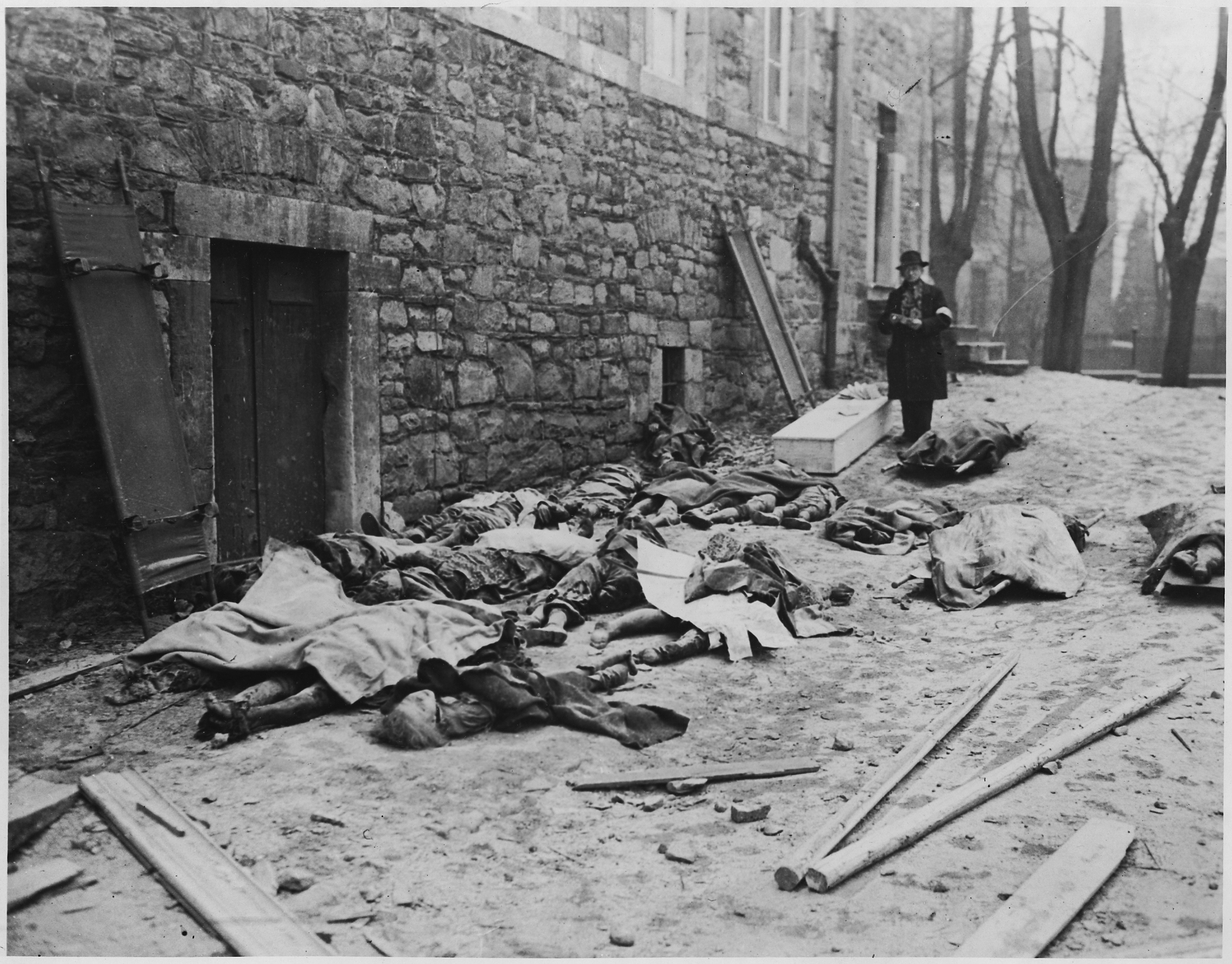
Nineteen Belgian civilians, mostly women and children, murdered by the Aryan heroes of Battle Group Peiper.
Peiper’s battle group included about 20 of the big Tiger tanks, plus 45 Panther tanks. He had a battalion of mechanized infantry riding in halftracks, parts of armored recon and engineer battalions, assault guns, anti-aircraft batteries, and combat engineers. Plus, a large supply echelon.
Peiper had the task of quickly reaching the Meuse River, rushing through breakthroughs made by the 12th People’s Grenadier Division. The narrow roads in his sector could not accommodate the 70-ton Royal Tiger (something the battle group commander should have known before the operation began, but the SS (the Nazi Party militia, and not an element of the armed forces) was not noted for careful planning.
Peiper instead counted on sheer firepower and weight of numbers to reach his objective. The American units standing in his way disagreed.
Scenario One
The Fuel Depot at Büllingen
17 December 1944
Much like the Austro-Hungarian plan for their offensive along the Piave River in the summer of 1918, the German plan in the Ardennes called for the panzer spearheads to sustain themselves with captured enemy fuel. Interrogation of those prisoners not murdered in Honsfeld revealed the presence of an American fuel depot in Büllingen. Peiper directed his battle group to capture it as quickly as possible.
Conclusion
An independent engineer battalion tried to halt the oncoming Nazis, and had some success before enemy numbers overwhelmed them. Battle Group Peiper captured about 250 American soldiers in and around Büllingen, murdering 50 of them and putting the remainder to work pouring American gasoline into German tanks. Those men were sent to the rear under guard, and Peiper continued his advance.
Notes
The SS may be the vile dregs of humanity, but they do know how to fight and they are very well-armed. The damned engineers have a simple task: to hang on as best they can, for no help is on its way. It’s not nearly so simple.
Scenario Two
Fumbled Chance at Stavelot
18 December 1944
Peiper’s forward elements arrived at the heights east of Stavelot, on the Amblève River, as night fell on the 17th. Its importance lay in the stone bridge over the river. Peiper had no Army experience or training, having only served in the SS party militia. He stopped for the night, later offering the transparent excuse that American tanks blocked his way while their infantry worked around his flanks. His subordinates disagreed, stating that the Americans were withdrawing. Peiper finally attacked in the morning, after American reinforcements had rushed into the town.
Conclusion
American engineers had wired the bridge over the Amblève for demolition, but failed to set them off when the Germans started crossing thanks to their scrambled command structure. The American armored infantry and engineers fought fiercely for Stavelot over several hours of brutal house-to-house combat, finally giving way by mid-morning once the huge Royal Tigers arrived to shake the inexperienced Americans’ morale. The best chance to stop the rampage had been lost.
Notes
It’s not a very large scenario; the Germans must secure Stavelot and its bridge, and motor on to death and/or glory. The Americans don’t have a lot of force, but even so they have to stop them.
Scenario Three
Back to Stavelot
19 December 1944
Once again displaying his amateur’s approach to war, Peiper failed to leave anyone behind in Stavelot to secure his lines of communications. The Tennessee National Guardsmen of the 30th “Old Hickory” Infantry Division snatched the opportunity and attacked Stavelot, initially held only by a few stragglers trying to catch up with Peiper. As German reinforcements arrived, fighting raged through the town.
Conclusion
By noon the Americans held all of Stavelot save for a few houses at the western edge. Most importantly, they had finally blown up the bridge over the Amblève: the Americans had blundered on the previous day by waiting for orders to set off the explosives, and now the SS militia returned the favor by leaving the demolition charges in place. Heavy artillery fire ravaged an attempted German counter-attack, and over 1,000 German corpses littered the banks of the Amblève by day’s end. Peiper and his battle group were now isolated.
Notes
The Americans start out with numbers, but the Germans have nearby reinforcements (already on the map) who can quickly interfere with the drive on the bridge hex. This is no small task for the Tennessee Volunteers, but they do have good artillery support.

American infantrymen walk past one of Peiper’s Royal Tiger heavy tanks, abandoned east of La Gleize.
Scenario Four
Frontal Assault at La Gleize
21 December 1944
Peiper, now trapped with American forces pressing in from all sides, made the village of La Gleize a miniature fortress and a key to his position as the SS militia group hunkered down and waited for rescue. He still had heavy tanks that would shred the American Shermans, and so Major K.T. George of the 3rd “Spearhead” Armored Division sent his armored infantry forward on foot as his task force’s spearhead.
Conclusion
Even in a support role, the Shermans proved vulnerable to long-range German anti-tank fire, and McGeorge’s task force quickly lost two of its tanks before the armor pulled back. McGeorge lacked enough infantry to take the town head-on, and a flanking attempt likewise failed. For the moment, the SS would retain their fortress.
Notes
Neither side has a great deal of force, but the Americans do have good artillery support, while the Nazis have none. However, the bad guys do have a Panther tank that can shoot up those road-bound Shermans.
Scenario Five
The Final Reserve
22 December 1944
As the American divisions steadily pressed Peiper’s battle group into a smaller and smaller area, all while pouring down artillery fire on the trapped Nazis, Peiper made the rather foolish decision to commit his reserves to widening the pocket rather than retaining them for a potential breakout. His small strike force, hampered by lack of fuel, set out for the village of Les Tscheous.
Conclusion
The 30th Infantry Division reported that they drove off the Germans with heavy casualties, employing only artillery fire. VII Corps had temporary operational control of the division, which still formally belonged to XIX Corps, and between them it’s unclear whether additional American reinforcements helped secure the village from Nazi attack.
Notes
This is a rather small scenario. The Germans don’t have a whole lot of force to accomplish their mission, though they do have a tank; the Americans just have to fend them off and count on their artillery.
Scenario Six
Crushing the Viper
23 December 1944
With Peiper’s role in massacres of both prisoners of war and Belgian civilians now well-known to American front-line troops, the GI’s pressed forward relentlessly to eliminate his battle group. Two infantry battalions with armor support advanced on La Gleize from the west, while the Spearhead Division’s Task Force McGeorge struck the town from the north and east.
Conclusion
Fighting like the desperate, cornered rats that they were, the SS militia repulsed the Americans at La Gleize, but they could not stop the Americans from linking up to the south and completely isolating the battle group. An increasingly panicked Peiper begged for permission to break out, but was told to stand his ground.
Notes
Now this one. This one is a big, fat scenario, with the attackers having to slog through the snow and the defenders unable to move all of their tanks since they set off without enough gasoline. The Americans have plenty of Nazi-blasting artillery, and they Nazis have the temporary courage of desperation.
Scenario Seven
The Last Stand of Battle Group Peiper
23 December 1944
With the hated SS trapped and vulnerable, 3rd Armored Division’s aggressive commander, Maurice Rose, pressed McGeorge to clear Les Tscheous of Nazis for good, and press on to join the 30th Infantry Division at La Gleize. The village had already been cleared of the enemy at least once, and they had filtered back in. This time, McGeorge determined, they would be ejected for good.
Conclusion
The small village changed hands multiple times, as the Americans pressed their attack but the Nazis kept counter-attacking. The SS tankers now burned their last carefully-husbanded stocks of fuel to bring their armor into action, and when night fell, they still kept a foothold in Les Tscheous. Once the darkness became complete, the Nazis abandoned their weapons and vehicles to flee eastward on foot.
Notes
One last chance to make Nazis cry. It’s just a small scenario, and while there are not many Nazis, neither has Rose given McGeorge much with which to work. It’s just a small battalion-sized task force, but the Americans do have artillery on their side. They’re going to need it.
And that’s all for Chapter One. Next time: Chapter Two.
Order Snowstorm of Steel Here.
Snowstorm of Steel is also available as a digital download. This is not a physical product (you’ll get a .pdf microseconds after completing your order):
Download Snowstorm of Steel Here.
It’s $16.99, but if you’re a Gold Club member, you can download for $11.89 using your private Gold Club link (That’s the only way to claim your Gold Club discount).
Sign up for our newsletter right here. Your info will never be sold or transferred; we'll just use it to update you on new games and new offers.
Mike Bennighof is president of Avalanche Press and holds a doctorate in history from Emory University. A Fulbright Scholar and NASA Journalist in Space finalist, he has published a great many books, games and articles on historical subjects; people are saying that some of them are actually good.
He lives in Birmingham, Alabama with his wife and three children.
Daily Content includes no AI-generated slop or third-party ads. We work hard to keep it that way, and that’s a lot of work. You can help us keep things that way with your gift through this link right here.
|