Linienschiffe 1919:
The New German Ships, Part One
by Mike Bennighof, Ph.D.
December 2025
 Even as the Great War strained Imperial German industry’s capacity to provide weapons, ships, and submarines, the Navy’s admirals dreamed of new and ever-greater battleships and battle cruisers. Young naval architects employed on this vital war work could be spared from conscription and assignment to the trenches, and so the German Admiralty’s Construction Bureau, much like its counterparts in other warring powers, kept the drawing boards filled with fantasy projects. Even as the Great War strained Imperial German industry’s capacity to provide weapons, ships, and submarines, the Navy’s admirals dreamed of new and ever-greater battleships and battle cruisers. Young naval architects employed on this vital war work could be spared from conscription and assignment to the trenches, and so the German Admiralty’s Construction Bureau, much like its counterparts in other warring powers, kept the drawing boards filled with fantasy projects.
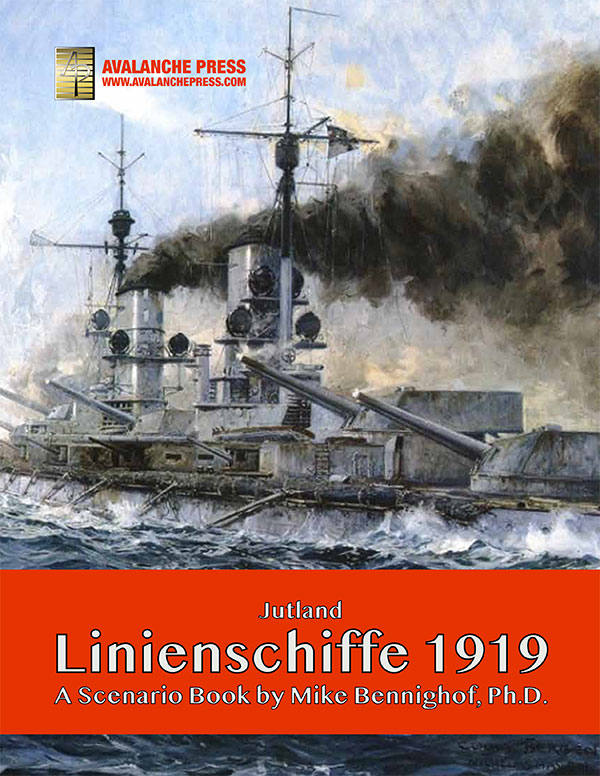
Jutland: Linienschiffe 1919 is focused on these drawing-board battleship and battlecruiser projects, allowing you to add them to the High Seas Fleet (and give the British Grand Fleet a few additions as well). The book includes new and powerful dreadnoughts, battle cruisers, fast armored cruisers, light cruisers and destroyers for the High Seas Fleet and the Grand Fleet. Let’s have a look at them.
The Fast Battleship

Since taking over as Navy State Secretary in June 1897, Alfred von Tirpitz had insisted on keeping large cruisers separate from battleships, since their funding came from separate appropriations. As battleships gained speed and “great cruisers” (what the German Navy called its battle cruisers) gained guns and armor, they appeared headed toward a merger. Perhaps, some naval writers suggested, the fleet needed only one type.
Tirpitz fought furiously to keep the “Type Question” from even being raised. He went to the extremes of rejecting designs for battle cruisers that added more guns at minimal cost in price or performance, to keep them distinct from battleships. That continued until his forced retirement in March 1916; just over a month later, the Construction Bureau presented drafts for a battleship similar to the then-new Bayern class, with the same armor and armament but long with six additional boilers to provide a speed of 26 knots. This would be labelled design L1 (L for Linienschiff).
An alternative fast battleship design, L3, got her extra horsepower from larger boilers rather than additional ones, and in a radical break from previous German dreadnought design, she would burn oil rather than coal. She would also break with previous practice in her armor scheme, adding a thick armored deck (at the cost of an extra 4,600 tons’ displacement).
We’ve got four of Design L3 in Linienschiffe 1919. They’re exactly as advertised: the same qualities as Bayern, just faster. But they give the High Seas Fleet a fast wing of battleships, though at this point in the evolution of the Imperial German capital ship, there’s no practical difference in combat power between this ship and the new GK1 battle cruiser design presented at the same meeting.
The Triple-Stack

Design L2, presented in the same April 1916 meeting as fast battleship Designs L1 and L3, started with the same hull. For this ship, the architects removed the extra boiler room and added a fifth twin turret for 380mm (15-inch) guns. Her speed dropped to 25 knots.
Unlike most contemporary designs, the additional turret would be placed aft atop a towering armored barbette that allowed it to fire over both stern turrets. The committee
reviewing the designs questioned the slight drop in speed despite the loss of six boilers, and the assertion that this swap would not result in any increase in displacement despite the great height of the new armored barbette. They also insisted to the skeptical admirals of the review board that the triple-stacked turret would not cause stability problems.
The North Sea Monster

Following the June 1916 Battle of Jutland, the High Seas Fleet staff wrote a memo demanding a much more capable new battleship. Germany would never match Britain in terms of total dreadnoughts. Therefore, each new German battleship should be much more powerful than its British counterpart. That meant still-larger guns, thicker armor, and higher speed.
The L20e, presented in August 1917, met the first two of those, but would be slightly slower than the assumed speed of the British Queen Elizabeth class (her design speed of 23.5 knots was actually slightly better than the true speed of the British fast battleships). She would be armed with eight 420mm (16.5-inch) guns, a weapon that did not yet exist. Her belt armor and internal protection would be similar to Bayern, but she would have much thicker deck armor, as she would be expected to engage her enemies at a much greater range than previously foreseen.
Four examples of the ultimate Linienschiff appear in Linienschiffe 1919. They are formidable fighting ships. Almost as formidable as the new British Nemesis class.
Last of the Iron Dogs

The Imperial Admiralty knew that Senior Naval Architect Hans Hüllman had produced an extraordinary design with the battle cruiser Derfflinger, and the next three classes all followed the same pattern, the ships steadily enlarged to carry ever-larger guns. The four-ship Mackensen class would have had eight 350mm (13.8-inch) guns, and the next class of three ships (sometimes called the Ersatz Yorck class in secondary works, but the ships never received formal names), authorized in April 1915, would move up to the 380mm (15-inch) guns carried by the Bayern-class dreadnoughts. This would, not coincidentally, violate the old Tirpitz principle of arming great cruisers with smaller or fewer guns than those of the contemporary dreadnought class.
Tirpitz had sought to build one battle cruiser equivalent for each new class of dreadnoughts. That applied to the Mackensen class as well, but with Eduard Capelle’s elevation to Navy State Secretary in March 1916, the admirals saw an opportunity to order a full class of four great cruisers at once.
In April 1916, the Construction Bureau presented three new designs for great cruisers (German Navy parlance for battle cruisers) along with the new battleship sketches. All three followed the Derfflinger lineage, outwardly similar to Ersatz Yorck but with variations in their power plant. They likewise carried eight 380mm guns in four turrets, but with a slightly slower design speed of 27 knots. The Admiralty hoped to lay down four of them to follow the Ersatz Yorck trio, but funding never came. They’re included in Linienschiffe 1919 as the Kaiserin Augusta class.
Order Linienschiffe 1919 Here.
Please allow an extra six weeks for delivery.
Sign up for our newsletter right here. Your info will never be sold or transferred; we'll just use it to update you on new games and new offers.
Mike Bennighof is president of Avalanche Press and holds a doctorate in history from Emory University. A Fulbright Scholar and NASA Journalist in Space finalist, he has published a great many books, games and articles on historical subjects; people are saying that some of them are actually good.
He lives in Birmingham, Alabama with his wife and three children.
Daily Content includes no AI-generated content or third-party ads. We work hard to keep it that way, and that’s a lot of work. You can help us keep things that way with your gift through this link right here.
|