9 April 1940
Designer’s Notes
by Mike Bennighof, Ph.D.
December 2025
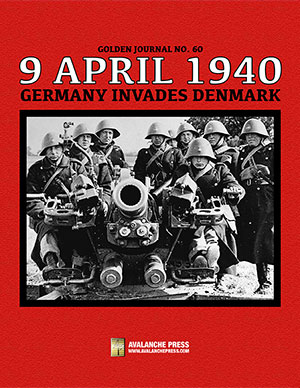 A while back, we offered our Gold Club members the opportunity to sponsor a Golden Journal of their choice. We had some strict parameters: among others, the topic couldn’t offend us, and it had to be something I believed I could create. David Kirk wanted a Panzer Grenadier expansion based on the German invasion of Denmark in April 1940. I decided that I could make this happen, and the project commenced. A while back, we offered our Gold Club members the opportunity to sponsor a Golden Journal of their choice. We had some strict parameters: among others, the topic couldn’t offend us, and it had to be something I believed I could create. David Kirk wanted a Panzer Grenadier expansion based on the German invasion of Denmark in April 1940. I decided that I could make this happen, and the project commenced.
The Six Hour War didn’t even last a full six hours, but the scattered acts of resistance have become vital to Danish national identity in the more than eight decades since. That made for challenging research: there’s a lot of embroidery on the Danish side, at least in the very limited historiography that exists in English and German. And descriptions of the Royal Danish Army often rely on the German Army’s account, in turn based on records they seized when overthrew the Danish government in August 1943 and took full control of the kingdom. But the story’s there, with some digging, even if it is mostly in Danish.
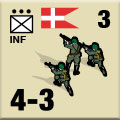 The Danes defended their neutrality during the 1914-1918 war with a large army, considering the kingdom’s wealth and population, equipped with relatively modern arms. By 1939, the army had been greatly reduced in size, and still wielded many of the same weapons. Those reductions meant few opportunities for promotion, and Danish officers were at least a decade older than their German peers of similar rank. Denmark was a poor, primarily agricultural country, but even so, the army and the small military-industrial complex did evince some glimmers of innovation. The Danes defended their neutrality during the 1914-1918 war with a large army, considering the kingdom’s wealth and population, equipped with relatively modern arms. By 1939, the army had been greatly reduced in size, and still wielded many of the same weapons. Those reductions meant few opportunities for promotion, and Danish officers were at least a decade older than their German peers of similar rank. Denmark was a poor, primarily agricultural country, but even so, the army and the small military-industrial complex did evince some glimmers of innovation.
One battalion, the Fourth, had been mounted on bicycles and a handful of motorcycles (plans to put a full company on motorcycles had not been realized when the Germans made their move). The Danes based their experiment on Dutch and Swedish developments, and since Denmark isn’t very large, the Danes hoped that their bicycle troops could deploy quickly to the battlefield. It’s probably not a coincidence that all three of those armies saw no action in the Great War, but the bicycle troops did most of the fighting in 1940.
The Danes had bought enough Bofors 37mm anti-tank guns to equip all of their regiments with anti-tank companies. That met the standard for armies of 1940, and the guns themselves were perfectly adequate to combat the German panzers. During the brief war the anti-tank gunners saw limited action, though those who did engage the Germans did so with extreme bravery.
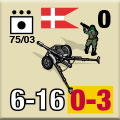
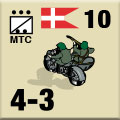
 Instead, the Danes relied on their 20mm autocannon. There’s an accurate depiction of the autocannon in action in the 2015 Danish war movie April 9th (in which Euron Greyjoy from Game of Thrones leads a platoon battling the invaders). The Danes mounted the weapon on motorcycles, which looks cool and innovative in period photos, but the recoil shifted the entire vehicle and automatic firing would have been pretty dicey. The idea was that the autocannon would be removed from the motorcycle and fired from the ground, and there it proved pretty effective as the Danes used it both as an anti-tank gun and a massively oversized heavy machine gun with an epic muzzle flash. Instead, the Danes relied on their 20mm autocannon. There’s an accurate depiction of the autocannon in action in the 2015 Danish war movie April 9th (in which Euron Greyjoy from Game of Thrones leads a platoon battling the invaders). The Danes mounted the weapon on motorcycles, which looks cool and innovative in period photos, but the recoil shifted the entire vehicle and automatic firing would have been pretty dicey. The idea was that the autocannon would be removed from the motorcycle and fired from the ground, and there it proved pretty effective as the Danes used it both as an anti-tank gun and a massively oversized heavy machine gun with an epic muzzle flash.
The Danes would claim a dozen German armored cars and four tanks knocked out; 20mm autocannon accounted for most of those (the others fell to 37mm Bofors fire). DISA, the manufacturer, would claim that their cannon killed 200 Germans (this is not likely to be true) when they tried to sell it to the Wehrmacht. Surprisingly, their pitch was not warmly received.
 The autocannon was only effective in the very narrow time and place of the German invasion of Denmark. The Germans did lead with armor, but it was decidedly third-rate armor: open-topped armored cars and Panzer I tankettes, with a handful of Panzer II light tanks. All of them were in theory vulnerable to the 20mm rounds, though the Danes had more success shooting out their tracks first and then going after the crew when they bailed out. The autocannon was only effective in the very narrow time and place of the German invasion of Denmark. The Germans did lead with armor, but it was decidedly third-rate armor: open-topped armored cars and Panzer I tankettes, with a handful of Panzer II light tanks. All of them were in theory vulnerable to the 20mm rounds, though the Danes had more success shooting out their tracks first and then going after the crew when they bailed out.
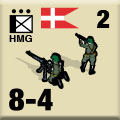
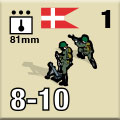
The Danes did not employ a true heavy machine gun, using their domestically-produced Madsen light machine guns on tripods for the heavy role. They did not have a light mortar, and their 81mm tubes never came into action. Danish and German accounts describe the Danes fighting with determination, and there are no tales of Danes panicking in the face of German armor. Danish accounts at times border on hagiography, but on this score there’s little reason to doubt them.
 I gave over most of the Journal’s small page count to the story of the campaign, and the structure, order of battle and weaponry of the Royal Danish Army, plus a look at the corps-sized German invasion force which was spearheaded by a unique and short-lived formation, the 11th Motorized Rifle Brigade. I gave over most of the Journal’s small page count to the story of the campaign, and the structure, order of battle and weaponry of the Royal Danish Army, plus a look at the corps-sized German invasion force which was spearheaded by a unique and short-lived formation, the 11th Motorized Rifle Brigade.
That left room for four scenarios, all of them quite small, and all based on actual battles waged during the Six-Hour War. I decided to accept at least some of the Danish view of their own bravery; it’s pretty clear that no one ran away in their first encounter with armored vehicles, something even the legendary Finns can’t claim. What makes this remarkable, to me anyway, is that while the Fourth Battalion came from Odense, in the Danish islands well away from the frontier, the other battalions that saw combat (Third Infantry and First Pioneer) were local boys. The border region had been part of Germany until 1920, and many of these soldiers’ fathers fought for the Kaiser in the Great War.
 In the Journal’s game scenarios, the Danes are determined, they have adequate leadership, and their weaponry is, well, adequate. Their infantry firepower is less than that of the Germans, but they do have their autocannons. The Danes are no pushover. Except that they are very few. In the Journal’s game scenarios, the Danes are determined, they have adequate leadership, and their weaponry is, well, adequate. Their infantry firepower is less than that of the Germans, but they do have their autocannons. The Danes are no pushover. Except that they are very few.
The Germans are on their way to becoming the army that knocked off France in six weeks. They’ve learned many lessons from the Polish campaign: they have the initiative, morale to match that of the Danes, better leadership and much more firepower. They also have armor, though here they have mis-calculated, thinking that their tin-clad armored cars and tankettes will be adequate.
 9 April 1940 is the sort of thing I want to create and publish. It’s deeply researched in primary sources. The internet does have a few positive aspects, making Danish primary documents available, with AI to aid in translations but not actual research, since the robot tends to fantasize. A lot. When it can’t find information easily – and you’re not going to find details of the Six-Hour War easily – it just makes stuff up like a wargame designer relying on video games for “research.” 9 April 1940 is the sort of thing I want to create and publish. It’s deeply researched in primary sources. The internet does have a few positive aspects, making Danish primary documents available, with AI to aid in translations but not actual research, since the robot tends to fantasize. A lot. When it can’t find information easily – and you’re not going to find details of the Six-Hour War easily – it just makes stuff up like a wargame designer relying on video games for “research.”
Could the Danes have held out longer? Yes and no. It would have taken full mobilization of an army the size of the 1918 force, military increases to match population growth, modernization of the Danish artillery, and deployment up on the border behind a fortified line. None of that lay within Denmark’s financial means, and the socialist government had chosen to spend what money it had on housing and health programs. That’s not to portray the Stauning government as a pack of feckless civilians: they and their policies were very popular. The Danish people voted for this military weakness.
But the Germans had a powerful trump card that the Danes could never have countered: overwhelming superiority in the air, and an absolute willingness to deploy it against civilians. The Danish government was not willing to see its people slaughtered in a war that they knew they could not win.
9 April 1940, though a small book as these things go, was a deeply satisfying project to write and design. I think you’ll like it.
Order 9 April 1940 Here.
Sign up for our newsletter right here. Your info will never be sold or transferred; we'll just use it to update you on new games and new offers.
Mike Bennighof is president of Avalanche Press and holds a doctorate in history from Emory University. A Fulbright Scholar and NASA Journalist in Space finalist, he has published a great many books, games and articles on historical subjects; people are saying that some of them are actually good.
He lives in Birmingham, Alabama with his wife and three children.
Daily Content includes no AI-generated content or third-party ads. We work hard to keep it that way, and that’s a lot of work. You can help us keep things that way with your gift through this link right here.
|