9 April 1940
The Germans
by Mike Bennighof, Ph.D.
September 2025
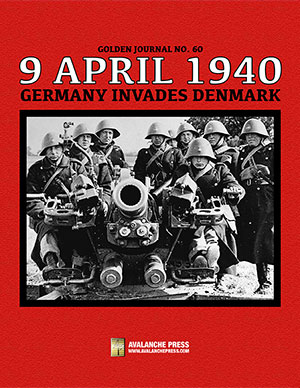 On the German side, the invasion of Denmark would be entrusted to Leonhard Kaupisch, a twice-retired Air Force general brought back into active service for the second time in August 1939. He then commanded an ad hoc corps that bore his name, consisting of several distinctly third-line formations and charged with reducing Polish positions along the Baltic coast. He did not do particularly well in this assignment; Polish troops on the Hel Peninsula were among the very last to give up the fight. On the German side, the invasion of Denmark would be entrusted to Leonhard Kaupisch, a twice-retired Air Force general brought back into active service for the second time in August 1939. He then commanded an ad hoc corps that bore his name, consisting of several distinctly third-line formations and charged with reducing Polish positions along the Baltic coast. He did not do particularly well in this assignment; Polish troops on the Hel Peninsula were among the very last to give up the fight.
Kaupisch brought his headquarters with him, now titled the XXXI Special Purpose Command. He would have the 170th Infantry Division and 11th Motorized Rifle Brigade arrayed along Denmark’s landward border with Germany, and the 198th Infantry Division to occupy the Danish islands. This was more than enough force to overwhelm the depleted Royal Danish Army, but would have needed significant reinforcements to defeat the fully-mobilized Danes. But the Danes had sent most of their men home.
The 170th Infantry Division had been formed in December 1939, a standard unit of the seventh mobilization wave with nine infantry battalions. It would remain in Denmark for the rest of April and May, boarding trains for the Western Front on 31 May and drawing the lucky card of occupation duty in Paris. It fought on the Eastern Front from beginning to end, avoiding annihilation until it was trapped in East Prussia in April 1945.
The 198th Infantry Division formed at the same time, as part of the same mobilization wave. It went to France in June 1940 and to the Eastern Front in April 1941 along with the 170th Infantry Division. It came back to the Western Front in July 1944 and survived long enough to surrender to the Americans in April 1945.
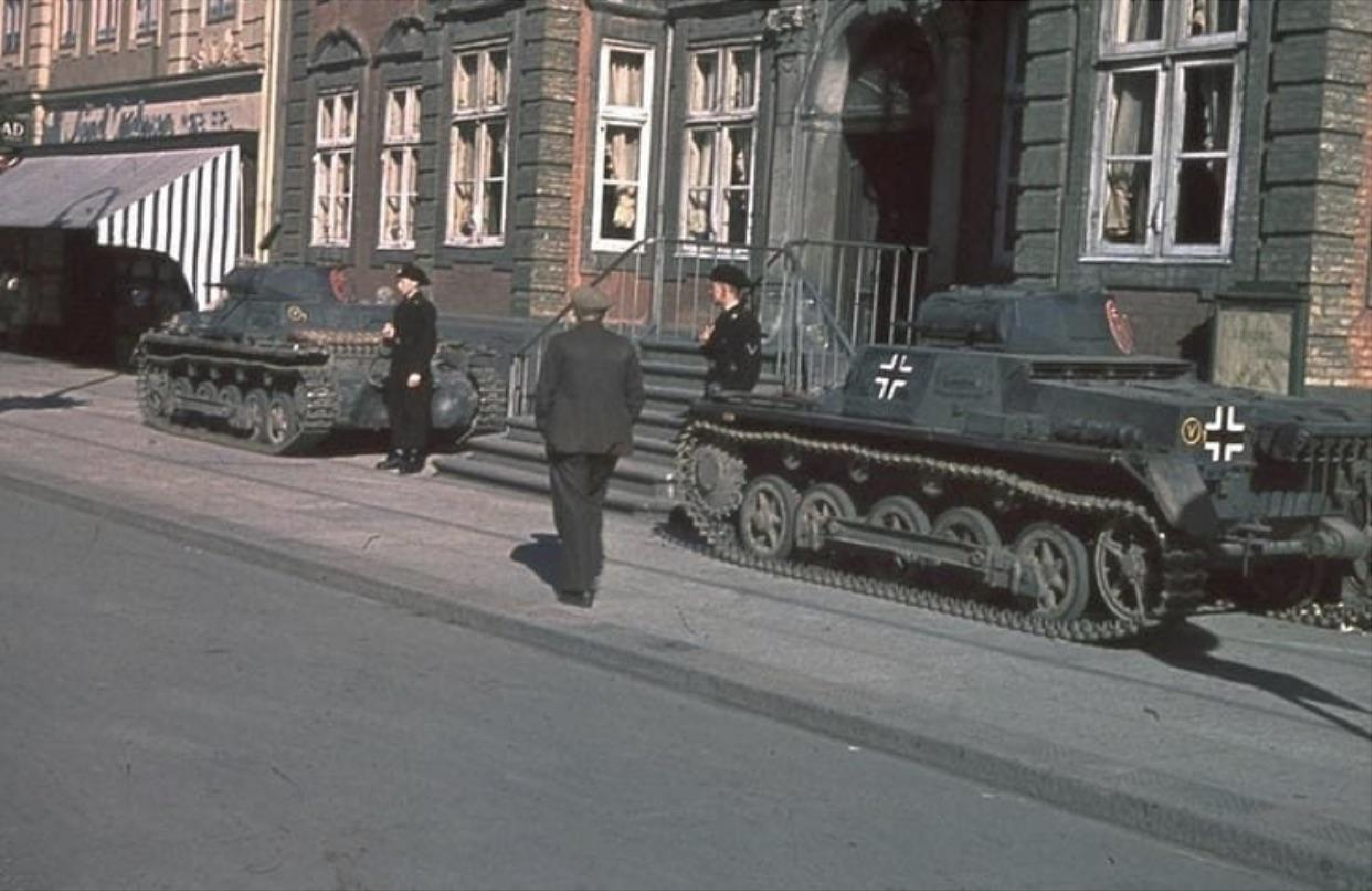
Panzer I tanks of the 40th Special Purpose Battaltion in Horsens, Denmark. April 1940.
The 11th Motorized Rifle Brigade had been organized in December 1939 as an independent formation, commanded by Col. Günther Angern, former commander of the 3rd Panzer Division’s 3rd Rifle Brigade. It was intended to form part of a new 11th Panzer Division, but the German Army did not yet have enough tanks and tankers to give the formation its armored component. German panzer divisions at the time each had slightly different organizations from one another, varying in the exact composition of their infantry component but almost all containing four battalions of tanks.
The 11th Motorized Rifle Brigade included two motorized rifle regiments (110th and 111th), each of two battalions and a motorcycle company. It followed a slightly unusual table of organization; like other German motorized infantry, its battalions had three rifle companies and one heavy company. But the rifle companies appear to have had no heavy machine-gun group, substituting a fourth rifle platoon instead. As in the panzer divisions, each battalion had a platoon of anti-tank guns, without a regimental anti-tank company. In another departure, each regiment, and the brigade headquarters, had an attached armored-car platoon.
In March 1940 the brigade added the 40th Special-Purpose Tank Battalion, with 69 light tanks (42 Panzer I, 21 Panzer II and six Panzer I command tanks). This newly-formed battalion drew one company each from three different panzer divisions.
The 11th Motorized Rifle Brigade also added the 14th Motorized Machine-Gun Battalion at the same time. The battalion had been formed from the 70th Infantry Regiment’s 2nd Battalion in November 1938 as part of the West Wall garrison, a static battalion manning fortified machine-gun positions. In February 1940 it was re-organized as a motorized unit with three machine-gun companies, each with four platoons, with two heavy machine guns in each platoon. The fourth, anti-tank company operated a dozen 37mm anti-tank guns, divided into four three-gun platoons. In all the battalion operated 48 heavy machine guns and a dozen 37mm guns; though motorized, the battalion’s trucks served to carry the loads of weapons and ammunition, not to make it an instrument of blitzkrieg.
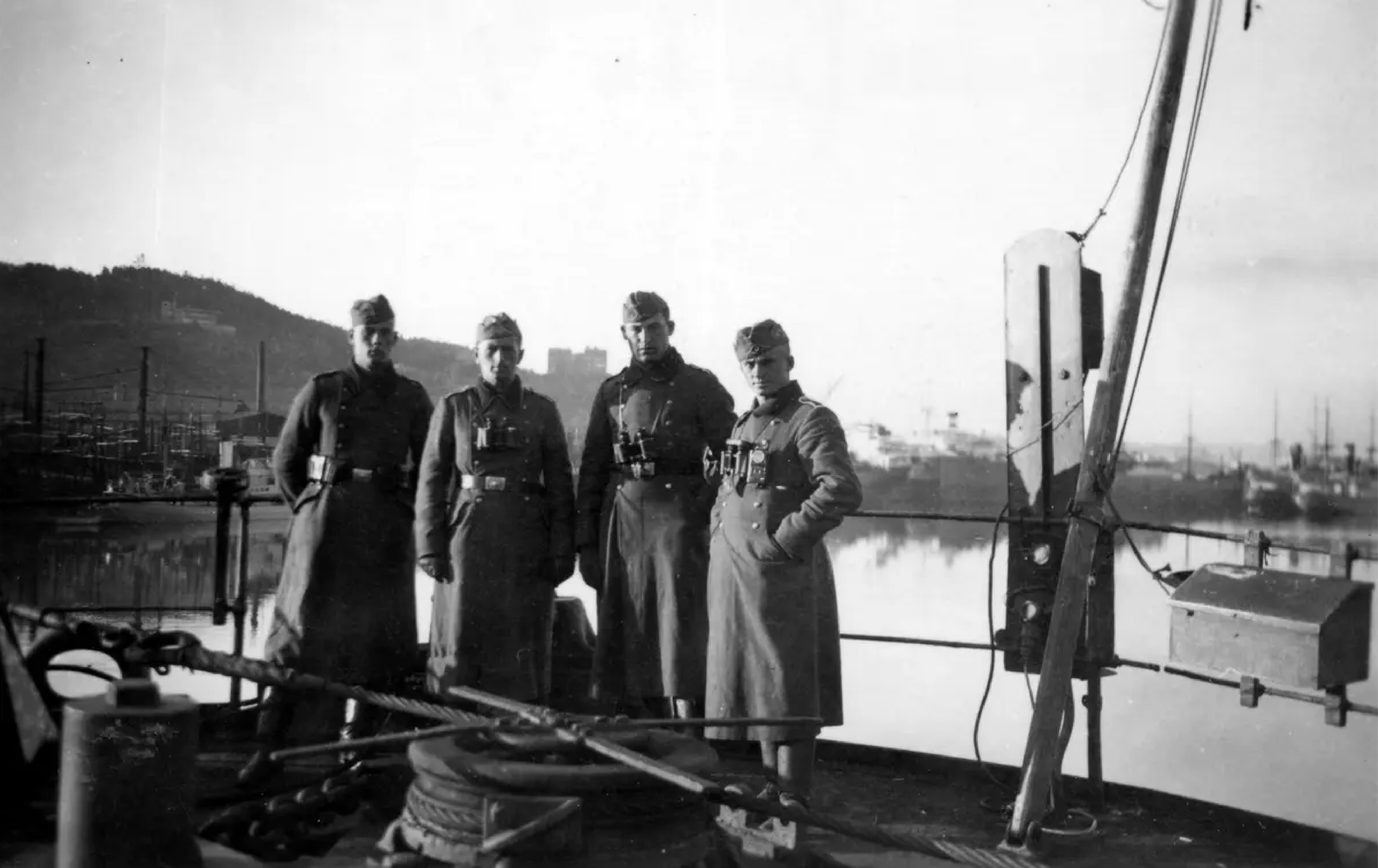
Soldiers of the 1st Company, 14th Motorized Machine-Gun Battalion. Aboard the transport Cortona in Oslo harbor, 27 April 1940.
The 11th Brigade had no artillery of its own; its heaviest weapons were limited to a pair of 75mm infantry guns and six 81mm mortars operated by each battalion. It had no engineers, and a recon element of just one motorcycle platoon (the two motorcycle companies were intended as very fast infantry). It did have its own ambulance platoon, and medical, fuel, transport, and maintenance companies.
What it did have was speed, in no small part thanks to that lack of supporting arms. During the invasion of Denmark, the 11th Motorized Rifle Brigade raced past the Danish units stationed on the border and headed for the airfield at Aalborg in far northern Denmark. German paratroopers had seized the airfield, and a battalion of infantry had been flown in on transport planes to secure their foothold. The 11th Brigade quickly established overland contact, and brought all of Jutland under at least nominal German control within hours.
The brigade would remain in Denmark until 13 May 1940, as the XXXI Special Purpose Command prepared to meet an unlikely but not impossible counter-invasion by the British. When the 160th Static Infantry Division arrived to replace it, the brigade moved on to join the ongoing campaign in France. Though a late arrival to the battlefield, it joined XV Motorized Corps for the 20 May Battle of Arras, and would see much more action in Case Red, the second-phase offensive in France, in the Somme crossing and in Brittany. In August 1940 it received two tank battalions from 5th Panzer Division, additional support units, and a motorized artillery regiment, to become the 11th Panzer Division.
The 40th Special Purpose Tank Battalion, having already sent one company to Norway at the start of the operation (a British submarine sank the transport carrying all but two of them), deployed its two surviving companies to Norway on 20 April. They arrived four days later, and took part in the fighting there. The battalion formed a new 3rd Company with captured French light tanks in the fall, and in the spring of 1941 moved on to Finland for Operation Barbarossa. Usually operating as separate companies, the unit moved to Norway in September 1943 to become part of the newly-formed 25th Panzer Division.
The 14th Machine Gun Battalion likewise moved on to Norway by the end of April, and then in the spring of 1941 went to Finland to participate in Operation Barbarossa. It would be converted to a ski-mounted machine gun battalion in 1944.
Kaupisch did not have a very large force, and it might not have sufficed against even the troops still under the Dannebrog on 9 April 1940, had the Danish government chosen to resist. But in the face of limited opposition, they were enough to complete the task.
Order 9 April 1940 Here.
Sign up for our newsletter right here. Your info will never be sold or transferred; we'll just use it to update you on new games and new offers.
Mike Bennighof is president of Avalanche Press and holds a doctorate in history from Emory University. A Fulbright Scholar and NASA Journalist in Space finalist, he has published a great many books, games and articles on historical subjects; people are saying that some of them are actually good.
He lives in Birmingham, Alabama with his wife and three children. He misses his lizard-hunting Iron Dog, Leopold.
Daily Content includes no AI-generated content or third-party ads. We work hard to keep it that way, and that’s a lot of work. You can help us keep things that way with your gift through this link right here.
|