9 April 1940
Scenario Preview
by Mike Bennighof, Ph.D.
December 2025
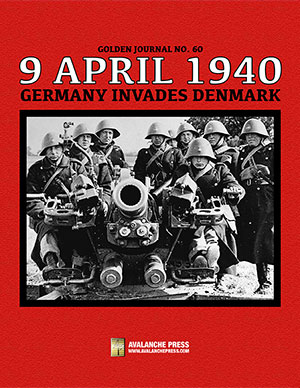 When I undertook to write and design a Golden Journal based on the April 1940 German invasion of Denmark, I knew enough about the campaign to know that I could come up with something. I might have to expand the battles into hypothetical territory, but I could make it work using the maps and German pieces from Road to Dunkirk. When I undertook to write and design a Golden Journal based on the April 1940 German invasion of Denmark, I knew enough about the campaign to know that I could come up with something. I might have to expand the battles into hypothetical territory, but I could make it work using the maps and German pieces from Road to Dunkirk.
The Danes had two battalions on or near the frontier, plus some other elements nearby. They also had a civilian government well aware that the Germans had committed aerial atrocities against Warsaw six months earlier and would have no compunctions about doing the same to Copenhagen. The Danes would not resist the invasion.
The government actually got the word out rather quickly, but fighting had already broken out between those frontier forces and the German invaders. The Six Hour War, as it became known, featured only a handful of skirmishes. But we cover them all in Golden Journal No. 60: 9 April 1940. The Journal has plenty of history, and that left just enough room to include scenarios for all four engagements large enough to be turned into Panzer Grenadier scenarios. Let’s have a look at them:
Scenario One
Firefight at the Crossroads
9 April 1940
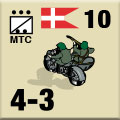 The Danish Fourth Bicycle Battalion’s 1st Company raced, on their bicycles, to grab the strategic crossroads of Bredevad and Korskro before the lead elements of the German 11th Motorized Rifle Brigade could secure them. The Danes were very few, but the Germans had raced ahead of their brigade and didn’t have great numbers, either. But they did have armor, such as it was, which the Danes did not. The Danish Fourth Bicycle Battalion’s 1st Company raced, on their bicycles, to grab the strategic crossroads of Bredevad and Korskro before the lead elements of the German 11th Motorized Rifle Brigade could secure them. The Danes were very few, but the Germans had raced ahead of their brigade and didn’t have great numbers, either. But they did have armor, such as it was, which the Danes did not.
Conclusion
The Danes met the invaders with unexpected Nordic fury, shooting up the first three armored cars that tried to force their position, and then engaging the motorcyclists in a firefight. They destroyed two more armored cars before the Germans outflanked the detachment in Bredevad and all of the Danes withdrew. They soon learned of the cease-fire, and returned to their barracks.
Notes
Like all of the Danish scenarios, this is a small one. The Danes have beaten the Germans to the crossroads town, but only just barely so they’re not dug in yet. They’ve got high morale (same as the Germans) and good leadership (same as the Germans); what they don’t have is any artillery support, any armor, or heavy weapons beyond a motorcycle-mounted autocannon battery.
Scenario Two
Roadblock at Sølsted
9 April 1940
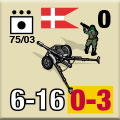 As soon as the alarm came, the Danish Pioneer School mobilized and sent its students and instructors to stop the invaders. Their building skills proved inadequate as their first several attempts at crafting roadblocks failed to keep the German armored cars from just plowing through them. Finally, a rickety structure of long wooden beams and wagons brought the Germans to a halt, right in the line of fire of Danish autocannons. As soon as the alarm came, the Danish Pioneer School mobilized and sent its students and instructors to stop the invaders. Their building skills proved inadequate as their first several attempts at crafting roadblocks failed to keep the German armored cars from just plowing through them. Finally, a rickety structure of long wooden beams and wagons brought the Germans to a halt, right in the line of fire of Danish autocannons.
Note: The Roadblock at Sølsted is depicted on the Roadblock marker in Road to Dunkirk.
Conclusion
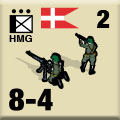 The Germans obligingly rolled up to the roadblock so that the Danes covering it could shoot them, but finally wised up and outflanked it. That forced a cross-country Danish retreat that ended with the cease-fire. But two more armored cars had been claimed by the 20mm autocannons. The Germans obligingly rolled up to the roadblock so that the Danes covering it could shoot them, but finally wised up and outflanked it. That forced a cross-country Danish retreat that ended with the cease-fire. But two more armored cars had been claimed by the 20mm autocannons.
Notes
Another small scenario, this time the Germans are on foot for the most part so the action develops more slowly. They out-number the Danes, and they get some air support. The Danes have their fierce morale and this time two autocannon batteries.
Scenario Three
Autocannons and Panzers
9 April 1940
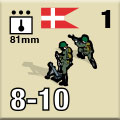 Lt. Col. S.E. Clausen’s 4th Bicycle Battalion, nominally part of the Sjaelland Division, had brought in its reservists and come very close to full strength before the Germans struck. As the only mobile formation in the Royal Danish Army, Clausen’s battalion ended up strung out all along the border region. He put together an ad hoc force from elements of all four of his companies, but before he could decide where to commit it, the Germans came to him. Clausen’s men dug in along a woods line and lined up their trusty autocannons. Lt. Col. S.E. Clausen’s 4th Bicycle Battalion, nominally part of the Sjaelland Division, had brought in its reservists and come very close to full strength before the Germans struck. As the only mobile formation in the Royal Danish Army, Clausen’s battalion ended up strung out all along the border region. He put together an ad hoc force from elements of all four of his companies, but before he could decide where to commit it, the Germans came to him. Clausen’s men dug in along a woods line and lined up their trusty autocannons.
Conclusion
The Danes stood their ground, behind their autocannon fire, until the Germans brought up tanks that, together with their infantry, filtered around the forest position and threatened to surround the defenders. The Danes retreated through the woods and later surrendered when they received the cease-fire order.
Notes
While the Danes actually begin this scenario dug in, they’re quite mobile (if you count bicycle infantry as mobile); everyone who doesn’t ride a bike is motorized. Unfortunately for the forces of good, so are the Germans. Stand in place, or conduct a mobile defense? The Danes stood, but you can try the mobile way.
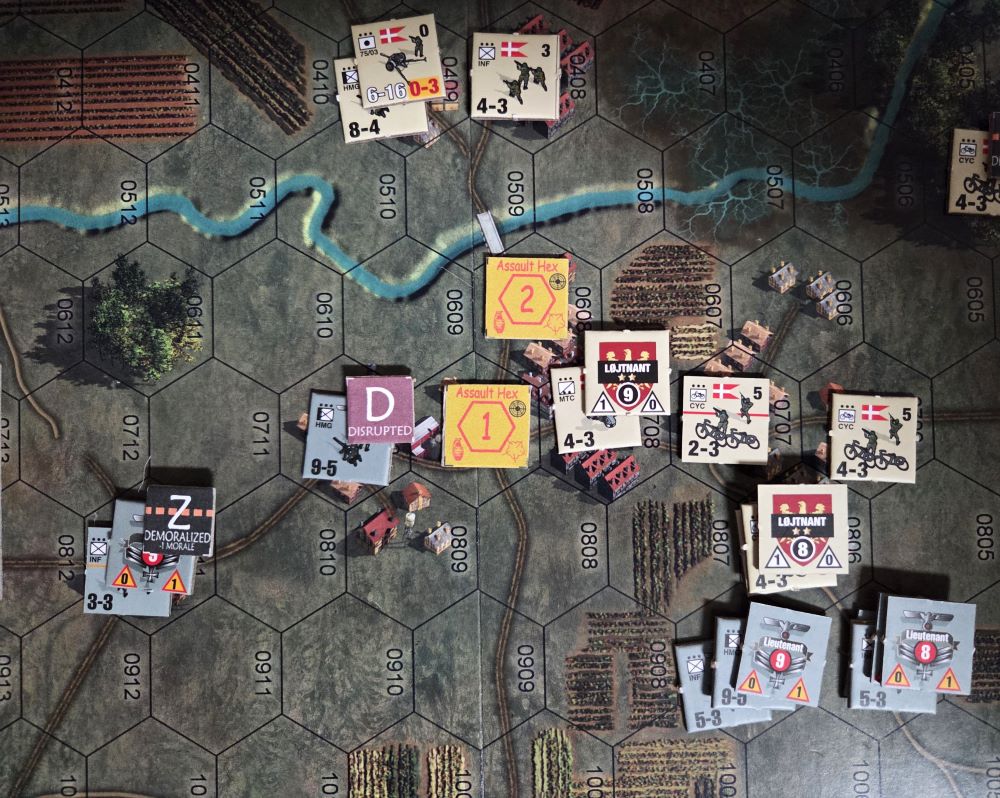
Photo by Dave Davieau.
Scenario Four
Last Stand at Haderslev
9 April 1940
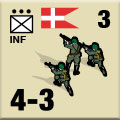 The Danish 2nd Infantry Regiment, stationed in the formerly German barracks of the II Battalion, 84th Infantry Regiment in Haderslev (Hadersleben under German rule), assembled at 0415 to greet the invaders. The garrison included the 2nd Regiment’s Anti-Tank Company. The Danes piled milk wagons into makeshift barricades and set up their anti-tank guns to cover the approaches to the town. Col. Anton Hartz, commanding both the regiment and the garrison, had orders to resist any invasion. He intended to follow them to the utmost, and perhaps a little beyond. The Danish 2nd Infantry Regiment, stationed in the formerly German barracks of the II Battalion, 84th Infantry Regiment in Haderslev (Hadersleben under German rule), assembled at 0415 to greet the invaders. The garrison included the 2nd Regiment’s Anti-Tank Company. The Danes piled milk wagons into makeshift barricades and set up their anti-tank guns to cover the approaches to the town. Col. Anton Hartz, commanding both the regiment and the garrison, had orders to resist any invasion. He intended to follow them to the utmost, and perhaps a little beyond.
Conclusion
 The Danes fought for Haderslev until reliable word of the cease-fire order arrived. This was the largest action of the Six-Hour War; the Danish reinforcements did not make it to the battlefield in time to participate. Whether Hartz deliberately ignored the orders to stop resistance is still unclear. The Danes fought for Haderslev until reliable word of the cease-fire order arrived. This was the largest action of the Six-Hour War; the Danish reinforcements did not make it to the battlefield in time to participate. Whether Hartz deliberately ignored the orders to stop resistance is still unclear.
Notes
This is what passes for a big scenario in this set; there’s still only one board in play, but you’ll use all of the Danes (if their reinforcements show up) and the Germans have flung an entire battalion at them, supported by armored cars. The Danes have not only their autocannons this time, but genuine anti-tank guns – and an actual artillery battery. Plus, that fearsome Danish morale. Will it be enough? There’s no sudden-death rule to end the fighting, so you’ll get to find out.
Correction
The river in Scenario Four is Major (actually, it’s a fjord); River crossing numbers are
Foot 8, Mechanized/Motorized 4.
Order 9 April 1940 Here.
Sign up for our newsletter right here. Your info will never be sold or transferred; we'll just use it to update you on new games and new offers.
Mike Bennighof is president of Avalanche Press and holds a doctorate in history from Emory University. A Fulbright Scholar and NASA Journalist in Space finalist, he has published a great many books, games and articles on historical subjects; people are saying that some of them are actually good.
He lives in Birmingham, Alabama with his wife and three children.
Daily Content includes no AI-generated content or third-party ads. We work hard to keep it that way, and that’s a lot of work. You can help us keep things that way with your gift through this link right here.
|