9 April 1940
The Invasion, Part One
by Mike Bennighof, Ph.D.
November 2025
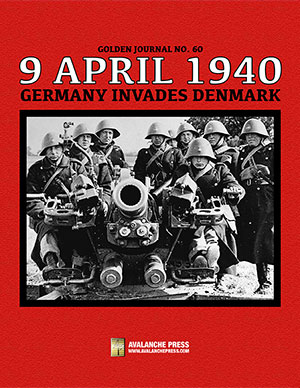 The Kingdom of Denmark and the German Reich will under no circumstances resort to war or any other form of force against each other. – Danish-German Non-Aggression Pact, 31 May 1939. The Kingdom of Denmark and the German Reich will under no circumstances resort to war or any other form of force against each other. – Danish-German Non-Aggression Pact, 31 May 1939.
Adolf Hitler had an enemies list. A lengthy one, reflecting both personal grievances and those he took on as personal grievances on behalf of his aggrieved supporters. Despite the presence of a German minority in North Schleswig (yielded to Denmark in 1920), Hitler did not demand a return of the small region to Germany, or the cession of any of Denmark’s colonies including Greenland.
The Danes had the misfortune of occupying a small, but strategic, piece of real estate. The narrow straits connecting the Baltic and North Seas passed between the Danish islands and mainland, at all times within sight of Danish land. And from the German perspective, Denmark presented a crucial springboard for any invasion of Norway, itself a strategic area allowing a German fleet to escape the bottleneck of the North Sea.
As early as 1905, Imperial Germany had made plans to occupy Denmark in case of war with France and Russia, to make sure that any sea communication between the two would be interrupted. The Kaiser chose not to activate them, and Denmark did extraordinarily good business during the First World War, selling foodstuffs and horses to the Germans.
In 1864, Austria and Prussia wrested control of Schleswig and Holstein from the Danish crown (the King of Denmark ruled them separately from the Danish kingdom). German-speaking Holstein meant little to Danish nationalists, but Schleswig had a large Danish population known as Eider Danes, most of them living north of the Eider River, the medieval boundary between Denmark and Germany. Schleswig initially came under Prussian occupation, with Holstein occupied by the Austrians. Austria ceded her claim after her defeat in the 1866 Austro-Prussian War, with the peace treaty included a provision that Danish-speaking areas of Schleswig would have a plebiscite, a chance to vote on whether they preferred Danish or Prussian rule.
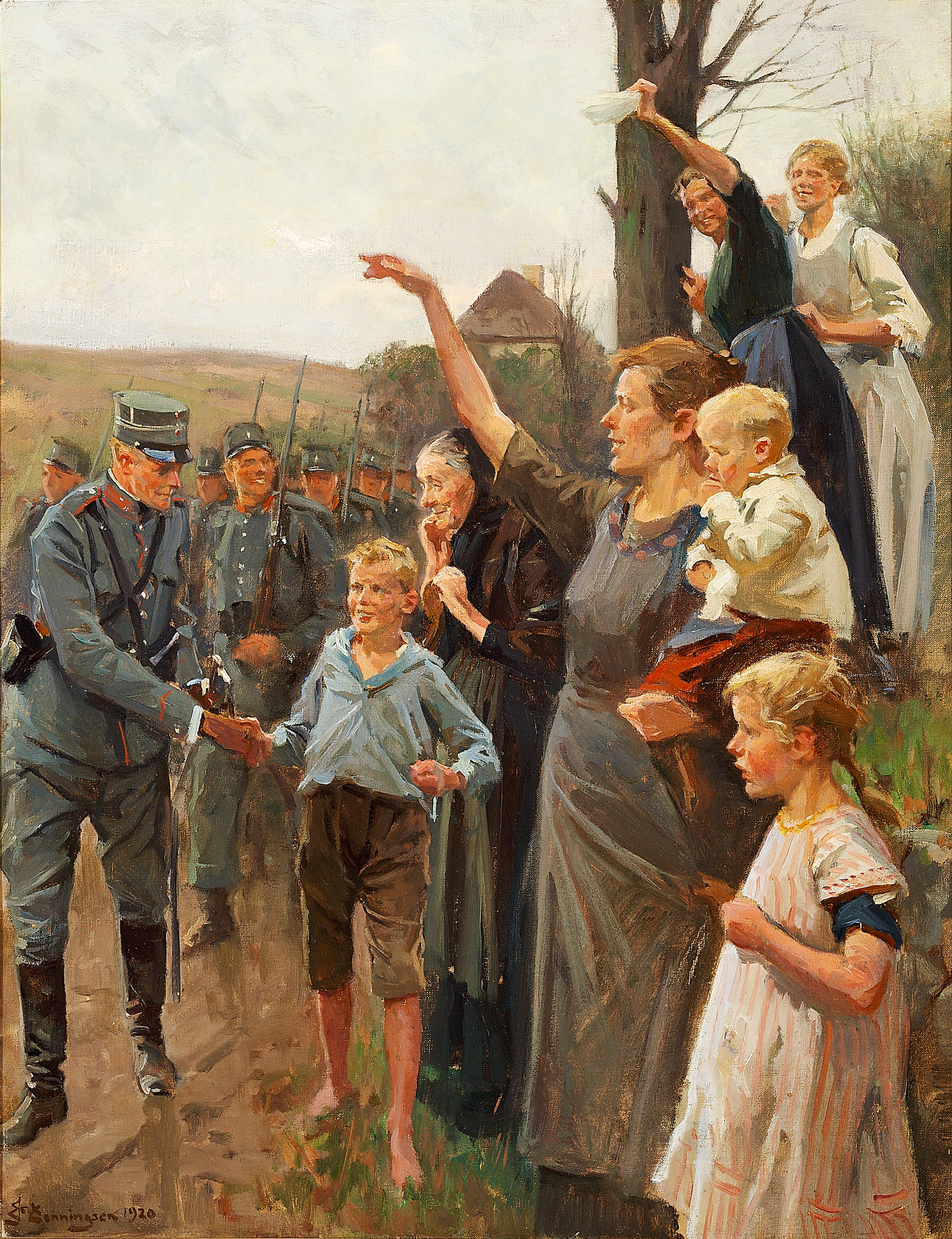
Danish troops enter North Schleswig, 1920. Painting by Erik Hennigsen.
That vote never happened. Prussia annexed Schleswig and Holstein in January 1867, expelling those who did not swear loyalty to the new regime (about 50,000 out of 150,000). Conscription came into force almost immediately, and Eider Danes formed two regiments (84th Infantry and 86th Fusilier), seeing bloody action at Mons against the BEF in 1914. Schools switched to the German language in 1880. The Kingdom of Denmark refused to accept the deported Danes, and most filtered back into German territory, living as stateless persons until 1907 when Germany and Denmark reached an agreement in 1907: the Eider Danes could apply for Prussian citizenship, and Denmark would stop deporting those who declined back to Germany (but did not agree to grant them Danish citizenship). The Danes also confirmed their acceptance of the 1864 border.
A strong Royal Danish Army enforced neutrality during the First World War. The Danes raised eight infantry regiments, each of two battalions, and three cavalry regiments plus a strong artillery component. In all, Denmark maintained 80,000 men under arms during the conflict, at considerable economic cost.
After the First World War, the Danish government (with backing from France, eager to do anything that diminished Germany) asked the Versailles Peace Conference to include the long-delayed plebiscite in the treaty ending the war. The provision made it into the treaty, and Schleswig divided into three zones for the vote. Northernmost Schleswig voted for Denmark in February 1920, but Central Schleswig opted for Germany a month later. With that, the vote for the southern portion was cancelled by mutual agreement. Northern Schleswig joined Denmark and Central Schleswig remained German.
Northern Schleswig had a German-speaking minority, about 25 percent of the population, and by the 1930’s had developed a small but vocal Nazi Party of their own. Yet their sliver of Denmark joined the list of “German soil in foreign hands,” like Danzig or the Sudetenland. The Danes would be included in the eventual “Germanic Empire” of Aryan peoples, and so there was no need to antagonize them. The central Nazi Party ordered its Danish satellite to cease agitation for a return of Northern Schleswig to Germany in 1935, and again in 1938.

The Danish Fourth Bicycle Battalion rides to war. Morning of 9 April 1940.
Nevertheless, the Germans made plans to invade Denmark in the early months of 1940. Initially, they intended just to seize the airfield at Aalborg on the far northern tip of Jutland, to assist in the invasion of Norway. The rest of Denmark would be left alone, but in March 1940 Hitler personally directed that all of Denmark be occupied. The Danes were to be told that their independence and neutrality would be respected, that the government would remain in control, and even the armed forces would remain under Danish command.
For their part, the Danes had greatly relaxed their defenses during the so-called “Phony War” in the months following the collapse of Poland. Denmark had finally started to shift from an agricultural to an industrial economy, and long-time Prime Minister Thorvald Stauning, a Social Democrat, had a healthy fear of Communist or National Socialist inroads among the rapidly-growing working class. He oversaw cuts to an already paltry defense budget in 1932 and 1937, disbanding one fo the infantry regiments and one cavalry regiment. Stauning’s social spending made him extremely popular and he won 46 percent of the vote in 1935, still a record for the Danish Social Democratic Party. Now labeled “The Father of the Country,” Stauning advocated a strategy of neutrality, taking no actions whatsoever that might annoy Hitler even in the slightest degree.
When the German invasion of Poland began on 1 September, Denmark immediately mobilized, with the Royal Danish Army reaching its war strength of 55,000 men in two divisions. Keeping that many men under arms should have been very possible for a nation of 3.8 million people (the active army would have been just under 1.5 percent of the population, an extremely low number for the period). Denmark certainly had the population, financial means, and industrial base to support an army three times that size along with moderate air and naval forces.
The army’s commander-in-chief, Lt. Gen. William Wain Prior, urged the government to not only keep the army fully mobilized, but increase its size and prepare to defend Denmark. But Stauning yielded to his working-class base, and the demands of civilian employers for the return of their manpower. In December, Parliament ordered the army to send 40,000 men home, and sent more home as the new year’s class of recruits mustered in. By April, of the 15,000 men still on active duty, 6,000 were raw conscripts undergoing training. About one-third of the other 9,000 men made up the full-time Life Guards Regiment in Copenhagen.
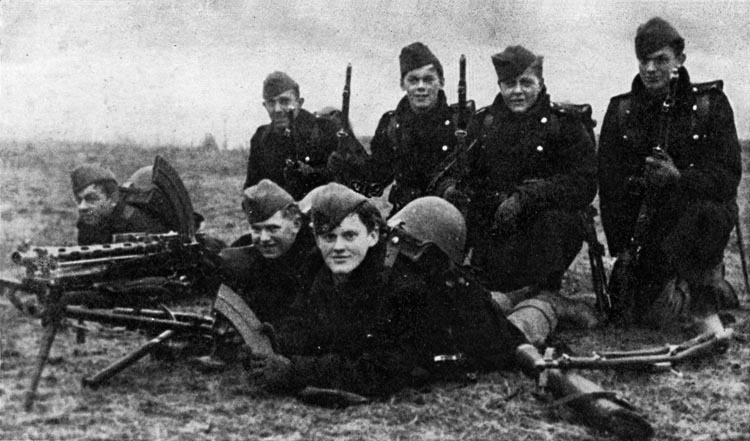
A Danish 4th Battalion machine-gun team of various ages poses on the morning of 9 April 1940. Within an hour, two of these men would be killed in action.
That put the Danish defenses along the border with Germany in the hands of two battalions. These belonged to different regiments, with some other elements nearby that might have joined the defense given more than a half-hour’s warning. Both battalions were split into smaller detachments to cover the border, with a few extra companies and the NCO School, supported by an artillery battery and three anti-aircraft batteries from the 14th Artillery Regiment, and another battery from the 8th Artillery Regiment. The IV/3 Infantry Battalion had been intended as a mobile reserve, its troops mounted on bicycles and motorcycles. The III/2 Battalion, actually from the Sjaelland Division, had been rotated to the mainland for exercises and a stint on the frontier.
All told, the Danes had fewer than 2,000 men on the border. The government had forbidden all entrenchment and fortification work, to avoid provoking the Germans. The Royal Danish Army went to alert status on 8 April 1940. Soldiers were issued live ammunition, and told to sleep in their uniforms that night. The Royal Danish Navy did nothing. The war warning came at 0417 on 9 April, and at 0435 the troops filed out of their barracks and off to war.
Order 9 April 1940 Here.
Sign up for our newsletter right here. Your info will never be sold or transferred; we'll just use it to update you on new games and new offers.
Mike Bennighof is president of Avalanche Press and holds a doctorate in history from Emory University. A Fulbright Scholar and NASA Journalist in Space finalist, he has published a great many books, games and articles on historical subjects; people are saying that some of them are actually good.
He lives in Birmingham, Alabama with his wife and three children.
Daily Content includes no AI-generated content or third-party ads. We work hard to keep it that way, and that’s a lot of work. You can help us keep things that way with your gift through this link right here.
|