9 April 1940
The Invasion, Part Two
by Mike Bennighof, Ph.D.
November 2025
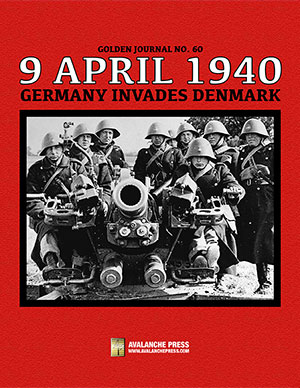 In the event of a direct attack on Danish territory, the force's mission and the purpose of the battle must be a clear and unambiguous declaration of the will to defend - regardless of the strength of the forces. – Royal Danish Army order of the day, 9 April 1940. In the event of a direct attack on Danish territory, the force's mission and the purpose of the battle must be a clear and unambiguous declaration of the will to defend - regardless of the strength of the forces. – Royal Danish Army order of the day, 9 April 1940.
The small German invasion fleet headed out in six separate groups on the evening of 8 April, bound for the Danish islands. They almost immediately ran into problems. The elderly battleship Schleswig-Holstein, the flagship of the motley invasion flotilla, ran aground on a shoal in the Great Belt channel between the two main Danish islands, Sjaelland (where Copenhagen is located) and Fyn. The 198th Infantry Division’s command staff had embarked aboard her in Kiel, and transferred to the ship’s small boats to complete their journey.
Patrolling Danish warships almost immediately spotted the slowly-oncoming Germans. The modern torpedo boat Glenten fished 32 Germans out of the water, who had been aboard a tugboat that another, unidentified ship rammed and sank at 2120 on the evening of 8 April. Her commander did not radio a warning, observing orders not to transmit, and rushed to port to telegraph his discovery to the War Ministry. Even though the information came hours late, this was the Danes’ first warning of a German invasion. The gunboat Ingolf’s commander, surrounded by dark shapes that would not identify themselves, ordered his ship cleared for action at 0340 but did not open fire.
German infiltrators started crossing the landward border with Denmark at 0330 on 9 April, with a platoon of Brandenburg commandos in civilian clothing slipping into the border town of Padborg, and a uniformed patrol of German infantry crossing the border to hide out at a farm owned by a German-born Danish citizen, who’d decided to betray his country to the Nazis. Danish border guards reported the sounds of motor vehicles engines and a great deal of shouting from the other side of the frontier.
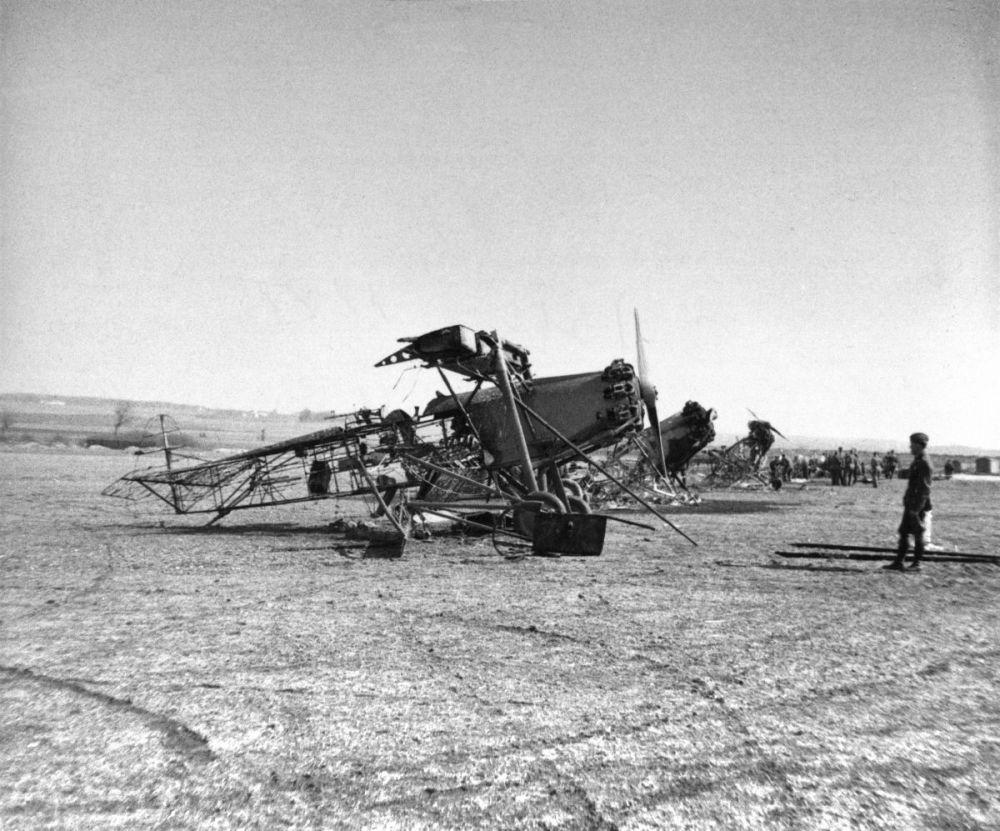
Danish Fokker C.V aircraft, destroyed on the ground like most Danish planes.
At 0400, German soldiers unexpectedly erupted out of a ferry that arrived a little early at Gedset, on the island of Falster, while toll-taker Karl Petersen shouted at them that they had not paid and were not allowed to enter Denmark. At about the same time, the civilian-garbed commandos in Padborn gunned down three Danish border guards.
The full-scale invasion began at 0415. German troops from the 170th Infantry Division and 11th Motorized Rifle Brigade at four crossing points, keeping mostly to the well-kept roads.
In accordance with pre-war plans, Maj. Gen. Christian Gørtz of the Jylland Division intended to mobilize his troops and make a stand behind the Velje River, some 80 kilometers north of the German-Danish border. The units along the frontier would delay the Germans long enough to allow this defense to form. That intent fell apart when the Danish government issued orders forbidding moving troops into defensive positions or constructing roadblocks and entrenchments.
King Christian X and War Minister Alsing Andersen met at 0505, and over the next 20 minutes more of the government’s ministers joined them. Given the reports of German troops crossing the land frontier and landing on the Danish islands, German planes sighted over Copenhagen and German paratroopers having landed, by 0600 the king and his government had reached a consensus that resistance must cease. Army commander Lt. Gen. William Wain Prior, dictated the cease fire order, which was sent by teleprinter and verbally by telephone to the two division commands, the Aalborg Air Command, and the Southern Jutland Command:
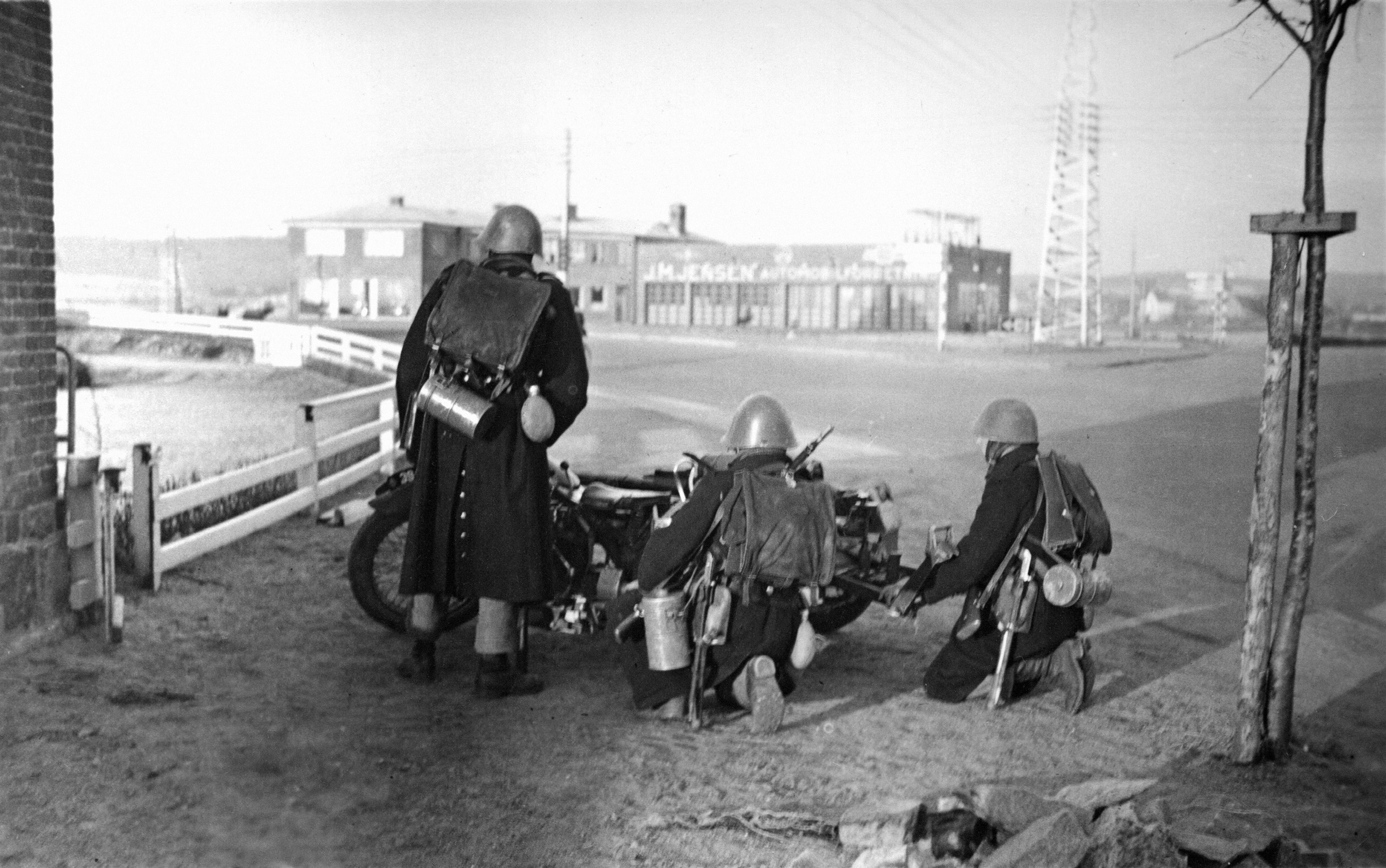
A Danish 20mm autocannon of Fourth Bicycle Battalion outside Abenraa. 9 April 1940.
All hostilities to cease immediately. Units to remain in place and await instructions.
All four commands received the order between 0622 and 0625. Getting word to the front-line forces took somewhat longer, and firefights flared at multiple places.
While the Danes made ready, none of the local commanders showed the anti-German zeal of Col. Anton Hartz, in charge of the garrison at Haderslev. Hartz had helped draw up a plan to move troops quickly to the border zone using rented private trucks, but the Germans moved much faster than expected and this plan quickly fell apart. He decided that he would hold Haderslev, and urged Esseman of Jylland Division to release the 13th (II/2) Battalion from its training area at Velje on the central east coast of Jutland to join the regiment’s 3rd (I/2) Battalion at Haderslev. The infantry battalion, about half of its men raw recruits, set out at 0800 and marched until 1600, when someone in the Defense Ministry realized that Jylland Division was reinforcing its front-line positions and Wain Prior ordered an immediate halt. The battalion stopped at Christiansfeld, about 10 kilometers north of Haderslev, and camped on the spot.
The first clash came on the Danish left flank, where Lt. Hans Schrøder’s half-platoon of cyclists – 19 men with one 20mm autocannon and two light machine guns – from the Fourth Bicycle Battalion seized a hilltop position on the Lundtoftbjerg just north of the border. Two belligerent border guards joined them there. At 0450 they opened fire on an approaching German column of about 200 men, mostly in trucks but led by armored cars and motorcyclists. In a half-hour firefight the Danes shot up two armored cars and three motorcycles. They killed four Germans and lost one of their own – autocannon gunner Carl G. Jørgensen – before pulling back.
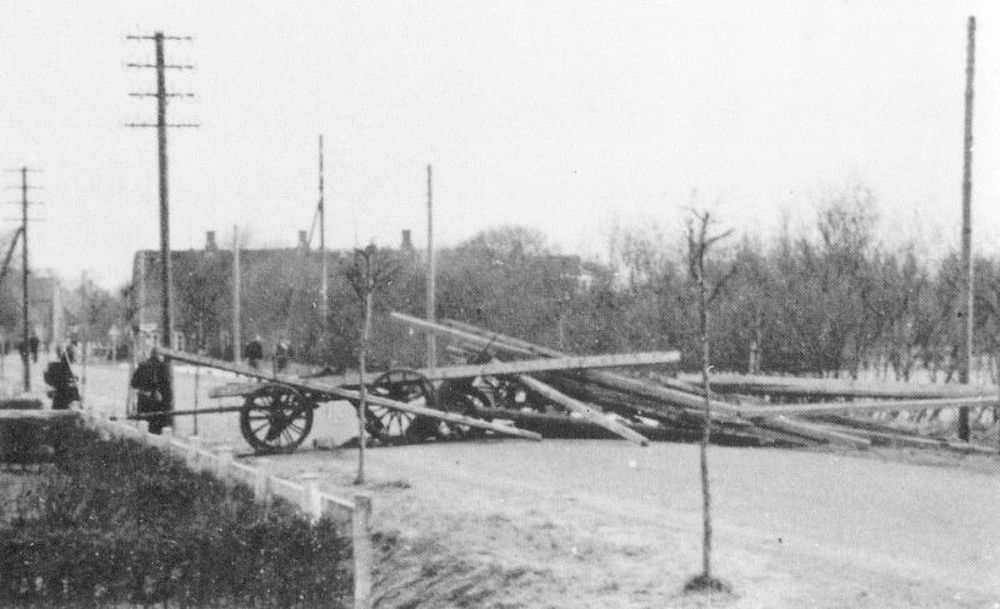
The roadblock at Sølsted. Also seen on the Panzer Grenadier marker sheet.
The 401st Infantry Regiment of the German 170th Infantry Division crossed at Saed and headed up Highway 11 near the west (North Sea) coast of Jutland. Capt. Eigil Fabricius of the 1st Pioneer Battalion had been forbidden to begin the carefully-planned demolitions of the 1938 war plan, which listed 60 bridges, culverts and other locations that should be destroyed. Once radio reports indicated that the Germans crossing the border, he loaded explosives and 25 men from his unit and the Pioneer School intro trucks and set out to blow things up.
Their first attempts to set up roadblocks failed, but at Sølsted (about 14 kilometers north of of the border) they managed to erect a quite ragged one of wagons and pieces of lumber, and cover it with a pair of 20mm autocannon. At about 0500 German armored cars rumbled up the road and the autocannon knocked out the first two, but another slipped behind the roadblock and forced the Danes to retreat. The Danes came under air attack, but had suffered no casualties when word came to cease resistance.
Order 9 April 1940 Here.
Sign up for our newsletter right here. Your info will never be sold or transferred; we'll just use it to update you on new games and new offers.
Mike Bennighof is president of Avalanche Press and holds a doctorate in history from Emory University. A Fulbright Scholar and NASA Journalist in Space finalist, he has published a great many books, games and articles on historical subjects; people are saying that some of them are actually good.
He lives in Birmingham, Alabama with his wife and three children.
Daily Content includes no AI-generated content or third-party ads. We work hard to keep it that way, and that’s a lot of work. You can help us keep things that way with your gift through this link right here.
|