9 April 1940
The Invasion, Part Three
by Mike Bennighof, Ph.D.
November 2025
 On the Baltic shore of the peninsula’s border with Germany, other elements of the Fourth Bicycle Battalion took up positions several kilometers north of the frontier. Two regiments of the German 170th Infantry Division (the 391st and 399th) crossed at Krusa, just inland from the Flensborg Fjord leading to the Baltic, and the 11th Motorized Rifle Brigade crossed at Padborg, two kilometers to the south-west of Krusa. From there, a highway (today’s E45) led directly northward up the Danish east coast all the way to Aalborg and its strategic airfield. On the Baltic shore of the peninsula’s border with Germany, other elements of the Fourth Bicycle Battalion took up positions several kilometers north of the frontier. Two regiments of the German 170th Infantry Division (the 391st and 399th) crossed at Krusa, just inland from the Flensborg Fjord leading to the Baltic, and the 11th Motorized Rifle Brigade crossed at Padborg, two kilometers to the south-west of Krusa. From there, a highway (today’s E45) led directly northward up the Danish east coast all the way to Aalborg and its strategic airfield.
The Danish battalion’s 1st Company, a bicycle-mounted outfit, just barely beat the 11th Motorized Rifle Brigade’s lead elements to the key crossroads of Bredevad and Korskro. The Germans advanced with armored cars and motorcycle troops leading the way, and the Danes met them with autocannon fire that knocked out three armored cars and led to a firefight that lasted 45 minutes, and resulted in two more armored cars knocked out. The Germans outflanked the detachment in Bredevad, and the Danes withdrew when captured German dispatch riders revealed that another column including tanks was approaching. The Danes were still on the march when word arrived of the cease-fire order.
To the north, the Fourth Battalion’s commander, Lt. Col. S.E. Clausen, assembled an ad hoc reserve from elements of several of his companies and placed them along a line of woods at Bjærgskov, to await the Germans coming up the road. When the Germans approached at 0630, led by armored cars, the Danes held their fire until they drew close before opening up with all of their weaponry including the ubiquitous 20mm autocannon. The Danes held firm until the Germans brought up tanks to drive them back from the woods line. Clausen ordered his men to scatter through the woods and re-group on the other side, where they received word of the cease-fire order.
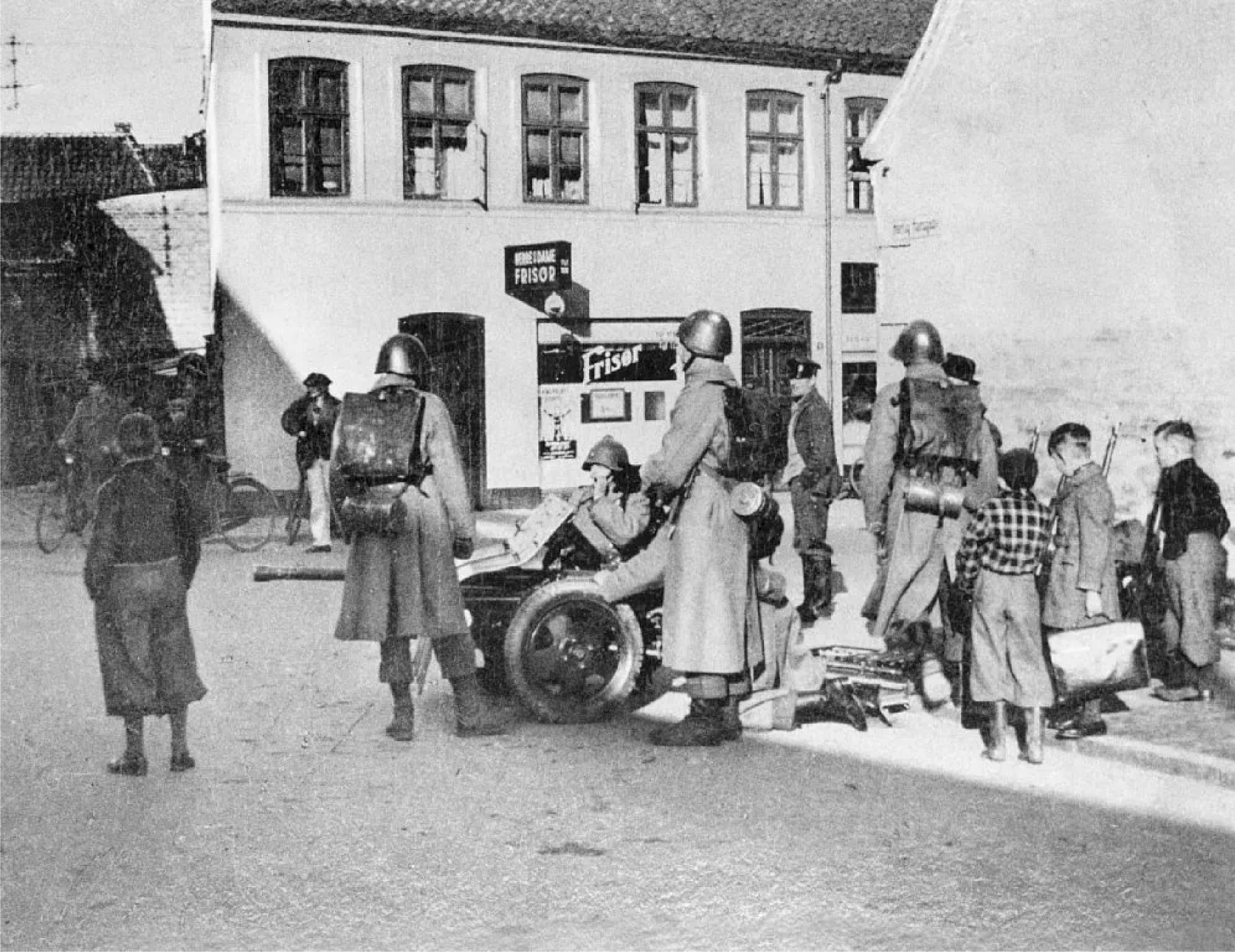
The 37mm anti-tank gun at Haderslev, before.
The biggest clash would come at Haderslav, home station of Anton Hartz’s 2nd Regiment. Hartz had a rifle company and the heavy weapons company of his regiment’s 3rd Battalion, the 2nd Regiment’s anti-tank company and some elements of the Fourth Bicycle Battalion that had withdrawn northwards. A battery of the 8th Artillery Battalion unlimbered north of the town to provide support, but ultimately did not fire as the morning mists hampered observation.
The Danes set up one of the 37mm anti-tank guns just in front of the Hertug Hans Church with a long field of fire down the main road heading south out of town. The Germans arrived at 0545 and the anti-tank gunners hit two of the tanks, but their return fire smashed the gun and killed the gunner and two gawking civilians standing behind the gun. The second gunner, Hans Christian Hansen, appears to have been wounded and then murdered later by a local Nazi.
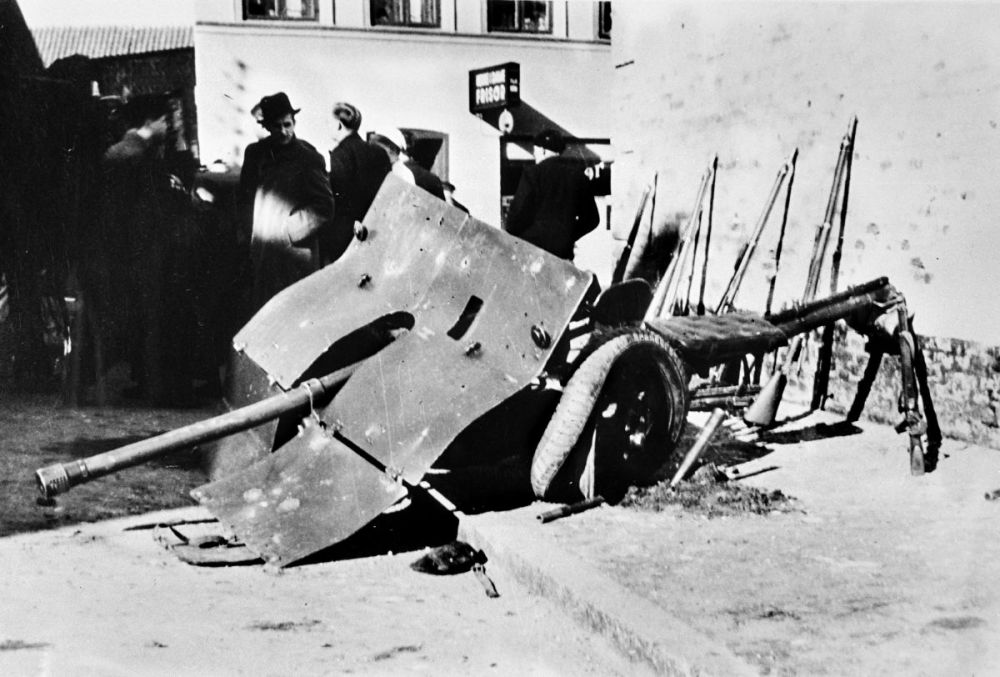
The 37mm anti-tank gun at Haderslev, after.
The Danes fought for Haderslev until about 0715, having initially rejected telephone orders from Copenhagen to cease fire as a German ruse. Four Danes in all had been killed. As Hartz negotiated with Lt. Gen. Walther Wittke, the German division commander, Capt. Kjarten Pedersen limbered up his artillery battery and headed back to Velje to join the rest of his battalion and prepare to resist the Germans there.
On the Danish islands, troops from the German 198th Infantry Division came ashore at six different points, mostly from requisitioned passenger ferries. In most locations they achieved full surprise, but the Royal Danish Life Guards exchanged fire with the invaders in defense of their king, and only laid down their arms after a direct order from Christian X. Many sources list one or two Guardsmen as killed in this action, but the Royal Danish Army lists only three Guardsmen as having been wounded and none killed. Not waiting for the Germans to arrive and disarm his men, Col. Helge Bennike of the 4th Regiment stationed outside Copenhagen took one company with him as he fled to Sweden; most of the Danes returned during the weeks that followed.
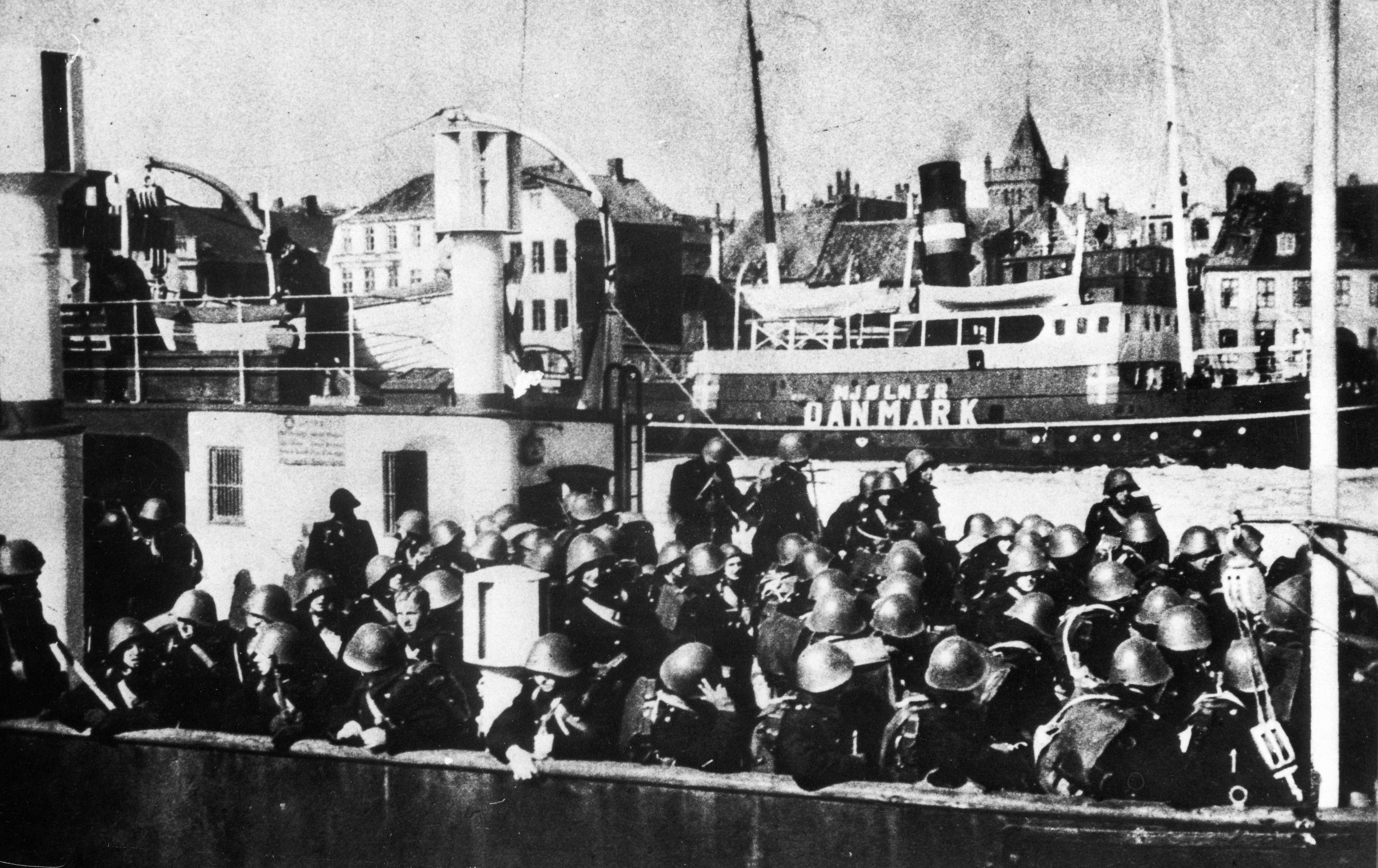
Col. Bennike and
his men board their ferry to Sweden. 9 April 1940.
Small German airborne units made two separate landings. One at Aalborg in far northern Jutland to seize the vital airfield there. And the other to seize the Little Belt Bridge connecting Jutland with the island of Funen. Neither met resistance, and the paratroopers (reinforced at Aalborg by an air-lifted infantry battalion) were relieved by ground forces within hours.
The last act of the invasion came a day later, when the German II/305 infantry battalion steamed out of Kiel on two freighters, escorted by a pair of picket boats (converted fishing boats). Bornholm, a Danish-ruled island about 150 kilometers east of Copenhagen, occupied a strategic spot in the middle of the Baltic Sea. The Danish Bornholm Defense Battalion had time to mobilize, but the island’s four coast-defense guns had no crews (and were not operable in any case), and Maj. A.C. Bohn’s heavy weapons consisted of one Madsen light machine gun. He greeted the Germans at dockside and formally surrendered the island. The occupation of Denmark was complete.
Assessment
The Danes suffered 16 dead and 21 wounded; the German Army never released a formal total and estimates of their dead range from three to 203. The latter figure comes from DISA, manufacturer of the 20mm autocannon, which clearly did inflict many losses on the Germans. DISA then used this as a marketing point in its unsuccessful efforts to sell the weapon to the Wehrmacht.
As in April 1940, any latter-day consideration of prolonged Danish resistance has to start with its ultimate purpose. Denmark could not defeat Germany, only hold out until foreign aid could arrive. But neither Sweden or Britain, the two most likely sources of assistance, showed any inclination to spill blood on Denmark’s behalf. The Danes might inflict more losses on the invaders, and suffer more of their own, but they could not alter the outcome.
The Royal Danish Army of 1940, a shell of its Great War strength, had little chance to repel a determined German invasion. The failure of the Danish Navy to employ its submarines and torpedo boats against the German invasion convoys – the very reason for their existence – rendered the Danish islands totally indefensible. The Danes might have held Copenhagen for a few days with a stronger (and fully-mobilized) garrison, but then the air attacks feared by the king and prime minister would have brought terror to the civilian population.
On the mainland, the orders from Copenhagen to remain in barracks and not dig entrenchments or perform demolitions likewise doomed the defenders. The Danes showed themselves willing to fight, at least for a brief period, and those skirmishes would become a vital part of Denmark’s national mythology. They allowed Danes of later generations to tell themselves that their country had not meekly submitted to the Nazis, but instead put up spirited if short-lived resistance.
Order 9 April 1940 Here.
Sign up for our newsletter right here. Your info will never be sold or transferred; we'll just use it to update you on new games and new offers.
Mike Bennighof is president of Avalanche Press and holds a doctorate in history from Emory University. A Fulbright Scholar and NASA Journalist in Space finalist, he has published a great many books, games and articles on historical subjects; people are saying that some of them are actually good.
He lives in Birmingham, Alabama with his wife and three children.
Daily Content includes no AI-generated content or third-party ads. We work hard to keep it that way, and that’s a lot of work. You can help us keep things that way with your gift through this link right here.
|