Campaign Studies:
Delving Into History
by Mike Bennighof, Ph.D.
January 2026
A long time ago, I worked as a “newspaper reporter.” Back then, the news was delivered on large sheets of really cheap paper, with stories about events, stories written by humans. I was one of those humans. And we had “editors,” who corrected errors and made judgements as to what should go into the paper. These things existed, I assure you.
You’d work really hard for just one quote or one tiny bit of information: standing in the rain, mucking through miles of paper files in the courthouse basement (before digitization, there was paper, and it was only “searchable” if you looked at every sheet). Or getting roughed up by Air Police if you overheard something inconvenient (like I wouldn’t write it after that). And then the city editor would bellow, “Just because you found it out, don’t make it news!”
Now that I’m in charge, I can include things in our books, just because I found them out. And so, I do. Even our little Campaign Studies get the most intense research I can muster, at least when it’s appropriate. We’ve started treating our little Campaign Studies like periodicals; when their print run is sold out, we’re not going to keep reprinting them, or we’ll be overrun by Campaign Studies. But I research and write them with the same fanatical intensity I applied back in the days of “newspapers.”
Let’s have a look at three of the intensely-researched Campaign Studies.
Tank Battle at Raseiniai
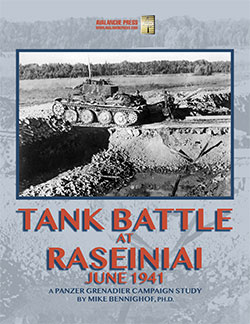 There are a lot of references to the large-scale tank battle at Raseiniai in June 1941, just over the Lithuanian frontiers from what was then German East Prussia. The German 1st and 6th Panzer Division attacked, and was in turn counter-attacked by a Soviet tank corps. This included a nearly-unstoppable KV heavy tank, though many secondary works claim that few details are available (because they’re relying on a single memoir, that of Erhard Raus, the 6th Panzer Division’s commander). There are a lot of references to the large-scale tank battle at Raseiniai in June 1941, just over the Lithuanian frontiers from what was then German East Prussia. The German 1st and 6th Panzer Division attacked, and was in turn counter-attacked by a Soviet tank corps. This included a nearly-unstoppable KV heavy tank, though many secondary works claim that few details are available (because they’re relying on a single memoir, that of Erhard Raus, the 6th Panzer Division’s commander).
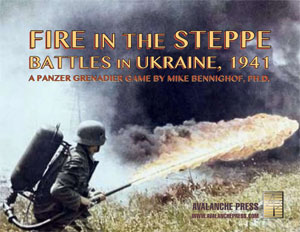
Panzer Grenadier: Tank Battle at Raseiniai tells the story of the battle, and then lets you play it out in ten Panzer Grenadier scenarios. The scenarios are structured to help tell more of the story. You’ll need Fire in the Steppe for maps and pieces, 1940: The Fall of France for some extra Czech-made German light tanks, and Lithuania’s Iron Wolves for the one Lithuanian light tank unit taken by the Soviets and issued to one of their mechanized infantry diovisions.
Raseiniai is an inconvenient battle for every strand of World War II mythology, and so the Heroic KV story is told, and the story moves on. The KV myth is often used to obscure one of the key factors; even serious histories pretend that 1st Panzer Division was diverted to save the neighboring 6th Panzer Division from this lone tank. The real story, which I found rooting through Soviet after-action reports buried in online archives, is that the Germans ran head-on into the well-armed and well-prepared Soviet 9th Anti-Tank Brigade, which shot their panzers to pieces.
So the Soviets punched blitzkrieg in the face, and they fought very hard. But the tank divisions that fought did so piecemeal, and were essentially wrecked by the experience. It could not be sold as a tale of defiant resistance. On the German side, blitzkrieg faltered on the first day of the invasion; it could not be sold as a tale of relentless advance. The mythical “unknown” KV received the glory (it’s not unknown, we even included a picture of it), along with a fantastical story of the Germans giving the brave crew a burial with full military honors (also, not true).
To the best of my knowledge, we present the fullest story of this battle in any work of history, let alone a wargame publication. This is why I do this job: to tell the stories that were replaced by fairy tales.
Order Tank Battle at Raseiniai Here.
Supplies are limited, and this book will not be reprinted.
49th Mountain Corps
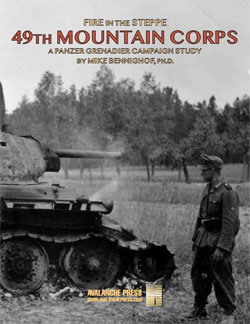 In 49th Mountain Corps, we add another chapter to Fire in the Steppe, with the battles fought by German mountain troops during the Brody-Dubno battles. You’ll need pieces from Parachutes Over Crete (the mountain guys), and maps and pieces from Fire in the Steppe. In 49th Mountain Corps, we add another chapter to Fire in the Steppe, with the battles fought by German mountain troops during the Brody-Dubno battles. You’ll need pieces from Parachutes Over Crete (the mountain guys), and maps and pieces from Fire in the Steppe.
The German 49th Mountain Corps went to war in June 1941 with two mountain divisions (though they did not fight in the line at the same time) and two regular infantry divisions. The corps fought on the right flank of the German Panzer Group One during the Brody-Dubno tank battles, and its 1st Mountain Division fought the Soviet 32nd Tank Division in a fierce battle in front of Lviv. Afterwards, its troops helped massacre Lviv’s Jewish population and the faculty of the local university.
While some good history’s been done on the Brody-Dubno battles, it usually doesn’t include the mountain corps, or if so, only in passing. Ferreting out the story took some work, though not as much as Raseiniai. These were foot-mobile formations fighting in a tank battle, and it’s the tank-against-tank action that gets all the attention (such as it is).
Once again, we added to the historiography, even if it was only presented in a little game-focused book, read by perhaps a thousand people. I’m still proud of it.
Order 49th Mountain Corps Here.
Supplies are limited, and this book will not be reprinted.
Black Sea Marines
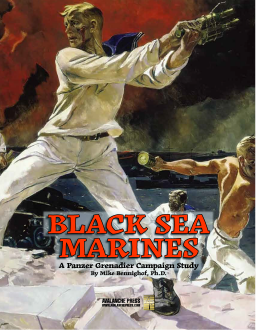 Black Sea Marines is a broader sort of tale, about the actions of the Soviet Black Sea Marines in defense of Odessa and of the Crimea, in 1941 (each campaign gets its own chapter). There were not a lot of Marines, but they made a difference when they fought. And it gives the Soviet side a unique, elite force. Black Sea Marines requires pieces from Armata Romana and River Battleships, and maps and pieces from Fire in the Steppe. Black Sea Marines is a broader sort of tale, about the actions of the Soviet Black Sea Marines in defense of Odessa and of the Crimea, in 1941 (each campaign gets its own chapter). There were not a lot of Marines, but they made a difference when they fought. And it gives the Soviet side a unique, elite force. Black Sea Marines requires pieces from Armata Romana and River Battleships, and maps and pieces from Fire in the Steppe.
This story needed less primary-source research than did Raseiniai, but did require some reading in Russian-language sources. The historiography of the Soviet Black Sea Marines isn’t very deep, and what Western secondary works do reference the Marines often confuse them with Naval Rifle formations (which were sailors inducted into the Red Army). I already had some good material on their battles from the Romanian perspective, so it wasn’t that hard to put together the narrative and flesh it out with scenarios.
In this case, I can’t claim that we added much to the history; the story was out there, if kind of scattered. I do think Black Sea Marines is a fine little book, and I’m glad we made it.
Order Black Sea Marines Here.
Supplies are pretty solid, but this book will not be reprinted.
Order River Battleships Here.
River Marines
• River Battleships
• Armata Romana
• Black Sea Marines
Retail Price: $114.97
Package Price: $90.00
Gold Price: $72.00
Join the Marines.
Summation
As I’ve been told many times, this is too much research effort for a $15.99 book that will struggle to sell 1,000 copies, be read only by wargamers, and then be forgotten. That’s probably true. Instead, I’ve followed a pretty selfish drive to satisfy my own wish to know things in great depth.
You can see all of the Campaign Studies going out of print here.
Sign up for our newsletter right here. Your info will never be sold or transferred; we'll just use it to update you on new games and new offers.
Mike Bennighof is president of Avalanche Press and holds a doctorate in history from Emory University. A Fulbright Scholar and NASA Journalist in Space finalist, he has published an unknowable number of books, games and articles on historical subjects.
He lives in Birmingham, Alabama with his wife and three children.
Want to keep Daily Content free of third-party ads? You can send us some love (and cash) through this link right here.
|