9 April 1940
The Royal Danish Army, Part Two
by Mike Bennighof, Ph.D.
November 2025
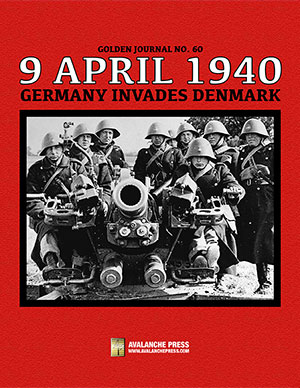 With Golden Journal No. 60: 9 April 1940, we introduce the Royal Danish Army to the Panzer Grenadier series. The title is the date on which German troops rolled into Denmark, with the government quickly ordering the Royal Army to stop its resistance. But not before it had indeed resisted, and those battles are at the heart of our Journal. With Golden Journal No. 60: 9 April 1940, we introduce the Royal Danish Army to the Panzer Grenadier series. The title is the date on which German troops rolled into Denmark, with the government quickly ordering the Royal Army to stop its resistance. But not before it had indeed resisted, and those battles are at the heart of our Journal.
Like most European nations, Denmark paid little attention and even less money to national defense in the years following the First World War. Military stood at about 1 percent of Gross Domestic Product (GDP), even less than her Nordic peers, much less neighboring Germany. As tensions rose and war seemed more likely, Danish spending rose as well, to 1.2 percent of GDP in 1935 and 2 percent in 1938. This was still much less than countries like Sweden (rising from 1.6 percent to 2.7 percent). Industrialization came late to Denmark, and in 1940 the kingdom’s economy remained primarily agricultural.
As Europe prepared for a new round of war, some nations had trouble acquiring new weapons, even when they had the cash and the will to spend it. Denmark had a small arms industry of its own, that could supply at least light arms, support weapons, and some artillery. Tanks and motor vehicles lay beyond the ability of Danish industry to produce, and beyond the limits of Danish military budgets. Most Danish spending went to the Royal Danish Army, and did provide a reasonably well-equipped force.
Heavy Weapons
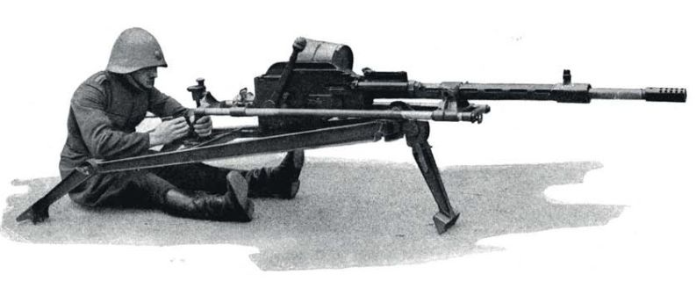
In 1933, Madsen developed a 20mm version of their machine gun, with similar action but reinforced to handle the stronger recoil of the bigger shell. The company touted their “autocannon” as a universal weapon, suitable as an anti-aircraft gun, anti-tank gun, and as a very heavy machine gun for use in infantry combat. It came with both armor-piercing and high-explosive rounds, fed by a 15-round drum. It could be fired from a bipod as a single-shot anti-tank rifle (it did not perform well in this role), from a tripod or directly from a motorcycle. It could be pulled by two men on its small two-wheeled cart.
The anti-aircraft version had a pedestal mount when used aboard ships, or a four-legged stand on dry land. This version was fed by a 100-round belt, and could pump out 180 rounds per minute from the original M33, 250 rounds per minute from the improved M38.
The Royal Danish Army bought 158 of them; they were also widely exported. In Danish service, the autocannon was issued as an anti-tank and anti-aircraft gun, and as a support weapon in the bicycle battalion. Since this outfit fought the iconic action of the Six-Hour War in 1940, the Madsen autocannon took on an outsized role. The firm tried to capitalize that success by selling it to the Germans; their sales pitch, built around the hundreds of Germans claimed to have been slain, amazingly did not go over well.
The Danes did not depend solely on the 20mm autocannon for anti-tank defense; they also purchased 92 37mm anti-tank guns from Bofors in Sweden, the most effective such weapon on the market at the time. These equipped the regimental anti-tank companies, and a handful of them saw action in 1940. Danish anti-tank gunners would claim two German tanks and eleven other armored vehicles, mostly armored cars.
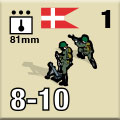
Unlike most armies, the Danes did not issue a light mortar at the company level. Danish heavy-weapons companies included a platoon of 81mm medium mortars. The Danish firm Copenhagen Machine Works, a sub-contractor for many of Madsen’s weapons, manufactured the weapon under license from Edgar Brandt’s French firm, and made 96 of them, enough to issue three tubes to each battalion. The Danish 81.4mm L/12 had slight modifications to the Brandt design, chiefly intended to make it easier to transport.
Artillery
On paper, the two Danish divisions fielded a fairly strong artillery component. The Sjaelland Division which guarded the Danish islands had two artillery regiments with seven battalions between them; four of these were motorized. Five battalions had a dozen 75mm field guns each, with the other two each wielding a mixture of eight 150mm howitzers and four 105mm long-ranger cannon. Those 84 guns gave the division more tubes than other similar formations of the time, but as Denmark had no corps-level headquarters (with only two divisions), some of these battalions would have been held a corps or army level in a larger army. The second artillery regiment had been placed under the division for administrative purposes (payroll and personnel matters).
The Jylland Division on the mainland had one artillery regiment of four battalions, with 36 75mm field guns, eight 150mm howitzers, and four 105mm long-range cannon. When the Germans invaded, only one of these battalions had been manned, the 8th Artillery Battalion with a dozen 75mm field guns in three batteries of four guns each. The other battalions maintained only minimal cadre strength, which appears to have been the case for all of the Sjaelland Division’s artillery.
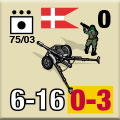
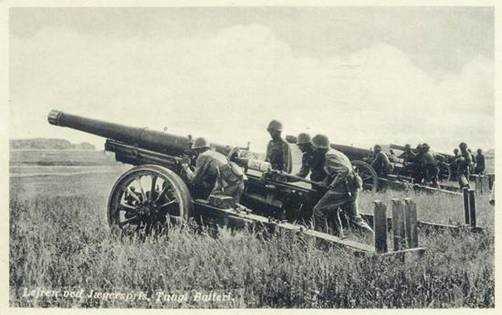
Denmark had purchased 128 75mm Krupp Model 1902 field guns in 1902, and almost four decades later these weapons, with very minimal gestures at modernization, remained the backbone of the Danish artillery arm. The 96 guns still in front-line service in 1940 equipped eight artillery battalions; others had been converted into rather ineffective anti-aircraft guns, assigned to the Bornholm Defense Battalion, or been retired.
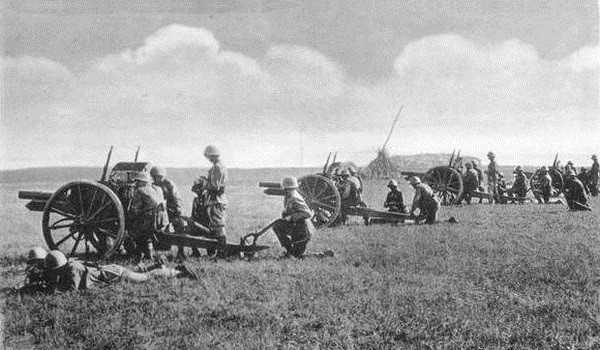
A battery of the Danish Sjaelland Division with their 75mm M1902
field guns.
The Model 1902 had slightly better performance than the German Army’s standard field gun of the time, the 77mm FK96, but was far inferior to the famed French 75 that remained in service with the French and Polish armies at the start of the war. It had a minimal anti-tank capability, and was intended for flat-trajectory fire in direct support of the infantry.
The Treaty of Versailles forbade German production and export of artillery, forcing the Danes to look elsewhere for new weapons. Schneider, the French arms conglomerate, provided the designs and prototypes of modern medium and long-range artillery that the New Clothing Store (the government arsenal outside Copenhagen, that also made the Danish army’s uniforms) could manufacture.
Danish medium artillery consisted of two dozen 150mm Model 1930 howitzers, four of them made by Schneider and the rest produced in the clothing store. These replaced the Swedish-made heavy howitzers formerly in use, their caliber chosen so that existing stocks of ammunition could still be used. Along with the howitzers, the Danes bought two dozen half-tracked prime movers to pull them, though they could also be moved by a team of six horses.
Sjaelland Division gunners with the modern 150mm/M30 howitzer. Note the spades secured to the ground.
The Danish howitzer had superior performance to the 150mm sFH18, the standard medium howitzer of the German Army. And weighed somewhat less. It was a fine weapon, that fired no shots in anger in April 1940, and would be taken over by the invaders and issued to their own troops.
Schneider also provided a long-range cannon, the 105mm Model 1930; all twelve of the guns bought by the Danes came from Schneider’s factory in Le Creusot; Greece and Poland also bought the design. It provided extraordinary range, for use against rear-area targets like ammunition depots and road junctions, and for counter-battery fire. But like the 150mm howitzer, these guns fired no shots at the Germans and would eventually fall into their hands.
The two weapons used the same carriage, with spade plates that had to be hammered into the ground to keep them in place when firing. This was not ideal for modern, mobile warfare.
Summation
The Royal Danish Army had not fought a European enemy since 1864, and as a result suffered from a deep conservatism. They flirted with some innovative concepts like the mobile battalions, drawing on ideas from the Dutch and Swedish armies (which also lacked modern combat experience). But they would not commit fully, assigning only the last-mobilized battalion of each regiment as the mobile unit, assuring that it would only reach full strength in the event of a complete callup of all reserves, something unlikely to happen in the age of blitzkrieg. And then they assigned the motorcycles purchased for the mobile battalions to other duties.
The troops themselves proved more than willing to fight, and they made good use of their 20mm autocannons, deploying them both in an anti-tank role and as very heavy machine guns. But the king and his ministers did not wish to subject their civilian population to Nazi terror-bombing, and it’s impossible to know how that initial enthusiasm among the Danish frontier forces would have stood up in a longer conflict.
On their own, Denmark’s two divisions could not have held out long against the Germans without Allied assistance. The Danish government had seen just seven months earlier how much good British and French guarantees had done for Poland, and in the attacks on Warsaw, also seen that the Nazi regime had no moral compunctions whatsoever and would gleefully bomb civilian targets.
The Danes also faced a numbers game: though the army had called up its reserves in September 1939 and stood at its full strength of 55,000 men, the economy could not stand the long-term loss of so much labor and in December 1939 the government sent 40,000 of them home. The Danish leadership was well aware that the Germans could collapse their economy merely by threatening invasion, backing down, and then threatening again.
The 15,000 men on duty in April 1940 included 6,000 conscripts of the class of 1940 still in training. The Royal Danish Army would not have a chance to defend the kingdom from the fascist horde.
Order 9 April 1940 Here.
Sign up for our newsletter right here. Your info will never be sold or transferred; we'll just use it to update you on new games and new offers.
Mike Bennighof is president of Avalanche Press and holds a doctorate in history from Emory University. A Fulbright Scholar and NASA Journalist in Space finalist, he has published a great many books, games and articles on historical subjects; people are saying that some of them are actually good.
He lives in Birmingham, Alabama with his wife and three children. He misses his lizard-hunting Iron Dog, Leopold.
Daily Content includes no AI-generated content or third-party ads. We work hard to keep it that way, and that’s a lot of work. You can help us keep things that way with your gift through this link right here.
|