Elsenborn Ridge:
Scenario Preview, Chapter Five
by Mike Bennighof, Ph.D.
October 2025
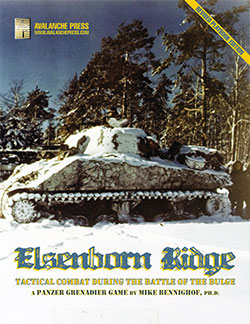 The flow of battle on the northern side of the Battle of the Bulge might as well have been laid down as a movie script or novel outline. There’s drama and sacrifice, good against evil, larger-than-life characters, and heroic deeds. And perhaps best of all from the storytelling perspective, the harsh terrain of the Ardennes and consequential importance of the few decent roads serve to channel the action into narrow silos. Divisions fight enemy divisions on a narrow front, and key crossroads and river crossings take on extreme importance. The flow of battle on the northern side of the Battle of the Bulge might as well have been laid down as a movie script or novel outline. There’s drama and sacrifice, good against evil, larger-than-life characters, and heroic deeds. And perhaps best of all from the storytelling perspective, the harsh terrain of the Ardennes and consequential importance of the few decent roads serve to channel the action into narrow silos. Divisions fight enemy divisions on a narrow front, and key crossroads and river crossings take on extreme importance.
All of that makes Panzer Grenadier: Elsenborn Ridge perfectly suited to our story-arc format. Both sides attack and defend, both are well-armed, but only one has right on their side. Let’s have a look at the fifth chapter.
Chapter Five
Criminal Elements
The German plan called for Battle Group Peiper to drive through a weak point in the American lines and head for the Meuse River. Joachim Peiper commanded the task force. Peiper had led the so-called “blowtorch battalion” on the Eastern Front, whose men delighted in setting civilians alight with flamethrowers. Peiper’s superiors hoped that his celebrated criminal record showed the “harshness” necessary to push his men to success; instead, he proved rather inept in command, as his task force missed the first day of the offensive thanks to poor march discipline.
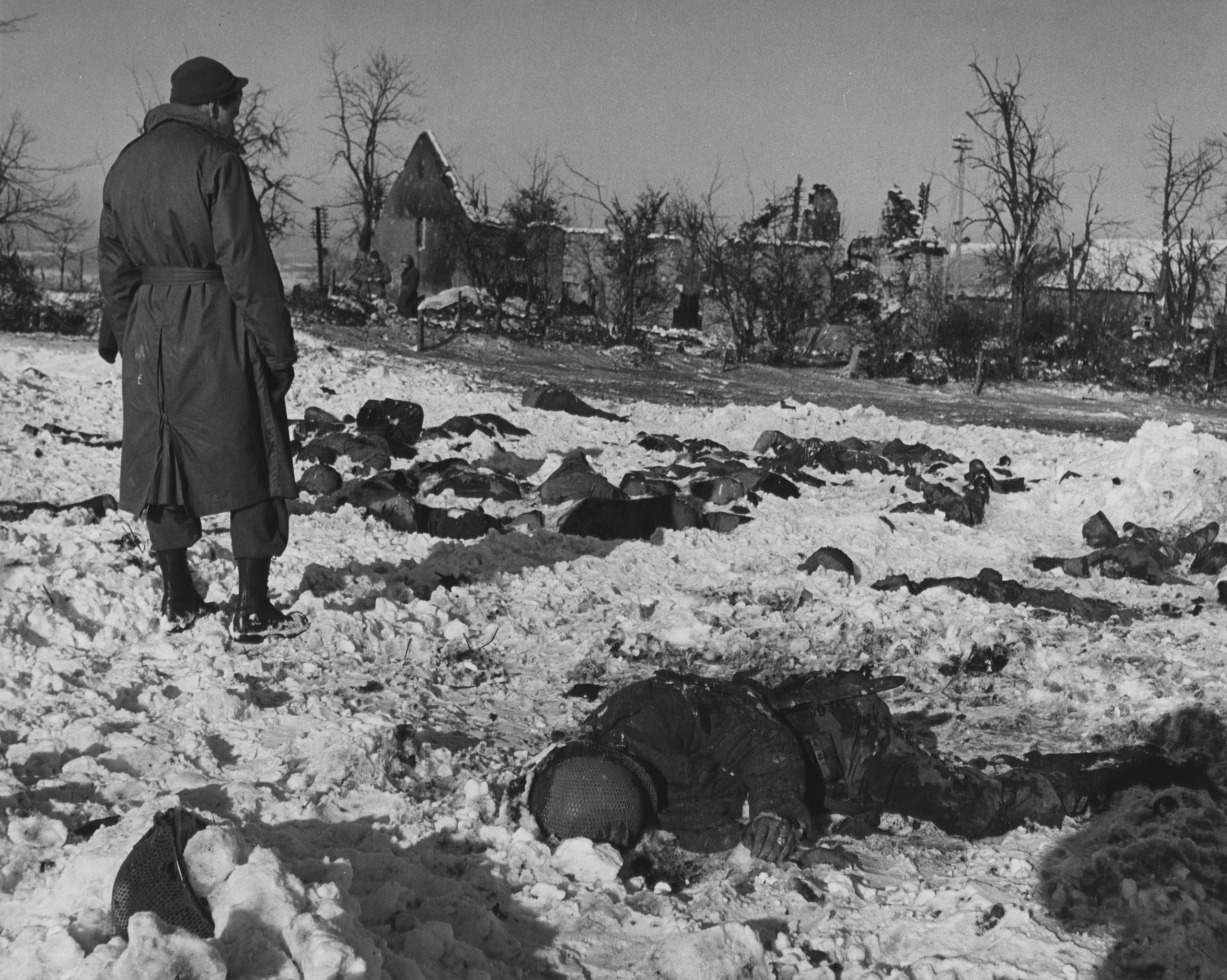
American prisoners of war murdered by Battle Group Peiper near Malmedy, Belgium.
The task force had an impressive array of units and weaponry, at least on paper: a mixed tank battalion, another tank battalion equipped with Tiger II heavy tanks, a mechanized infantry battalion in halftracks, an anti-aircraft battalion plus an artillery battalion and two companies of engineers. And all of those tracked vehicles would somehow force their way down the cowpaths that constituted the only “roads” in this section of the Ardennes. There was a reason that the Americans had only covered this part of the front with mechanized cavalry screening forces.
Peiper would be sentenced to death for his crimes, but this was commuted and he served only twelve years. He became an object of adoration for neo-Nazi fanboys that continues eight decades after his mass-murder spree. But against armed opponents in the Ardennes in late 1944, he had far less success.
Scenario Twenty-One
Carolina Fury
19 December 1944
German planners pinned most of their hopes on the 1st SS Panzer Division’s Battle Group Peiper. This powerful force of tanks and infantry made progress for the first several days of the offensive against confused and scattered opposition; the greatest delays seemed to come from the constant pauses to murder Belgian civilians and American prisoners. But at the town of Stoumont, Hitler’s SS ran into "Roosevelt’s SS"; the National Guard’s 30th Infantry Division, a veteran outfit so libeled by Nazi propagandist Axis Sally.
Conclusion
The Americans put up fierce resistance, but when the panzers reached the town and overran the last anti-tank guns, two of Lt. Col. Roy C. Fitzgerald’s companies broke. The third company of North Carolina Guardsmen fought practically to the last man inside Stoumont, with only 24 men surviving. Lt. Walter Macht’s tank company emerged from the fight with all of its Shermans and none of its ammunition. On the German side, the SS quailed until Maj. Werner Poetschke snatched up a Panzerfaust anti-tank rocket and stalked from tank to tank, threatening to use it on the reluctant crews himself if they did not advance on the Americans.
Notes
The SS party militia are on the attack with tanks and infantry against an American tank-infantry force with a slight edge in numbers and a serious edge in armor support (including Royal Tiger tanks). The Americans have determination, and a whole lot of artillery.
Scenario Twenty-Two
Bastard Tanks
20 December 1944
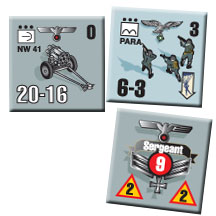 Having lost Stoumont, 30th Division moved quickly to take it back. Another battalion of the 119th Infantry moved up to replace Fitzgerald’s, and brought with it the 740th Tank Battalion. The tank battalion had just arrived at the front, with crews but no tanks, and Gen. Courtney Hodges of First Army ordered them to scrounge whatever vehicles they could from repair depots and join the attack. The Americans found a number of Shermans sent to U.S. repair centers by trusting British units, and stole those along with some duplex-drive amphibious tanks also left by the Brits. Maintenance crews worked throughout the night, cannibalizing vehicles whenever necessary, and when dawn broke 20 stolen “bastard tanks” rolled out to support the Guardsmen. Having lost Stoumont, 30th Division moved quickly to take it back. Another battalion of the 119th Infantry moved up to replace Fitzgerald’s, and brought with it the 740th Tank Battalion. The tank battalion had just arrived at the front, with crews but no tanks, and Gen. Courtney Hodges of First Army ordered them to scrounge whatever vehicles they could from repair depots and join the attack. The Americans found a number of Shermans sent to U.S. repair centers by trusting British units, and stole those along with some duplex-drive amphibious tanks also left by the Brits. Maintenance crews worked throughout the night, cannibalizing vehicles whenever necessary, and when dawn broke 20 stolen “bastard tanks” rolled out to support the Guardsmen.
Conclusion
Fighting quickly focused on the Catholic-run St. Edouard Sanitorium, a complex of stout stone buildings overlooking the road to Stoumont (Hex 1105 on Board 24). It changed hands several times, with combat taking on the surreal quality known to veterans of countless battlefields. At one point the Sister Superior and her nuns knelt in prayer, repeating the rosary while a company of SS men charged uphill chanting “Heil Hitler.” Snarling North Carolina Guardsmen answered with machine gun fire and then bayonets as the fighting raged from room to room. As night fell both sides had lost hundreds of men and the Americans pulled back to re-organize for another try.
Notes
These Nazis find that their speech is not protected by the National Guard. The criminal gang have a strong position and a good deal of armor to support their defense. The Americans have a lot of artillery to go with their stolen tanks. It’s okay to steal something if you use it to fight Nazis.
Scenario Twenty-Three
Night of the Long Knives
20 December 1944
As the "All American" Division joined the fight against Peiper, its staff found the Germans holding the key village of Cheneux. The 504th Parachute Infantry detailed two companies to capture it, but the attack faltered as night fell and the Germans poured fire on them from the many light anti-aircraft guns present in the town.
Conclusion
Deprived of artillery support, the paratroopers pressed captured German weapons into use but could get nowhere until a berserker fury overcame Sgt. George Walsh. Screaming “let’s get those sons of bitches!” he stormed forward alone, tossing grenades and drawing his fighting knife to tackle in hand-to-hand combat the German “flakwagons” punishing his company. One German crew died in a grenade blast, another in a flurry of knife slashes, and soon the troopers were swarming over the Germans. But American losses were so severe that they could not hold all of the ground they had taken, and it took reinforcements that arrived in the morning to finish the job.
Notes
It’s just a small scenario; the Nazis have some assault guns and anti-aircraft batteries pressed into ground combat; the Americans have a very angry sergeant with a very big knife.
Scenario Twenty-Four
Norwegian Nightmare
21 December 1944
With Battle Group Peiper trapped and Sixth SS Panzer Army unwilling to authorize a breakout, fresh reinforcements were flung into a relief attempt including Otto Skorzeny’s ramshackle “deception” brigade. His troops, clad in American uniforms, had been intended to seize the bridges over the Meuse River but now found themselves in regular ground combat.
Conclusion
Skorzney’s misfit band had a run of gross misfortunes: first, they ran into the only American unit containing a large proportion of Norwegians and recent immigrants, whose poor grasp of English made them immune to Skorzeny’s deception tactics. Next, they were attacking a scant few hundred yards from the site where SS men had murdered 86 unarmed American prisoners on the 17th; 43 men (including actor Charles Durning) escaped to bring the tale to other US units. Finally, Allied headquarters had issued permission to use the deadly proximity fuze that made American artillery utterly devastating to infantry in the open. This would be its first use. Skorzeny’s men attacked while shouting “surrender or die” and the Norwegians drove them back. The Germans in turn tried to surrender, milling about and screaming “Kamerad!” The Norwegians answered with machine-gun fire and an artillery barrage.
Notes
Those airbursts are deadly, and the Americans have Roland the Thompson Gunner fighting for them, too. It’s not a good day for the SS, and that’s how it should be.
Scenario Twenty-Five
Spearhead
21 December 1944
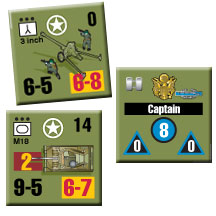 In Stoumont, the beleaguered SS militiamen of Battle Group Peiper came under intense, long-range direct fire from one of the “bastard” vehicles of the 740th Tank Battalion - a self-propelled 155mm GPF rifle of unknown origin, probably stolen from its parent unit. Running out of fuel, the militia could neither move forward nor retreat. The Americans planned a fresh assault that started to go wrong when an infantry battalion and its tank support attacked from wildly different directions instead of together. In Stoumont, the beleaguered SS militiamen of Battle Group Peiper came under intense, long-range direct fire from one of the “bastard” vehicles of the 740th Tank Battalion - a self-propelled 155mm GPF rifle of unknown origin, probably stolen from its parent unit. Running out of fuel, the militia could neither move forward nor retreat. The Americans planned a fresh assault that started to go wrong when an infantry battalion and its tank support attacked from wildly different directions instead of together.
Conclusion
The 2nd Battalion of the 119th Infantry Regiment lost its commander early in the attack when he stumbled into a German patrol. Meanwhile the 3rd Armored Division’s Task Force Jordan missed the infantry during its march south and, rather than keep looking for them, Capt. John Jordan ordered his troops to attack without them. Both units failed in their missions – one prong lacked tank support, the other sufficient infantry. The SS militia would soon slink away from Stoumont of their own accord.
Notes
Make sure you use those golden pieces from Spearhead Division when you play this scenario. The American player has the advantage of knowing where all of his or her troops are, while the SS are running out of gasoline. This is another tough one for the bad guys, as it should be.
And that’s Chapter Five. Next time, we dig into Chapter Six.
Order Elsenborn Ridge Here.
Sign up for our newsletter right here. Your info will never be sold or transferred; we'll just use it to update you on new games and new offers.
Mike Bennighof is president of Avalanche Press and holds a doctorate in history from Emory University. A Fulbright Scholar and NASA Journalist in Space finalist, he has published a great many books, games and articles on historical subjects; people are saying that some of them are actually good.
He lives in Birmingham, Alabama with his wife and three children. He misses his lizard-hunting Iron Dog, Leopold.
Daily Content includes no AI-generated content or third-party ads. We work hard to keep it that way, and that’s a lot of work. You can help us keep things that way with your gift through this link right here.
|