September 1939
Publisher’s Preview
by Mike Bennighof, Ph.D.
July 2025
 On 1 September 1939, the deluge began: Nazi Germany sent hordes of troops and tanks into Poland, backed by overwhelming air power. A little more than two weeks later, the Soviet Union joined in. The Polish armed forces fought valiantly in a doomed struggle; in a little over a month, Poland had been erased once again from the map of Europe. On 1 September 1939, the deluge began: Nazi Germany sent hordes of troops and tanks into Poland, backed by overwhelming air power. A little more than two weeks later, the Soviet Union joined in. The Polish armed forces fought valiantly in a doomed struggle; in a little over a month, Poland had been erased once again from the map of Europe.
On the strategic level, Poland never had a chance to defeat the twin invasions, given the balance of forces and geographic realities. On the operational level, the Poles overburdened their army headquarters and kept too many supporting arms under central control. But at the tactical level, where Panzer Grenadier lives, the Polish soldier proved himself at least the equal of his German enemy.
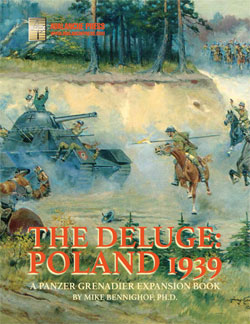
We told the story of the campaign’s first days in The Deluge. The Deluge has 40 scenarios from the September Campaign. Of those 40, 27 take place on 1 September, the first day of the invasion. That’s appropriate, since the Poles fought to defend their borders in the vain hope of screening their mobilization centers long enough to bring the full weight of their sixty-division-army into the field. That didn’t work out, and Poland fought with about half of her military potential. Some scenarios take place a few days later, but none after 5 September. The war went one for another month and a day, which means there’s still a lot of Polish valor to describe in game form.
I went with that approach for a few reasons. First, there’s the title, The Deluge. It’s borrowed from Henrik Sienkiewicz’s masterful “Polish Trilogy,” the foundational novels of modern Polish literature. The Deluge (the second volume) is told against the backdrop of the disastrous 1655 Swedish invasion of Poland (if you’re looking to read it in English, the 1904 translation by Curtin is bowdlerized drivel; the 1991 translation by Kuniczak shows the true artistry of the original). Concentrating on just the first day gives, I think, the same impression held by the Polish high command, that it’s 1655 all over again.
 It also fits in with the story-arc format we now use for all Panzer Grenadier books and games. The scenario set is built as a series of chapters, with each chapter covering a part of the campaign and the scenarios then showing the individual battles within it. There’s historical text to fill in the backstory, and a “battle game” to tie play of the scenarios together. It also fits in with the story-arc format we now use for all Panzer Grenadier books and games. The scenario set is built as a series of chapters, with each chapter covering a part of the campaign and the scenarios then showing the individual battles within it. There’s historical text to fill in the backstory, and a “battle game” to tie play of the scenarios together.
I like this format very much. First off, it gives a structure to play of the scenarios, drawing the players into the experience and helping suspend their disbelief (so they’re thinking about leading their troops rather than pushing little cardboard bits). Second, it lets me, as the designer, tell the story in game format; I want our games to be historical statements as well as fun pastimes.
Beyond that, from the design standpoint it just helps me to visualize what I want to say through the medium of the game. Once I’ve settled on the slice of the campaign I want to show through a particular chapter, and how the action advances, then the individual scenarios usually fall together pretty logically. While that does mean deciding on the broad parameters of six or seven scenarios at once (sometimes fewer, on occasion more), it’s far easier for me at least to do it that way than to design individual scenarios and try to fit them into a larger narrative.
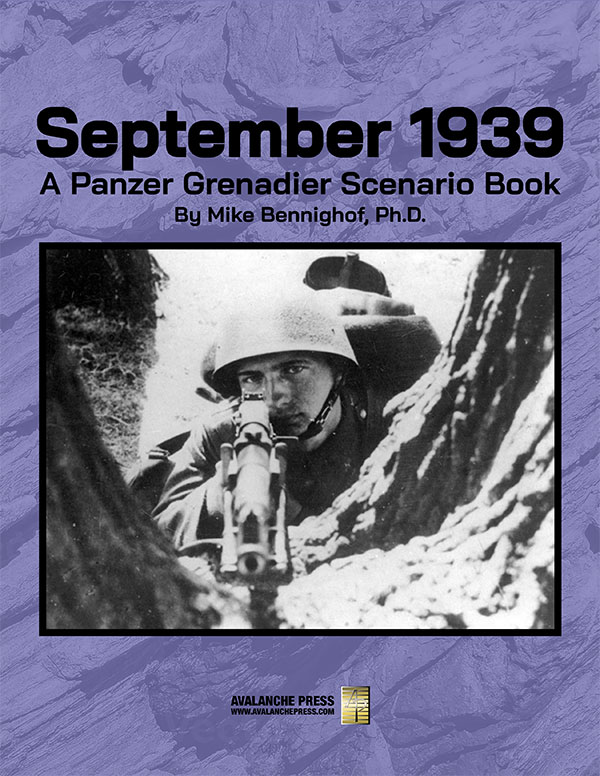
September 1939 is a scenario book, with another 40 scenarios picking up the story after the deluge of the campaign’s first day. Not every point of high drama took place on the first day, and building the story in this manner still left many exciting parts of the story for September 1939. September 1939 doesn’t include more pieces; the Polish pieces are found in The Deluge, which has 165 of them.
Despite what Nazi propaganda told the world, the Germans didn’t smash through Polish lines with their tanks. The first day’s successes were due to the German staff taking advantage of the thinly-spread Polish deployment along the border and concentrating their infantry and artillery to yield massive numerical advantages at key points. Only then did the panzers rampage through the Polish lines, cutting off isolated units and disrupting Polish re-deployments.
That means that much of the panzer action is still to come, in September 1939. Poland fielded two armored brigades in 1939 (one from the cavalry branch and one from the infantry branch; a pretty typical solution across European armies of the time including the Germans). We included the heroic defense of the cavalry’s armored brigade in The Deluge, since they were involved from Day One.

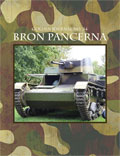
A Polish 7tp light tank, seen during the September Campaign.
They’ll show up again, and so will the infantry branch’s Warsaw Armored Brigade, which had most of Poland’s tanks and was part of the general reserve on Day One (and thus do not appear in The Deluge). They fought bravely and well in the Battle of Tomaszów Lubelski; they were also essentially destroyed as a combat unit. And along with Poland’s tanks, we see more of Poland’s ubiquitous armored trains, including history’s only battle between opposing armored trains.
The Poles had won their war with the Soviet Union at the 1920 Battle of Warsaw, with a grand counter-offensive that crushed the over-stretched Soviet armies and sent then tumbling back hundreds of miles to and past the frontier. The biggest Polish counter-attack of the war, along the Bzura River, took place over ten days starting on 9 September, and was more of a desperation move by the Polish Army Poznan seeking to fight its way clear of German forces threatening to surround it. The Polish cavalry fought with distinction, but could not prevent the Poles’ encirclement.
The Poles tried to rally around Warsaw, as they had done in 1920, and fought off several German assaults on the capital. German terrorism helped sap their will to fight; the Germans bombed and shelled civilian targets relentlessly, and even massacred the entire roster of the PZL Warzawa soccer team. Meanwhile, French and British politicians delivered stirring speeches praising Polish courage, but did nothing to relieve pressure on Warsaw with an offensive in the West. The capital held out for 19 days, and with its capitulation on 28 September, organized resistance would last for only another week.
That’s plenty of drama to fill September 1939, even without the Soviet invasion (we’ll cover that in another volume). Telling stories like this is the reason why I design wargames; if that’s why you read and play them, then you will want this book.
Join the Gold Club Here.
See your Gold Club Insider newsletter to order September 1939.
Order The Deluge Here.
Sign up for our newsletter right here. Your info will never be sold or transferred; we'll just use it to update you on new games and new offers.
Mike Bennighof is president of Avalanche Press and holds a doctorate in history from Emory University. A Fulbright Scholar and NASA Journalist in Space finalist, he has published a great many books, games and articles on historical subjects; people are saying that some of them are actually good.
He lives in Birmingham, Alabama with his wife and three children. He misses his lizard-hunting Iron Dog, Leopold.
Daily Content includes no AI-generated content or third-party ads. We work hard to keep it that way, and that’s a lot of work. You can help us keep things that way with your gift through this link right here.
|