| Parachutes Over Crete:
New Zealand’s Maori Battalion
By Mike Bennighof, Ph.D.
December 2022
 By 1939, many in New Zealand had begun to
accept the cultural equality of the native
Maori people with the pakeha (white European)
settler culture. As war seemed to be approaching
in the summer of 1939, two Maori members of
the New Zealand Parliament made a public demand
that any military expeditionary force sent
abroad include a distinctive Maori combat
unit. By 1939, many in New Zealand had begun to
accept the cultural equality of the native
Maori people with the pakeha (white European)
settler culture. As war seemed to be approaching
in the summer of 1939, two Maori members of
the New Zealand Parliament made a public demand
that any military expeditionary force sent
abroad include a distinctive Maori combat
unit.
A Maori Pioneer Battalion had served with
the New Zealand Expeditionary Force in France
in the First World War, but the political
thought of the 1930s and 1940s said combat
service was a necessary measure of racial
equality. On 4 October 1939, a month after
New Zealand declared war on Germany, the government
announced it would form a distinctively Maori
infantry battalion. The enlisted personnel would be
ethnic Maoris, but the government reserved
the right to appoint pakeha officers.
Though this provision proved unpopular with
Maori leaders, signs that the government and
army were actively seeking Maori officer candidates
to train and promote eased the protests somewhat.
And the Maori unit became especially popular
after one of the new recruits, Pvt. Anania
Amohau, wrote a marching song for the battalion
and introduced the haka, or preparatory war
dance. The haka became a distinctive feature
not only of the Maori Battalion but eventually
of the entire New Zealand Army and its international
sports teams. And the government kept its
promise; every battalion commander after the
first was at least partly Maori.
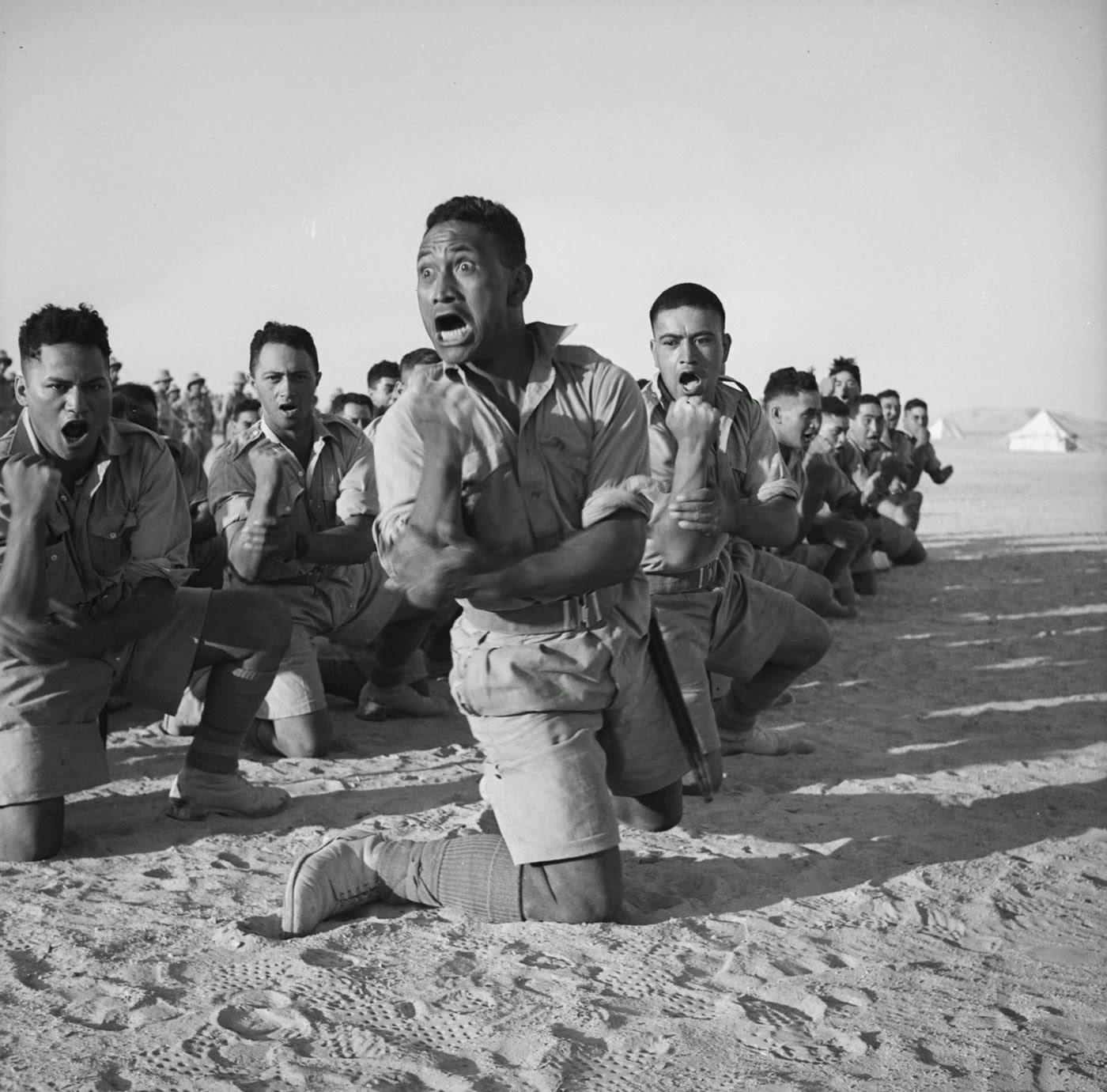
Maori troops perform
the haka. Egypt, 1941.
Maori soldiers
had a very pronounced habit of acquiring automatic
weapons from multiple sources: abandoned on
the battlefield, taken off enemy prisoners
or the dead, or “borrowed” from
other units. This is not an unusual situation: During wartime many soldiers
of all nationalities acquire additional pieces
of equipment. What made the Maori unique was
the sheer scale of their acquisitions, and
the reluctance of higher authority to take
their toys away. After one bad experience
in handing over their extra weapons for “inventory,”
the Maori never again yielded up their gear.
It appears that New Zealand officers did not
want to anger the warriors, and in the official
record there’s an unstated implication
that the Maori would have played the race
card over this issue in Parliament back home.
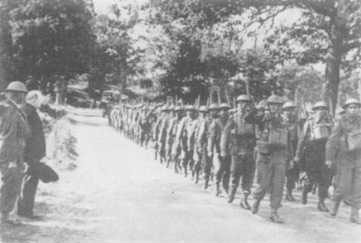
The
Maori Battalion in England
Maori also had a reputation for excellence
in fighting with knives or bare hands, and
for skill in close-quarter action. Whether
they were any better than other ANZACs (no
mean brawlers themselves) is open to debate. Throughout the war, all Maori were volunteers.
The battalion’s four companies were
organized by tribal affiliation, and gathered
on North Island for several months of training
before embarking for England on 1 May 1940.
After eight months of training there, the
battalion and the rest of the division went
to Egypt and on to Greece as soon as they
arrived.
The Maori saw their first combat on 16 April,
in a series of clashes with advancing German
mountain and panzer units near Mount Olympus.
When the 2nd New Zealand Division evacuated
Greece two weeks later, most of the battalion
got off intact. Its carrier platoon had been
detailed with the Divisional Cavalry and was
taken prisoner at Corinth while the battalion’s
Reinforcement Company was caught up in the
confusion and surrendered to the Germans at
Kalamata Bay.
The Maoris saw much more extensive fighting
during the German air landings on Crete,
escaping afterwards with the rest of the division
to Egypt. But their real test under fire came
in Libya, when the division entered the front
lines in November 1941, as part of the second
echelon of Operation Crusader.
Until these actions, the
New Zealand command seems to have been divided
over Maori fighting qualities. The inherent
racism of the era made it hard for some of
them to accept a unit including many non-white
commissioned officers. But after the battalion’s
excellent performance in Crusader, division
command never again left the battalion in
the rear and more than once separated it from
the brigade structure for use as a shock column
or special reserve.
The Maori accompanied the New Zealand Division
across North Africa and into Italy, fighting
at Monte Cassino. Their last battle came at
Udine in the Italian Alps in April 1945. In
January 1946, they returned to New Zealand,
where Maori women sang the tangi for the dead,
all had the blood of their enemies ceremonially
cleansed from their souls, and the battalion
ceased to exist.
You can order Parachutes over Crete right here.
Sign up for our newsletter right here. Your info will never be sold or transferred; we'll just use it to update you on new games and new offers.
Mike Bennighof is president of Avalanche Press and holds a doctorate in history from Emory University. A Fulbright Scholar and NASA Journalist in Space finalist, he has published a great many books, games and articles on historical subjects; people are saying that some of them are actually good.
He lives in Birmingham, Alabama with his wife, three children, and new puppy. He misses his lizard-hunting Iron Dog, Leopold.
Want to keep Daily Content free of third-party ads? You can send us some love (and cash) through this link right here.
|