Elsenborn Ridge:
Scenario Preview, Chapter Three
by Mike Bennighof, Ph.D.
September 2025
 Language matters, we were taught in grad school. It’s been a trend in academia to emphasize words over events for some decades now, to the point that “violence” has come to means “harsh words” or even “words I don’t like” in some quarters of the ivory tower. But just because a point gets taken to ridiculous extremes, that doesn’t make it invalid. Language matters, we were taught in grad school. It’s been a trend in academia to emphasize words over events for some decades now, to the point that “violence” has come to means “harsh words” or even “words I don’t like” in some quarters of the ivory tower. But just because a point gets taken to ridiculous extremes, that doesn’t make it invalid.
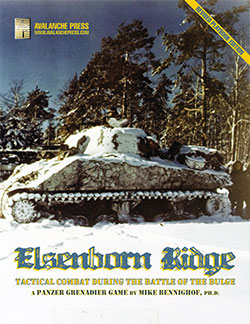
When I re-made Panzer Grenadier: Elsenborn Ridge, I made some changes to its language. I translated German terms that had been left in the original; “Volksgrenadier” is now “People’s Grenadier.” “Waffen SS” is now “Armed SS,” and the organization’s men are now properly described as a party militia. The Armed SS was a branch of the National Socialist German Workers’ Party, and not part of the German armed forces. They’re identical in that regard to the Italian Blackshirts, who wargames have almost always described as militia and not as “soldiers.”
Does it make much difference? Not really. But the servants of an evil regime don’t get to have cool, special names.
Let’s continue our scenario review with Chapter Three.
Chapter Three
Heroes of St. Vith
In order to move westward, the attacking Germans had to pass through the road junction of St. Vith. The only two paved roads in this sector converged on the Belgian town, funneling any movement there. As soon as the extent of the German offensive became apparent, the higher-level American commands – First Army and VIII Corps – began to direct reinforcements there.
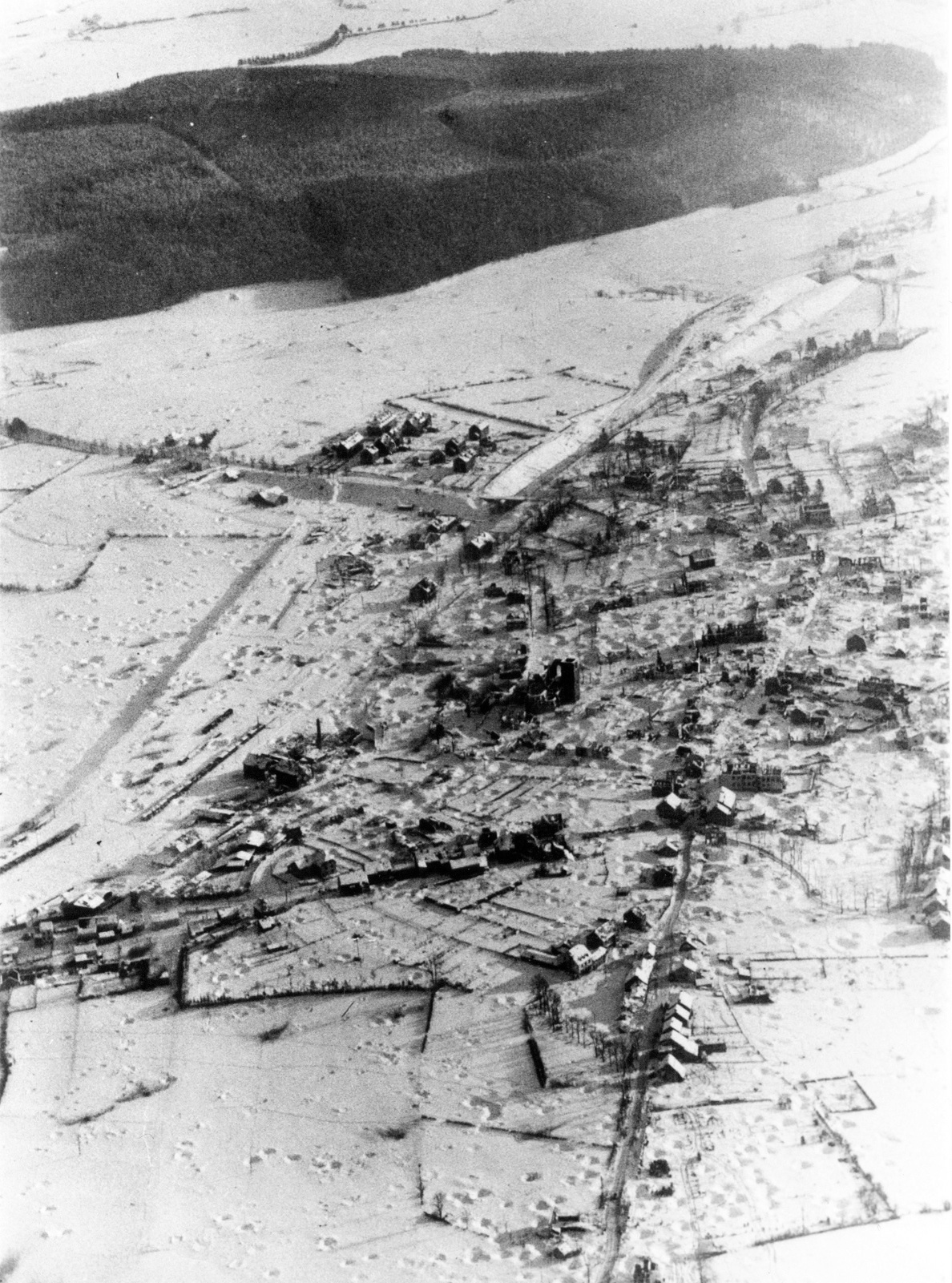 The wreckage of St. Vith. Late December 1944. The wreckage of St. Vith. Late December 1944.
But these still lay some distance away. Seventh Armored Division was in the Netherlands when the Germans attacked, sixty miles from St. Vith. Ninth Armored Division stood in the rear as VIII Corps’ reserve, and one combat command had begun to move forward on 13 December to take part in an American offensive into the West Wall fortifications. And finally, the lone remaining infantry regiment of the 106th Infantry Regiment was already in the area; the other two regiments were surrounded by the Germans and would surrender on 19 December.
But the sacrifice of those two regiments would hold up the Germans long enough for Combat Command B of 7th Armored Division to make it across narrow, icy roads and through monumental traffic jams to join the defense. A division’s worth of troops, but with no clear leadership or direction, would have to be enough against elements of four German divisions and an independent brigade.
Scenario Eleven
First Probe
18 December 1944
The town of St. Vith controlled a vital crossroads, but the German Fifth Panzer Army did not at first assign major forces to capture the town. Only on the offensive’s third day did a People’s Grenadier division bring up its “mobile” battalion and advance half-heartedly on St. Vith. The disorganized defenders - the senior American officer, Alan W. Jones of the shattered 106th Infantry Division, had abdicated command to a junior general, Bruce Clarke of the 7th Armored Division’s Combat Command B - had flung a cavalry squadron out to provide a thin screen northeast of the town.
Conclusion
The Germans made some initial progress, as the cavalrymen had little answer for the assault guns. When a company of tanks from the 9th Armored Division answered the cavalry’s frantic calls for help, the balance shifted and over half of the German vehicles were left burning on the battlefield. There would be no easy capture of St. Vith.
Notes
This is a small scenario, with a battalion’s worth of Germans backed by a company of assault guns running into an American screen with armored infantry and armored cars, later supplemented by Sherman tanks. The Germans are going to have to work fast to seize their objectives, which is going to be tough since they’re on foot and the Americans are in half tracks.
Scenario Twelve
First Assault
18 December 1944
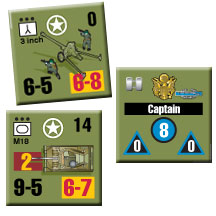 While the Americans milled around in confusion within the St. Vith perimeter, on the other side of the uncertain front lines, things were little better. It took a day and a half for the 18th People’s Grenadier Division to bring its infantry into line to attack, and even then, some of its artillery remained trapped in the massive traffic jams clogging the narrow roads. Ordered to attack anyway, the division launched its planned night assault in mid-morning. While the Americans milled around in confusion within the St. Vith perimeter, on the other side of the uncertain front lines, things were little better. It took a day and a half for the 18th People’s Grenadier Division to bring its infantry into line to attack, and even then, some of its artillery remained trapped in the massive traffic jams clogging the narrow roads. Ordered to attack anyway, the division launched its planned night assault in mid-morning.
Conclusion
The People’s Grenadiers made some progress against the American 38th Armored Infantry Battalion, but lost all their gains thanks to a timely counterattack by a nearby engineer battalion fighting as infantry. Troops on both sides proved very skittish under enemy artillery fire, with the greater American firepower making its weight felt.
Notes
It’s Fort Apache: The Ardennes, with hordes of Huns boasting low morale and no armor support crash against American positions manned by high-morale armored infantrymen backed by a handful of light tanks, a whole lot of artillery, and eventually getting help from those damned engineers. It’s probably going to be a long day for the Herrenvolk.
Scenario Thirteen
Help Arrives
18 December 1944
While three German divisions jostled for position to attack the vital crossroads town of St. Vith, two American armored divisions tried just as hard to jam reinforcements through the tidal wave of retreating men and vehicles streaming to the west. The two American divisions had little coordination, and when separate task forces found themselves heading up highway N23 to battle the advancing SS militia they joined up to give Hitler’s favorites a nasty shock.
Conclusion
As often happened during the Battle of the Bulge, the wandering American troops were perfectly willing to fight - as long as someone pointed them toward the enemy. Lt. Col. Leonard Engeman picked up some anti-aircraft halftracks along the way and tasked the 7th Armored tanks with providing fire support while his own went right at the SS. Stunned by the sudden violent resistance, the hardened Nazis fled in panic. Their division commander, Wilhelm Mohnke, decided that he really didn’t need to pass through St. Vith after all and turned his troops to the west.
Notes
This time the Armed SS militia attack St. Vith, and they do it with one of their handful of divisions that was actually good. The Americans aren’t very numerous, they have no artillery support and their infantry isn’t mobile, but they have tanks and heavy support weapons and a willingness to fight. The SS have to do a lot in order to win, so this is going to be tougher on the German player than it looks.
Scenario Fourteen
The Devil’s Own
20 December 1944
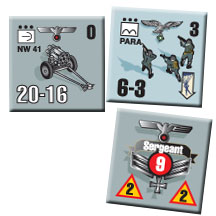 Ordered to attack St. Vith, Col. Otto Remer of the Supreme Leader’s Escort Brigade had his own ideas - a political soldier, he hoped to attract even more of his adored leader’s favor by reaching the Meuse River before any other unit. He therefore brought his brigade around the town’s northern perimeter and attacked a weak spot in the American lines. If successful, Remer’s brigade would bypass St. Vith completely and race into the rear areas. Ordered to attack St. Vith, Col. Otto Remer of the Supreme Leader’s Escort Brigade had his own ideas - a political soldier, he hoped to attract even more of his adored leader’s favor by reaching the Meuse River before any other unit. He therefore brought his brigade around the town’s northern perimeter and attacked a weak spot in the American lines. If successful, Remer’s brigade would bypass St. Vith completely and race into the rear areas.
Conclusion
Remer’s dreams came to a crashing halt in the form of 90mm shells from the 814th Tank Destroyer Battalion. The new, speedy M36 vehicles ambushed the German tank column and shot up its leading vehicles. The German attack fell apart and Remer pulled back to wait for the rest of his brigade to arrive before making a renewed (and unauthorized) dash for glory.
Notes
What’s a bumbling and incompetent authoritarian leader without even-more bumbling and incompetent minions? Here the minionist of the minions runs into strong opposition, and though Remer has excellent troops and top-flight equipment the Americans have a secret weapon (the M36 tank destroyer) and in this generation, the determination to resist evil.
Scenario Fifteen
The Fall
21 December 1944
The American 7th Armored Division had raced to St. Vith and flung its units into defensive positions haphazardly as they arrived. A handful of troops from the shattered 106th Infantry Division joined them, and a few small units of the 9th Armored Division also became intertwined. Nevertheless, they put up stout resistance, but when the Germans sorted out their own confusion and launched a mass attack numbers made a difference.
Conclusion
Though unsettled by the rocket fire, the Americans resisted with the aid of tanks and tank destroyers. When the huge Royal Tiger tanks finally rumbled into the battle zone, the Germans blinded the American tankers with flares and while they were still stunned the huge 88mm guns annihilated the Shermans. The American commander of the forward defenses, Col. Hurley E. Fuller of the 110th Infantry Regiment, apparently suffered a nervous breakdown and fled the battlefield (later to be captured), yet his junior officers refused to give up the now-uncoordinated fight and 7th Armored Division’s Combat Command B lost over 900 men in fierce close-quarters fighting. By midnight the Germans had secured St. Vith.
Notes
This time it’s a big scenario, with all the boards in play and the Germans flooding the zone with . . . not very good units, plus a battalion of Royal Tiger tanks. The Americans have armor support and as always lots of artillery, but there are an awful lot of awful Germans.
And that’s Chapter Three. Next time, we dig into Chapter Four.
Order Elsenborn Ridge Here.
Sign up for our newsletter right here. Your info will never be sold or transferred; we'll just use it to update you on new games and new offers.
Mike Bennighof is president of Avalanche Press and holds a doctorate in history from Emory University. A Fulbright Scholar and NASA Journalist in Space finalist, he has published a great many books, games and articles on historical subjects; people are saying that some of them are actually good.
He lives in Birmingham, Alabama with his wife and three children. He misses his lizard-hunting Iron Dog, Leopold.
Daily Content includes no AI-generated content or third-party ads. We work hard to keep it that way, and that’s a lot of work. You can help us keep things that way with your gift through this link right here.
|