| 1940 The Fall of France:
Scenario Preview, Part Three
By Mike Bennighof, Ph.D.
July 2026
.jpg) The 1940 campaign in Western Europe represents a historical oddity – it’s the one large-scale campaign during World War Two against what today would be called a peer adversary which the vaunted German Army actually won. The ubiquity of German soldiers and tanks and airplanes on wargame covers might lead one to think otherwise, but in the real thing, they were pretty consistent losers. The 1940 campaign in Western Europe represents a historical oddity – it’s the one large-scale campaign during World War Two against what today would be called a peer adversary which the vaunted German Army actually won. The ubiquity of German soldiers and tanks and airplanes on wargame covers might lead one to think otherwise, but in the real thing, they were pretty consistent losers.
Fighting the French, however, they had a great deal of success. France had a fine army, though one hampered by its success in the First World War – that led to the retention of the doctrine, weapons and generals of the last war. That fine army had difficulties coping with German mobility, but at the tactical level, where Panzer Grenadier lives, the French could still dish it out.
Together with Road to Dunkirk, the new Playbook edition of 1940: The Fall of France lets players dig into the history of the campaign at the level of the men who fought the battles. Let’s have a look at the scenarios from Chapter Two.
Chapter Two
Race to the Meuse
The French cavalry fell back in front of the 5th and 7th panzer divisions of Hermann Hoth’s XV Panzer Corps pressing westwards through the Belgian Ardennes. The cavalry retreated behind the river Ourthe, blowing up the bridges behind them. However, the 7th Panzer Division crossed the river anyway and attacked the town of Marche, defended by the 4th DLC. Surrounded on all sides by the armored cars and motorcyclists of the German reconnaissance units, the French cavalry conducted a fighting retreat towards the river Meuse. On the evening of 12 May the panzers reached the Meuse, to find that all of the bridges had already been blown up.
Scenario Eight
Through the Ardennes
11 May 1940
Between Marche and Rochefort, Belgium
 At the outbreak of war, the French cavalry divisions had been ordered into the Ardennes to delay any German advance there until Ninth Army’s infantry divisions could establish a strong defensive line along the Meuse River. But the cavalrymen badly misjudged German movements, expecting that it would take at least five days for the Germans to make their way through the forest. The rapid advance of the German motorized divisions caught the French forces off guard, and when they reached the Lomme River the French were not in a position to stop them. At the outbreak of war, the French cavalry divisions had been ordered into the Ardennes to delay any German advance there until Ninth Army’s infantry divisions could establish a strong defensive line along the Meuse River. But the cavalrymen badly misjudged German movements, expecting that it would take at least five days for the Germans to make their way through the forest. The rapid advance of the German motorized divisions caught the French forces off guard, and when they reached the Lomme River the French were not in a position to stop them.
Conclusion
At noon the motorcyclists and armored cars of the 1st Armored Car Regiment clashed with the advance elements of 7th Panzer Division near the Chavannes crossroad. Several armored cars were damaged on both sides before the French fell back towards the Lomme River. German attacks all along the river line put enormous pressure on the French formations, and when word came that the 4th DLC had retreated the French command sent some anti-tank guns to defend the river bridges while the engineers worked to blow them up. The maneuver worked, with the bridges destroyed after all French units had retreated behind the river.
Notes
This time, it’s a revised version of a first edition scenario, and it’s quite a large one: four boards with the lead elements of a panzer division crashing into a well-supported force of dismounted cavalry backed with a lavish assortment of machine guns, mortars, anti-tank guns and armored cars. The French are holding a river line; the Germans are trying to cross it. German tanks are numerous, and that’s about the best that can be said of them – the French armored cars will shoot them to pieces, given half a chance. The Germans are better supplied with artillery but have to seize a serious bridgehead if they want to win.
Scenario Nine
Race to the Meuse
12 May 1940
Between Marche and Dinant, Belgium
 On the evening of May 11th, General André Corap commanding the French Ninth Army ordered the vanguard elements of the cavalry divisions in the Ardennes to fall back to the Meuse River. The relatively lightly-armed cavalry had no answer for German numbers and firepower, and their mobility allowed them to threaten the French flanks and press toward circling the defenders. The French began to withdraw early on 12 May, with mobile elements covering the retreat of the slower units. On the evening of May 11th, General André Corap commanding the French Ninth Army ordered the vanguard elements of the cavalry divisions in the Ardennes to fall back to the Meuse River. The relatively lightly-armed cavalry had no answer for German numbers and firepower, and their mobility allowed them to threaten the French flanks and press toward circling the defenders. The French began to withdraw early on 12 May, with mobile elements covering the retreat of the slower units.
Conclusion
With the French infantry divisions still arriving along the Meuse and not yet ready to hold the line at this stage, the retreating units had to make a fighting withdrawal. Taking every possible advantage of the terrain, the dragons and chasseurs succeeded in slowing down the Germans so that the less-mobile French units could cross the Meuse in safety. German attempts to press the retreating French proved costly in men and machines; a sole 25mm French anti-tank gun claimed no less than a dozen German tanks destroyed in one day. Around 1600 French engineers blew up the bridges at Dinant and Bouvignes within view of the first approaching panzers, just after the last French elements had crossed to safety.
Notes
We had a version of this scenario in the first edition, and it is a huge one: seven boards laid out to form a long east-west corridor. The French are trying to get safely off the west edge; the Germans are chasing them. The French have surprisingly good morale for such a situation, and artillery support: this is not a panicked flight. They also have three batteries of the very good 47mm APX anti-tank gun, which will shred the German tanks if given a chance. The French player will have to decide carefully when to run, and when to turn and fight.
Scenario Ten
Rommel Crosses the Meuse
13 May 1940
Between Anhée and Houx, north of Dinant, Belgium
 Rommel’s 7th Panzer, the “ghost division,” beat the neighboring 5th Panzer Division to the Meuse, though not by much. Col. Paul-Hermann Werner of 5th Panzer came very close to capturing the bridge at Yvoir, but a few Belgian engineers blew it up just in time. At Houx, some kilometers farther south, a motorcycle unit discovered a small lock with an intact foot bridge linking both banks of the river to a small island. These troops crossed the river at night on 12 May (leaving their motorcycles behind) and set up defensive positions on the west bank. At dawn the next day, the main German assault across the Meuse began. Rommel’s 7th Panzer, the “ghost division,” beat the neighboring 5th Panzer Division to the Meuse, though not by much. Col. Paul-Hermann Werner of 5th Panzer came very close to capturing the bridge at Yvoir, but a few Belgian engineers blew it up just in time. At Houx, some kilometers farther south, a motorcycle unit discovered a small lock with an intact foot bridge linking both banks of the river to a small island. These troops crossed the river at night on 12 May (leaving their motorcycles behind) and set up defensive positions on the west bank. At dawn the next day, the main German assault across the Meuse began.
Conclusion
From their crossing point at Houx, German infantry slowly infiltrated French lines and sowed confusion among the newly-arrived French 39th Infantry Regiment. Meanwhile, just south of Yvoir, Werner – commanding 5th Panzer Division’s advance guard - made an amphibious assault across the river but was beaten back with heavy losses by French artillery and machinegun fire. Most of the boats were destroyed, and 5th Panzer Division had to no choice but to brave heavy French artillery fire and concentrate its efforts on the Houx foot bridge. Eventually the already-weakened French 39th Infantry Regiment collapsed in the face of intensifying German infantry attacks, and by the end of the day the German bridgehead was deep enough to support a full-scale assault the following day. Six weeks later, the 47-year-old Werner would celebrate his regiment’s arrival on the Atlantic coast by swimming out into the cold waves, where he suffered a heart attack, slipped under the waves and drowned.
Notes
In another re-made first edition scenario, the board’s small, but the forces are (relatively) huge: roughly four German battalions (with tanks and support weapons) are trying to force a river crossing against three battalions of French troops backed by artillery. This is a really fun scenario: there’s not much subtlety as big stacks of infantry brawl at the river’s edge. With only two boards in play there’s no space for cute little maneuvers: the Germans are going to have to come right at the French.
Scenario Eleven
Spearhead
14 May 1940
Haut-le-Wastia, Belgium
 On 13 May, the 5th Panzer Division crossed the Meuse north of Dinant and sent infantry probes westward to expand the bridgehead and secure strategic objectives. A tiny village on the edge of a plateau overlooking the road to Anthée, Haut-le-Wastia became one such unwilling objective. French forces defended the village all day long, and the 1st Groupement de Reconnaissance de Division d’Infanterie – a battalion-sized independent recon unit – arrived as reinforcements. But German air attacks kept them away and the village fell that night. Gathering reinforcements under cover of darkness, they counterattacked at dawn the next day. On 13 May, the 5th Panzer Division crossed the Meuse north of Dinant and sent infantry probes westward to expand the bridgehead and secure strategic objectives. A tiny village on the edge of a plateau overlooking the road to Anthée, Haut-le-Wastia became one such unwilling objective. French forces defended the village all day long, and the 1st Groupement de Reconnaissance de Division d’Infanterie – a battalion-sized independent recon unit – arrived as reinforcements. But German air attacks kept them away and the village fell that night. Gathering reinforcements under cover of darkness, they counterattacked at dawn the next day.
Conclusion
Several AMR33 and P16 armored cars supported the dragoons attacking from the west. Many of the Germans retreated to the center of the village, but the French quickly surrounded them there and forced them to surrender when the Germans’ ammunition ran out. By 0730 hours the fighting died down and the French commander radioed Ninth Army headquarters to report his victory. Army commander Gen. André Corap responded by ordering a retreat, since German tanks had crossed the Meuse.
Notes
We return with another revised first edition scenario, this time a little one with just one map. The French are on the attack, and their troops are of mixed quality. The Germans are pretty good but have no support from artillery or heavy weapons. Objectives are pretty straightforward: the Germans hold the town hexes, and the French are here to kick them out.
Scenario Twelve
Expanding the Bridgehead
14 May 1940
West of the Meuse, near Dinant, Belgium
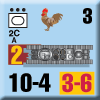 The day began well for the French; the successful early-morning counterattack at Haut-le-Wastia had endangered the whole German bridgehead on the Meuse. But 5th and 7th Panzer Divisions had been working to merge their two separate toeholds on the left bank and expand their control to the west. German engineers labored through the night to throw two pontoon bridges across the Meuse, one to the south of Houx and another one at Bouvignes. But neither bridge was strong enough to support tanks, so the main burden of expanding the bridgehead once again fell to the infantry. The day began well for the French; the successful early-morning counterattack at Haut-le-Wastia had endangered the whole German bridgehead on the Meuse. But 5th and 7th Panzer Divisions had been working to merge their two separate toeholds on the left bank and expand their control to the west. German engineers labored through the night to throw two pontoon bridges across the Meuse, one to the south of Houx and another one at Bouvignes. But neither bridge was strong enough to support tanks, so the main burden of expanding the bridgehead once again fell to the infantry.
Conclusion
French soared in the wake of their successful morning counterattack, and several French units attacked the narrow German bridgehead aggressively. Poor coordination denied success to the French this time, and one battalion of the 39th Infantry Regiment was encircled and crushed after retaking the Surinvaux woods on the heights above the river. Meanwhile, the Germans sent the 2nd Battalion of their 7th Schützen Regiment toward Onhaye, a village four kilometres west of Dinant. The battalion met little resistance, so Rommel followed them with his main body. Riding in a tank, Rommel was lightly wounded when his column came under anti-tank fire after pushing too far into an area held by 5th Motorized Dragoon Regiment. But the Germans took Onhaye along with all the other hastily-formed French strongpoints in the area. By evening, the German advance was running wildly ahead of schedule and the shattered French XI Corps had to be disbanded.
Notes
We wrap the chapter with a revised first edition scenario, and it’s a big one. The Germans have crossed the Meuse and are trying to expand their bridgehead, while the French hope to throw them back. Both sides have plenty of artillery and only light armored support.
And that’s all for Chapter Two; next time we’ll dig into Chapter Three.
Order 1940 The Fall of France Here.
Order 1940 The Fall of France (Anarchy) Here.
No rules! You’ll need the Fourth Edition rules from another Panzer Grenadier game. Earlier edition rules will not work with this game.
1940: The Grand Tour
1940: The Fall of France
1940: Road to Dunkirk
1940: Swallows of Death
1940: The Last Days of May
1940: Polish Exiles
9 April 1940
Retail Price: $341.94
Package Price: $275
Gold Club Price: $220
Take The Full Tour.
Fall of France Playbook Edition: Downloadable Upgrade
Includes Last Days of May Campaign Study
You can transform your old copy of 1940: The Fall of France (the boxed edition) into the splendid Panzer Grenadier: 1940 The Fall of France Playbook Edition, bundled with The Last Days of May. It’s $39.99, but if you’re a Gold Club member, you can download for $27.99 using your Gold Club link (That’s the only way to claim your Gold Club discount).
Sign up for our newsletter right here. Your info will never be sold or transferred; we'll just use it to update you on new games and new offers.
Mike Bennighof is president of Avalanche Press and holds a doctorate in history from Emory University. A Fulbright Scholar and NASA Journalist in Space finalist, he has published an unknowable number of books, games and articles on historical subjects.
He lives in Birmingham, Alabama with his wife and three children
Want to keep Daily Content free of third-party ads? You can send us some love (and cash) through this link right here.
|