| 1940 The Fall of France:
Scenario Preview, Part One
By Mike Bennighof, Ph.D.
July 2026
.jpg) Panzer Grenadier first appeared just over 20 years ago, and during that stretch it’s evolved steadily, with new editions of the rules (now on the Fourth Edition) and a switch to wonderful die-cut, silky-smooth playing pieces. Panzer Grenadier first appeared just over 20 years ago, and during that stretch it’s evolved steadily, with new editions of the rules (now on the Fourth Edition) and a switch to wonderful die-cut, silky-smooth playing pieces.
The biggest change has been a greater emphasis on story-telling and history. 1940: The Fall of France was always strong in this regard, but newer games took a deeper approach and when it was time to switch to a new, Playbook format, designer Philippe Léonard revisited this wonderful game and gave it the depth it deserved.
It’s now organized into chapters, with each chapter receiving its own battle game to link together the scenarios within it. New scenarios help flesh out the narrative, while the old ones have all been revised. The new 1940: The Fall of France is a fitting companion piece to Road to Dunkirk. So let’s start a look at the first chapter’s scenarios:
Chapter One
Meeting at the Border
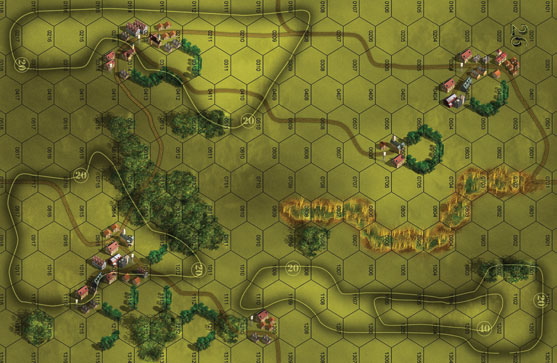 The 2nd Light Cavalry Division (DLC) belonged to the French Second Army. In the event of a German attack, the cavalry would enter the Belgian Ardennes and the Grand Duchy of Luxembourg to seek out the enemy’s direction of advance, identify their columns and slow them down. The 2nd Light Cavalry Division (DLC) belonged to the French Second Army. In the event of a German attack, the cavalry would enter the Belgian Ardennes and the Grand Duchy of Luxembourg to seek out the enemy’s direction of advance, identify their columns and slow them down.
The Semois River would be one of the defensive lines in Belgium where the 2nd DLC’s vanguard would fight a delaying action. In front of the main body, small detachments would screen the main body and seek contact. These French cavalry units, like the majority of the reconnaissance groups, were a mix of horsed and motorized troops.
On the German side, the Kleist group with its five panzer divisions, three motorized infantry divisions plus the separate Grossdeutschland motorized infantry regiment had four routes, or Panzerstrassen, by which they would cross Luxembourg. It’s the Panzerstrassen Nr. 3 and 4 which concern us here, with elements of the 10th Panzer Division’s tank brigade and the Grossdeutschland regiment attempting to move along the road known as SR 69.
Scenario One
A Great Welcome
10 May 1940
Arlon, Belgium
 On the French Second Army’s front, the alert came around 0430 when the 10th Panzer Division entered Luxembourg. After some delay the first reconnaissance elements of the 2nd DLC set out towards Arlon on the Belgian border. A little before 0800, the Froidefond des Farges detachment crossed the border, immediately followed by the Varine-Bohan detachment but one platoon failed to join them. On the French Second Army’s front, the alert came around 0430 when the 10th Panzer Division entered Luxembourg. After some delay the first reconnaissance elements of the 2nd DLC set out towards Arlon on the Belgian border. A little before 0800, the Froidefond des Farges detachment crossed the border, immediately followed by the Varine-Bohan detachment but one platoon failed to join them.
Froidefond arrived in Arlon around 0900 but the Schoppach railway bridge had already been destroyed earlier that morning by Belgian Chasseurs Ardennais, blocking their passage. Froidefond bypassed the city to the south, and around 0930 continued toward the Luxembourg border. They met the first German motorcyclists at Autelbas, and soon others were reported in Sterpenich and Wolberg. “It was a crazy race to Arlon. Along the way, we were cheered by the people. At 9 am, we arrived in Arlon. At the station, the motorcycle platoon had to cross the railway tracks carrying their motorcycles. They settled in near the cemetery on the road to Diekirch, on a ridge 300 or 400 meters in front of the last houses.”
Conclusion
Fifteen minutes after the French arrived, the Germans infiltrated through the northern edge of the city. The French retreated towards Arlon, and after 90 minutes motorized infantry arrived to help the motorcycle troops. French anti-tank gunners drove off a German armored car, and more French reinforcements arrived, some of them abandoning their vehicles to cross the damaged bridge on foot. But as more and more Germans infiltrated around their positions, the French found the pre-war Belgian fortifications more of a hindrance to their own movement than an actual help to their defense. By 1600 the position had been compromised and the French withdrew.
Notes
A completely new scenario leads off the new Playbook edition of 1940: The Fall of France. This one is a small skirmish between French recon elements and advancing German infantry. The French have mobility on their side, but the Germans have the edge in firepower on theirs.
Scenario Two
Skirmish at Vance
10 May 1940
Vance, West of Arlon, Belgium
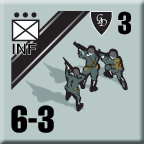 Coming out of Hachy, the vanguard of Infantry Regiment Grossdeutschland arrived in Vance on the Arlon-Florenville road, and immediately realized that they would have a much easier time than anticipated: the three casemates intended to defend the road junction were not occupied, and no road destruction had been carried out in the area. Turning west, the Grossdeutschland vehicles set off in the direction of Etalle along the main road. However, the Germans left a flank guard near the bridge over the Semois, which camouflaged itself behind a low wall and watched the roads leading south. Soon enough, French recon elements appeared. Coming out of Hachy, the vanguard of Infantry Regiment Grossdeutschland arrived in Vance on the Arlon-Florenville road, and immediately realized that they would have a much easier time than anticipated: the three casemates intended to defend the road junction were not occupied, and no road destruction had been carried out in the area. Turning west, the Grossdeutschland vehicles set off in the direction of Etalle along the main road. However, the Germans left a flank guard near the bridge over the Semois, which camouflaged itself behind a low wall and watched the roads leading south. Soon enough, French recon elements appeared.
Conclusion
The French crossed the Belgian border at around 0800, passed over the Semois bridge at Vance and continued to the east. After spotting a German motorcyclist in Vance, the French commander. Maj. Arnaud de Verthamon, sent a small detachment back to secure the bridge. As French engineers started to place mines, the Germans appeared and a firefight broke out. The French fell back on the Vance mill, while Verthamon decided to fall back south of Vance and rejoins the detachment. On the German side, reinforcements including tanks helped power an advance, but the French dug in around the mill and held them off. At noon, Verthamon called a retreat and the French pulled out toward Buzenol after destroying two German tanks.
Notes
This is another completely new scenario. It’s another small one, a collision of French recon elements and the Grossdeutschland Regiment, which has tank support. Both sides bring on reinforcements to keep the outcome in doubt, but it’s going to be a contest of weak anti-tank guns against weak armor.
Scenario Three
A Beautiful Morning
10 May 1940
Etalle, Belgium
 The Grossdeutschland Regiment, the self-styled “Bodyguard of the German People,” had missed the campaign in Poland and so received its baptism of fire in the Belgian Ardennes. The virgins with rifles sang as they crossed the border and entered the village of Sirvy on the morning of 10 May. Surprising a French motorcycle platoon that surrendered with nary a shot, they kept on singing as they marched to take the bridges across the Semois River at Etalle. The French motorized cavalrymen awaiting them there did not sing. The Grossdeutschland Regiment, the self-styled “Bodyguard of the German People,” had missed the campaign in Poland and so received its baptism of fire in the Belgian Ardennes. The virgins with rifles sang as they crossed the border and entered the village of Sirvy on the morning of 10 May. Surprising a French motorcycle platoon that surrendered with nary a shot, they kept on singing as they marched to take the bridges across the Semois River at Etalle. The French motorized cavalrymen awaiting them there did not sing.
Conclusion
The advance guard’s commander was mortally wounded in the assault on the barricade at the main bridge. The attack stalled until the II Battalion’s commander took over and renewed the attack, but then French motorized troops appeared to the north of the Germans and their advance again halted. Eventually the Germans regained some momentum, damaging or destroying several French armored cars and forcing the rest to withdraw. But then their commander took a bullet to the head and died, stunning the Germans and stopping them again. The arrival of German tanks finally tipped the balance in their favor and let them secure the town and bridges, but only after a delay of several hours.
Notes
This scenario appeared in the first edition, but Philippe gave it a number of fixes and I added a couple more. It’s a small scenario, just one board and a handful of units on each side. The Germans have sky-high morale, some artillery support and a rather worthless tank platoon that might eventually show up. All of the Germans are mounted on trucks, so they can get close to their objectives pretty fast: seizing the bridge hex, getting over the major river and taking town hexes on the opposite bank. Trying to stop them is a detachment of French motorized cavalry, backed by three platoons of the very good P178 Panhard armored car. Indifferent French morale makes what should be a tough defense vulnerable.
Scenario Four
Horse Soldiers
10 May 1940
Villers-sur-Semois, Belgium
 The Second Cavalry Squadron of the 5e Régiment de Cuirassiers scrambled at short notice and went into Belgium understrength, with only one officer on hand. They were to set up a first line of defense in a small village and hold it at all costs. As shots rang out to the east in Etalle, the cavalrymen sent their horses to the rear, and waited. The Second Cavalry Squadron of the 5e Régiment de Cuirassiers scrambled at short notice and went into Belgium understrength, with only one officer on hand. They were to set up a first line of defense in a small village and hold it at all costs. As shots rang out to the east in Etalle, the cavalrymen sent their horses to the rear, and waited.
Conclusion
The Grossdeutschland Regiment immediately took casualties when the French shot down the daring officers scouting ahead of their column. The cavalrymen repulsed two successive attacks before German tank and artillery reinforcements blasted through them and set the town on fire. Small firefights raged among the burning buildings thereafter, and some Frenchmen eventually escaped to the west through streets red with the blood of the horses caught in the battle.
Notes
The first edition had a scenario based on this action, but Philippe replaced it with what amounts to a new scenario.
It’s another clash between the Grossdeutschland Regiment and dismounted French cavalry. The French get to set up hidden, and they’re going to need that edge as the Germans have all the advantages: morale, numbers, mobility and artillery support. The Germans have a steep set of victory conditions, though, so the French can definitely put up a successful fight.
And there we have the first half of Chapter One. There’s more to come!
Order 1940 The Fall of France Here.
Order 1940 The Fall of France (Anarchy) Here.
No rules! You’ll need the Fourth Edition rules from another Panzer Grenadier game. Earlier edition rules will not work with this game.
1940: The Grand Tour
1940: The Fall of France
1940: Road to Dunkirk
1940: Swallows of Death
1940: The Last Days of May
1940: Polish Exiles
9 April 1940
Retail Price: $341.94
Package Price: $275
Gold Club Price: $220
Take The Full Tour.
Fall of France Playbook Edition: Downloadable Upgrade
Includes Last Days of May Campaign Study
You can transform your old copy of 1940: The Fall of France (the boxed edition) into the splendid Panzer Grenadier: 1940 The Fall of France Playbook Edition, bundled with The Last Days of May. It’s $39.99, but if you’re a Gold Club member, you can download for $27.99 using your Gold Club link (That’s the only way to claim your Gold Club discount).
Sign up for our newsletter right here. Your info will never be sold or transferred; we'll just use it to update you on new games and new offers.
Mike Bennighof is president of Avalanche Press and holds a doctorate in history from Emory University. A Fulbright Scholar and NASA Journalist in Space finalist, he has published an unknowable number of books, games and articles on historical subjects.
He lives in Birmingham, Alabama with his wife and three children
Want to keep Daily Content free of third-party ads? You can send us some love (and cash) through this link right here.
|