| Infantry Attacks 1918
By Mike Bennighof, Ph.D.
August 2026
 By 1918, four years of bloody, bitter combat on front lines all across Europe and corners of Asia and Africa had changed the way wars were fought. Infantry tactics evolved, artillery methods became much more sophisticated, and new weapons like poison gas appeared on the battlefield. By 1918, four years of bloody, bitter combat on front lines all across Europe and corners of Asia and Africa had changed the way wars were fought. Infantry tactics evolved, artillery methods became much more sophisticated, and new weapons like poison gas appeared on the battlefield.
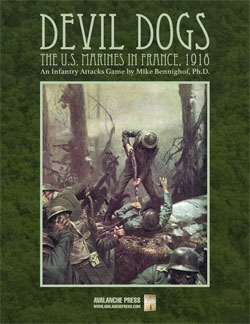
Devil Dogs takes the Infantry Attacks series to the battlefields of 1918, with the story of the American 4th Marine Brigade at Belleau Wood, Soissons, St. Mihiel, Blanc Mont Ridge, and the mesu-Argonne. It has 317 pieces, two maps, and 24 scenarios drawn from those two crucial battles.
Previously, Infantry Attacks has covered battles from the opening months of the Great War: August 1914, Fall of Empires, Black Mountain, Iron Dice of War, A Contemptible Little Army. By 1918, the battlefield had evolved, and so Infantry Attacks (the game system) has to evolve with it to bring these battles to your game table.
We’ll do that by keeping the core Infantry Attacks Second Edition series rulebook and charts as the heart of the game. We’re adding a 1918 Rules Addendum (called Infantry Attacks 1918), that broadens the series to cover the differences between 1914 and 1918. The additional rules are carefully crafted to adhere as closely as possible to the logic of the basic series rules, and to yield their effects in as minimalist a way as possible. We don’t want to make you learn a whole new set of rules to play this game: if you’re already up to speed on Infantry Attacks, we want you playing right away, not thumbing through a whole new rulebook.
Infantry Attacks 1918 has three major sections (not including tanks; we’ll talk about those separately). Let’s take a tour.
Advanced Artillery
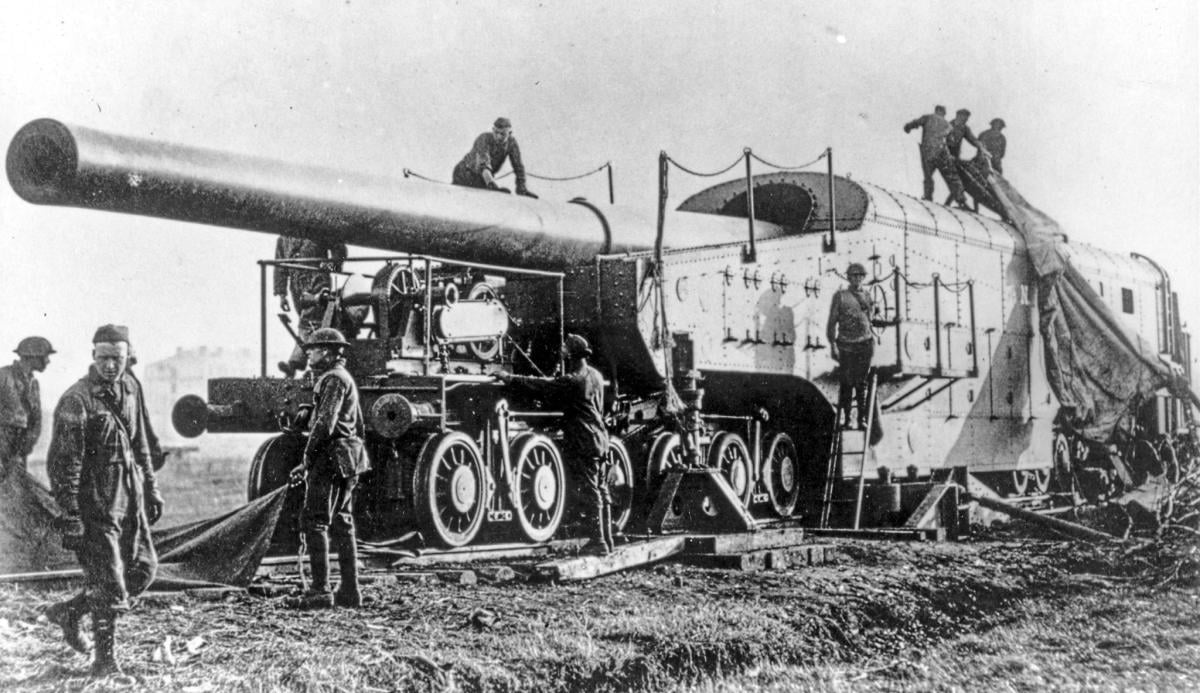
Camouflaging a U.S. Navy 14-inch railroad cannon.
There are two dynamics at work in the modified artillery phase of the game. Firstly, and perhaps most importantly, there’s simply more of it. In the 1914 games, a huge majority of the scenarios take place with no off-board artillery at all. That’s because the armies depended heavily on their field guns for infantry support, and those batteries exist right there on the map. The French and Austro-Hungarian armies have no off-board artillery support at all, and not coincidentally they both depend heavily on physical bravery to carry the day. Sometimes, it works.
Not anymore. Artillery’s plentiful enough on all sides to make the battlefield a killing ground, a true no man’s land. The field guns are still there, but now they’re supported by batteries of even larger guns well back behind the lines, on up to weaponry more suited to battleships, so large and heavy that they need special railroad cars and reinforced tracks to carry them.
Coupled with increased quantity, came more sophisticated means of deploying the big guns. This came both from battlefield experience, and having more firepower with which to work. In game terms, off-board artillery gains new capabilities (you can also, of course, just bombard the enemy the old-fashioned way):
• Drumfire.
This was already in the standard series rules, and there are no changes in the 1918 Rules Addendum. But with more guns, Drumfire becomes a much more potent tactic.
• Creeping Barrage.
You can plot a barrage to “walk” closer and closer to the enemy, with the oncoming infantry assault wave moving up right behind it, to work over an enemy in-depth defense. You can also send your infantry into assault combat in the same turn as the enemy gets shelled, and they get a bonus for it. This artillery tactic goes hand-in-hand with infantry infiltration (see below).
• Harassing Fire.
This allows artillery to deny movement corridors to enemy units. It’s not going to create many casualties (no step losses at this scale), but does affect morale and movement.
• Counter-Battery Fire.
Very similar to the rule from Panzer Grenadier’s The Book of Armaments: Eastern Front Artillery. You can shoot at the other guy’s off-board artillery and suppress it; for a major offensive, this is why the attacking side wants more guns than the defenders. This becomes an even more effective tactic when poison gas is in use (see below). It’s hard to work the guns when masked up.
• Interdiction.
Now you can also shoot at the enemy’s rear areas, and delay reinforcements. This is also a vital part of the artillery plan for a major offensive.
Chemical Weapons
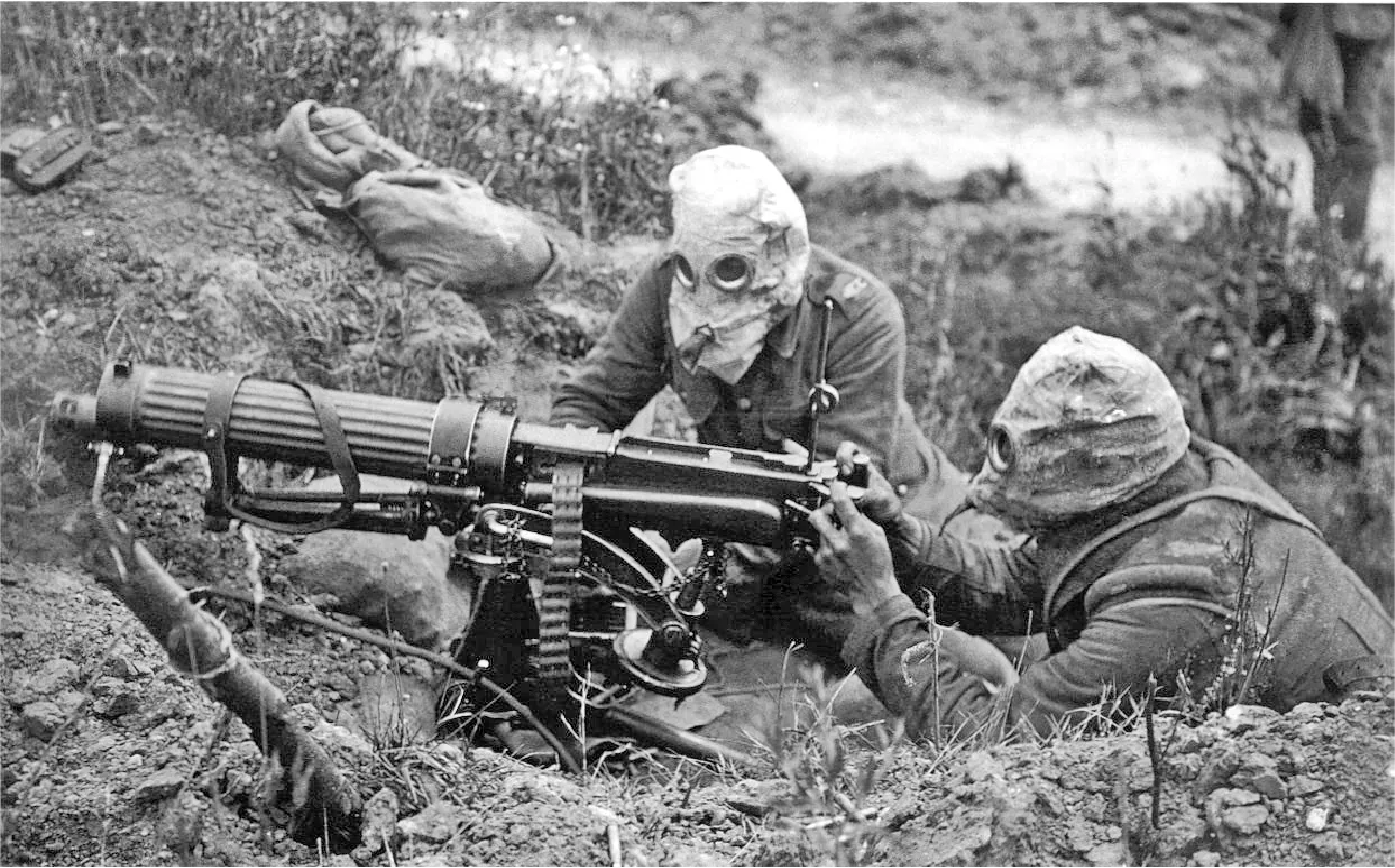
British machine gunners in their gas helmets, 1916.
The iconic horror of the Great War, a weapon so terrible that it would be banned in . . . 1899, sixteen years before the Germans unleashed it and everyone else followed suit. By 1918 the use of chemical weapons had become commonplace, as well as protocols for defending against them: warning systems and protective masks and clothing.
Panzer Grenadier has touched on chemical weapons; they did see limited use (the Finns probably tried to gas the Soviets in 1940, but were defeated by the extreme cold, while the Germans “accidentally” gassed the Poles in 1939, among other isolated incidents). By 1918 it was in common use, and so the 1918 rules include two types of chemical attacks, transient and persistent.
The primary effect is on morale, as your troops are discombobulated. A persistent gas attack lingers for some turns after the attack. This can continue to effect movement and assault combat. A transient gas barrage only has an immediate effect. In this era, mustard gas was the most common persistent agent, while phosgene and chlorine had more transient effects.
You’ll only have a limited amount of gas shells available; high-explosive rounds remain the most common. As mentioned above, you can also lob gas at enemy artillery batteries to limit their effectiveness.
Infiltration Tactics

German storm troopers train for the 1918 Spring Offensive.
Perhaps the best-known and least-understood of the changes wrought by four years of war. The quick and simple method would have been to just give units capable of infiltration a +1 modifier in assault combat, but that doesn’t really show what infiltration truly meant.
Infiltration means movement between enemy positions, and that’s what it means in Infantry Attacks 1918. You no longer need a leader for infiltration-capable (Storm) units to move closer to the enemy; you still need one to enter an enemy-occupied hex and assault them there and to do other things (this doesn’t automagically give every Storm unit an inherent leader). Opportunity Fire is less effective against infiltrating units (they’ve dispersed themselves and are hugging the sweet, sweet ground).
Those are the changes in tactics, and while they don’t make Storm units by themselves super-infantry, there are some in the German ranks (companies of young, fit men given plenty of hand-portable weaponry like light machine guns and grenades). But that’s not a special rule, just a unit with stronger firepower (and usually better morale). In future games, other armies will have these guys, too.
Conclusion
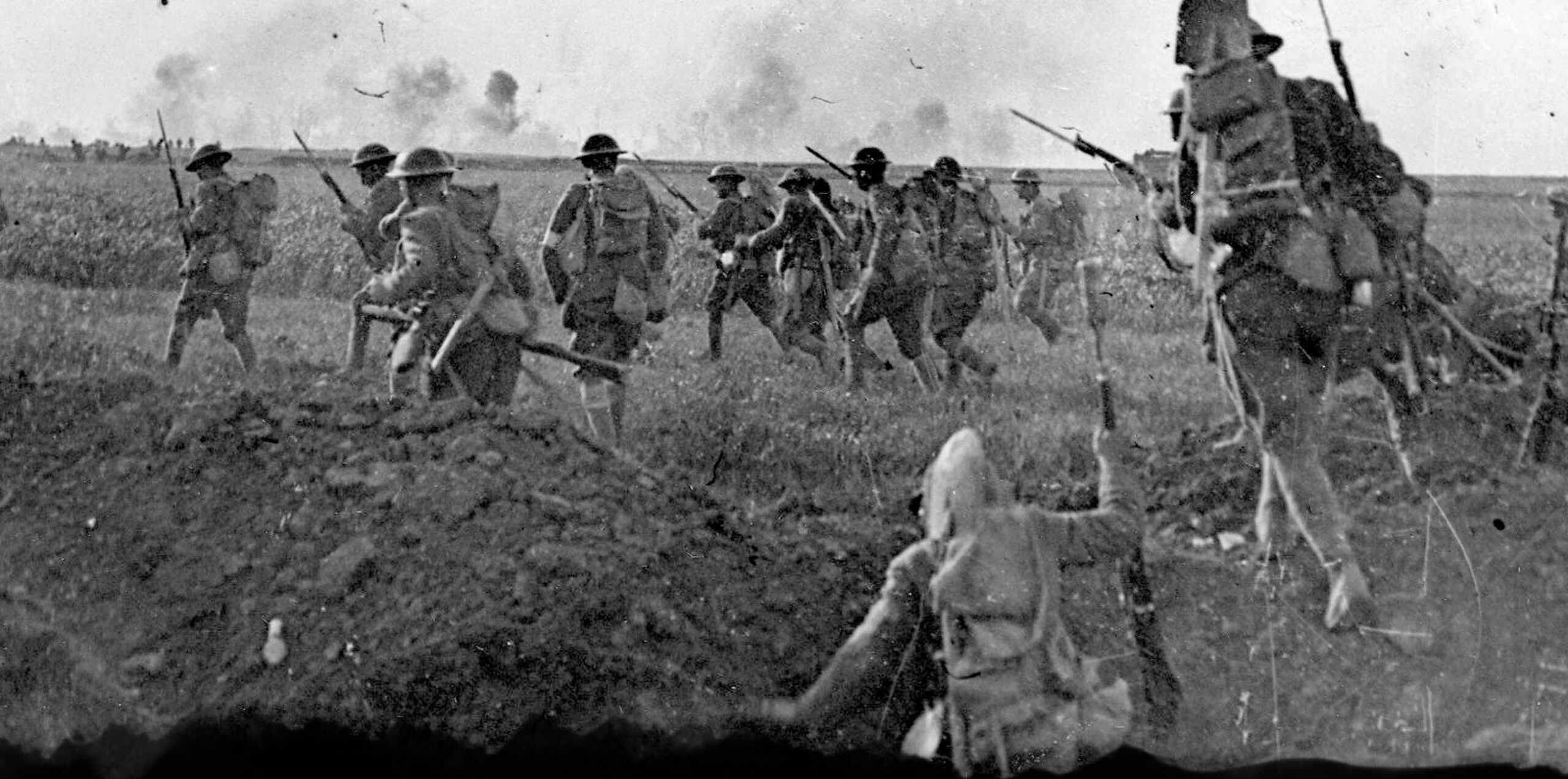
Doughboys of the U.S. Army’s Big Red One
go over the top. 28 May 1918.
Infantry Attacks 1918 tries to minimize rule changes, and make the new tactics fit within the established model. Many of the alterations have nothing to do with the rules, but with player behavior when faced with the mix of units under their command. The Germans have enormous numbers of automatic weapons, for example, compared to 1914. But they’re pretty weak in infantry, as the German Army tried to use technology to make up for a shortage of manpower (sound familiar?). If the Marines can get into the German trenches through that cascade of steel, the Germans are going to have a rough time trying to throw them back out. That’s true to a lesser extent of all of the armies: the lessons of 1914, where the armies have to solve all problems with masses of soft human flesh (and have plenty of it to feed the sausage-grinder), have given way to a hard school of industrialized warfare. Likewise, the biggest change in artillery is simply volume. You can do more things with it, sure. But quantity has a quality all its own.
So it’s not a long addendum, but it is a profound one. Infantry Attacks 1918 is a different game, and that’s only somewhat due to the added rules.
Order Devil Dogs Here.
Please allow an extra six weeks for delivery.
Sign up for our newsletter right here. Your info will never be sold or transferred; we'll just use it to update you on new games and new offers.
Mike Bennighof is president of Avalanche Press and holds a doctorate in history from Emory University. A Fulbright Scholar and NASA Journalist in Space finalist, he has published a great many books, games and articles on historical subjects; people are saying that some of them are actually good.
He lives in Birmingham, Alabama with his wife andthree children.
Daily Content includes no AI-generated content or third-party ads. We work hard to keep it that way, and that’s a lot of work. You can help us keep things that way with your gift through this link right here.
|