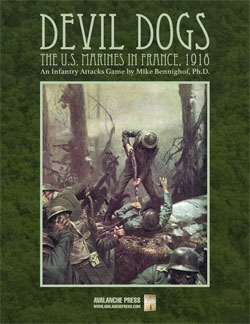
| Devil Dogs:
4th Marine Brigade
By Mike Bennighof, Ph.D.
February 2026
 The United States began preparing to send troops to fight in Europe well before the formal American declaration of war on Germany in April 1917. As soon as he heard whispers that an American Expeditionary Forces would be formed, Marine Corps Commandant Maj. Gen. George Barnett set to work to assure that a contingent of Marines would be included. Rebuffed by the War Department and by the AEF’s commander, John J. Pershing, Barnett went over their heads to draw the interest of President Woodrow Wilson. The United States began preparing to send troops to fight in Europe well before the formal American declaration of war on Germany in April 1917. As soon as he heard whispers that an American Expeditionary Forces would be formed, Marine Corps Commandant Maj. Gen. George Barnett set to work to assure that a contingent of Marines would be included. Rebuffed by the War Department and by the AEF’s commander, John J. Pershing, Barnett went over their heads to draw the interest of President Woodrow Wilson.
In May 1917, Wilson ordered the War Department to form a regiment of Marines for service in France. Barnett gave this task to his deputy, Col. John Lejeune, who began pulling together Marine rifle companies from detachments serving aboard the battleships of the Atlantic Fleet, depot companies at the various East Coast Navy yards, and Marines returning from scattered deployments in the Caribbean. The companies were numbered serially as they formed; these had no connection to their battalion or regimental assignments.
And then the winnowing began. The Marine companies, normally set at an establishment of 240 men, dropped to about forty each as older Marines, and those who had suffered wounds or Illness or simply were not physically fit, were transferred out. New recruits took their place: all of them volunteers, with Lejeune and his officers rejecting roughly 80 percent of the men who signed up (the United States was not a very healthy place in 1917, and many men could not meet Army or Marine physical standards).
The new regiment, the Fifth Marines, received less than a month of training – most of it devoted to the rifle range – at a hastily-erected camp at Quantico, Virginia, before shipping out for France. Officially activated on 8 June, it arrived at Brest on the 26th. Barnett, believing participation in the war an existential question for the Corps, continued to work on Secretary of the Navy Josephus Daniels, who prevailed on Wilson to allow Barnett to form a second regiment. The Sixth Marines arrived in France in September 1917, followed by the Sixth Marine Machine Gun Battalion in December.
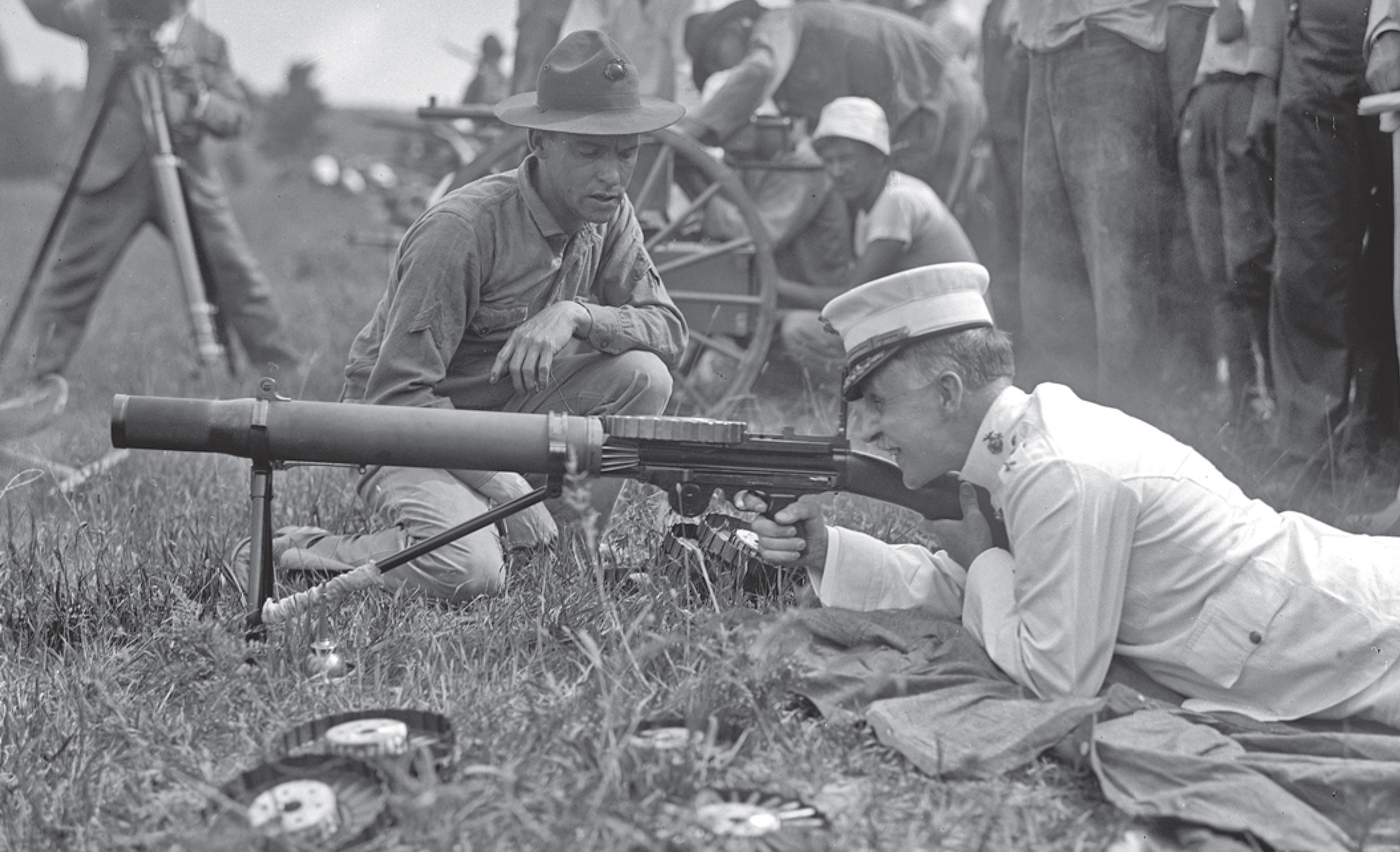
Corps Commandant Barnett tries out a Lewis machine gun. 1917.
That rounded out a complete Marine brigade, as the president had directed; the Fourth Marine Brigade became operational on 23 October 1917. An American infantry brigade had 8,417 men per the official tables of organization; the Marine brigade initially had slightly over 7,000 when shipped to France (it would complete its formation only after its arrival). The pre-war Marine Corps had numbered only 13,725 enlisted men and 511 officers (the latter figure including warrant officers, pay clerks, and retired officers on temporary active duty), and it still maintained its four pre-war regiments in Haiti and the Dominican Republic throughout the First World War. The Corps needed a great many new Marines, and officers to lead them.
The Marines agreed to follow Army tables of organization rather than their own, rather quirky methods. Barnett did manage to turn aside Pershing’s demand that they also wear Army khaki rather than Marine forest green; Pershing allegedly hated the sight of a Marine uniform. An Army infantry company had 256 men, compared to a Marine rifle company’s paper strength of 240 (much lower than that in practice). Four companies made up a battalion, three battalions formed a regiment. Two regiments, and a machine-gun battalion, formed a brigade.
Each company had four platoons. Huge platoons by latter-day standards, of 60 men apiece. Each of those platoons had a six-man headquarters element and four sections: one of automatic riflemen (13 men), one of rifle grenadiers (also 13 men), and two of riflemen (each of 14 men). The latter two sections each could split into two seven-man squads.
Very late in the war the automatic riflemen began to receive the superlative Browning Automatic Rifle, but in the battles included in Devil Dogs, they carried the French-made Chauchat, called the Sho-Sho by the Americans. Each section had four of them, to lay down a base of fire to allow the rifle sections to maneuver, while the grenadiers blew up German machine guns.
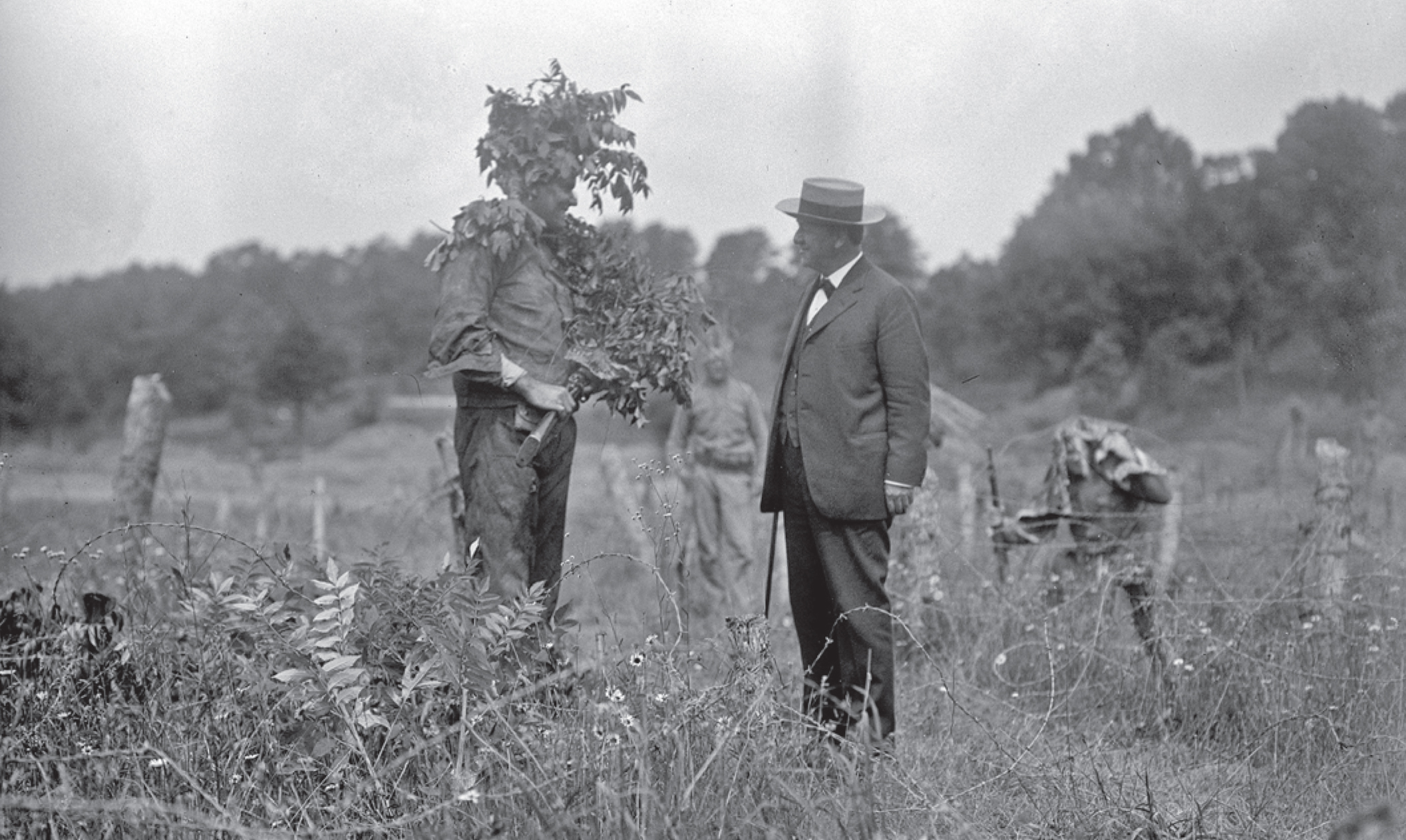
Secretary of the Navy Josephus Daniels (right) visits Marines training at Quantico, 1918.
The Chauchat fired the same round as the standard French Lebel 8mm rifle, slightly larger than that of the American .30-caliber Springfield Model 1903 that armed both Army and Marines. The Americans ordered a version chambered for their rifle round, which turned out to be a disaster as casings failed to extract when fired. The 8mm Chauchat wasn’t a very good weapon, but the failure rate of the .30 caliber version drove its reputation even lower. Marines grabbed as many extras as they could, expecting widespread failures.
“These weapons,” recalled Lt. James Sellers of the 78th Company, “looked as if they were made out of cigar boxes and tin cans, and we had an awful time making our men carry them. A man shooting one almost was in as much danger as anyone out in front being shot at.”
The Marine machine-gun companies (six of them: four in the 6th Machine Gun Battalion and one in each regiment) had four platoons each, each of these serving four Hotchkiss Mle 1914 air-cooled heavy machine guns. The Hotchkiss was a very heavy gun, weighing in at 50 kilograms for barrel and tripod together, and strip- rather than belt-fed; it had good long-range accuracy but needed a crew of at least three. The six machine gun companies were usually attached, one apiece, to the brigade’s six infantry battalions; the battalions in turn usually assigned a machine-gun platoon to each rifle company.
Unlike the situation in the Second World War, the Marines received the same weapons as the Army, rather than hand-me-downs and rejects. But otherwise, the bureaucratic struggle continued throughout the war, with the political side (President Wilson, Secretary of War Newton Baker, and Secretary of the Navy Josephus Daniels) favoring expansion of the Marine Corps, and the Army, personified by AEF commander Black Jack Pershing, firmly against it. Forced to accept the 5th Marines, Pershing assigned them to the 1st Infantry Division, which already had four Regular Army regiments. Told that a second Marine regiment would soon arrive (official notification coming only after the first contingent of the 6th Marines had left port), Pershing claimed that he could not assign them to the Big Red One, as it already had four regiments (somehow overlooking the Fifth Marines). Instead, he detailed the Marines to rear-area security for much of the remainder of 1917. If the Marines had so many surplus personnel that they could form a second regiment, he wired to the War Department, they should transfer these men to the Army.
In June 1918, the Marine Corps’ maximum strength was set at 75,500; at the time the numbers stood at 45,384. In August 1918, despite the ever-growing casualty lists, the War Department issued a cap on Marine recruiting. Other than those whose examinations were still pending, no new men would be inducted. The Marines still managed to organize another brigade, the Fifth Marine Brigade (11th and 13th Marine regiments and 5th Marine Machine Gun Battalion), with the intent of forming a Marine division. The brigade began landing in France in September 1918, with the final elements of the machine gun battalion stepping ashore on 9 November 1918, two days before the Armistice. Pershing assigned them all to rear-area security duty.
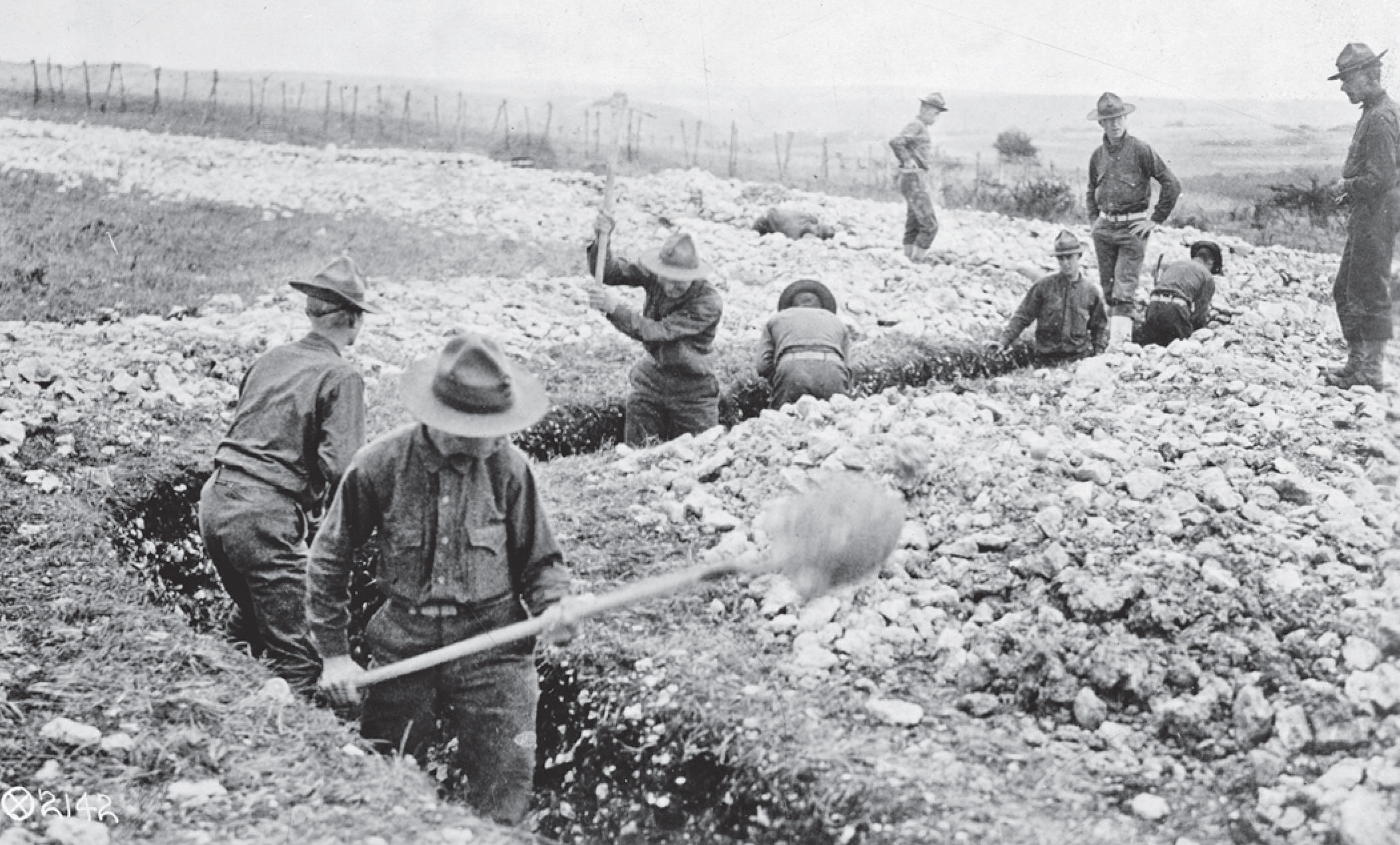
Marines practice digging trenches, somewhere in France, 1918.
As for the 4th Marine Brigade, it and the 2nd Infantry Division moved to the French Army’s Bourmont training area, where French instructors taught the Marines the finer points of trench warfare: gas protocol, grenade (what was then called “bomb”) throwing, wiring, trench construction. Even the finer points of trench life, like what to do with shit (defecate on a shovel, toss it over the top. On the enemy-facing side.). Being Marines, the brigade staff supplemented the French-provided instruction with a great deal of marching and rifle practice. AEF headquarters groused about the emphasis on static defense rather than the maneuver warfare that Pershing and his aides still fantasized.
Between 13 and 17 March 1918, the 2nd Infantry Division moved into the trenches in front of Verdun, a so-called “quiet” sector where the Americans could become acclimated to the actual conditions of front-line combat. And there they swiftly encountered the lice, bad food, and shit-infused mud that had defined the trenches since 1914, as well as rodents of unusual size.
“Never in my life have I seen rats of such size as these are here,” remembered Cpl. Adel Storey of the 83rd Marine Company. “They don’t run from us, either, like any ordinary rat does. Where we are now there are several cats . . . when everything is quiet at night around the trenches and in the dugouts the rats are out in force and the cats take refuge in No Man’s Land.”
Faced with feline cowardice, the Marines deployed dogs, bayonets, and an aardvark. The aardvark proved extremely effective. Their French liaison officers tried to teach them some of the unwritten rules of the trench war, such as not firing at enemy laundry parties washing clothes in a nearby river. The Marines got their first taste of combat, repelling German trench raids and making aggressive patrols of their own. They also endured repeated gas attacks; German procedure called for greeting newly-arrived units in the line with plenty of poison gas. They had expected relief fairly soon, but the French units that would have taken their place instead deployed to stem the German offensive that opened a few days after the Marine arrival.
Finally on 13 May, French units began to relieve the Marine brigade. The Marines had suffered 513 casualties during their stay in the “quiet” sector. But now they were headed for the real war.
Order Devil Dogs Here.
Please allow an extra six weeks for delivery.
Sign up for our newsletter right here. Your info will never be sold or transferred; we'll just use it to update you on new games and new offers.
Mike Bennighof is president of Avalanche Press and holds a doctorate in history from Emory University. A Fulbright Scholar and NASA Journalist in Space finalist, he has published a great many books, games and articles on historical subjects; people are saying that some of them are actually good.
He lives in Birmingham, Alabama with his wife andthree children.
Daily Content includes no AI-generated content or third-party ads. We work hard to keep it that way, and that’s a lot of work. You can help us keep things that way with your gift through this link right here.
|